Our verdict
Shuri Soba is one of Okinawa's most closely followed soba counters, drawing visitors to the historic Shuri district for a bowl that reflects the island's distinct culinary identity. Okinawan soba sits apart from the buckwheat noodles of the Japanese mainland, built on pork and bonito in ways that carry centuries of Ryukyuan influence. The restaurant holds a firm position in local dining conversation and rewards early arrivals.

Pearl is the En Primeur Club membership app — saves, bookings, and concierge access live there. Same editors, same standards.
- Address
- 首里赤田町1-7, 那覇市, 沖縄県, 903-0813
- Directions
- Get directions
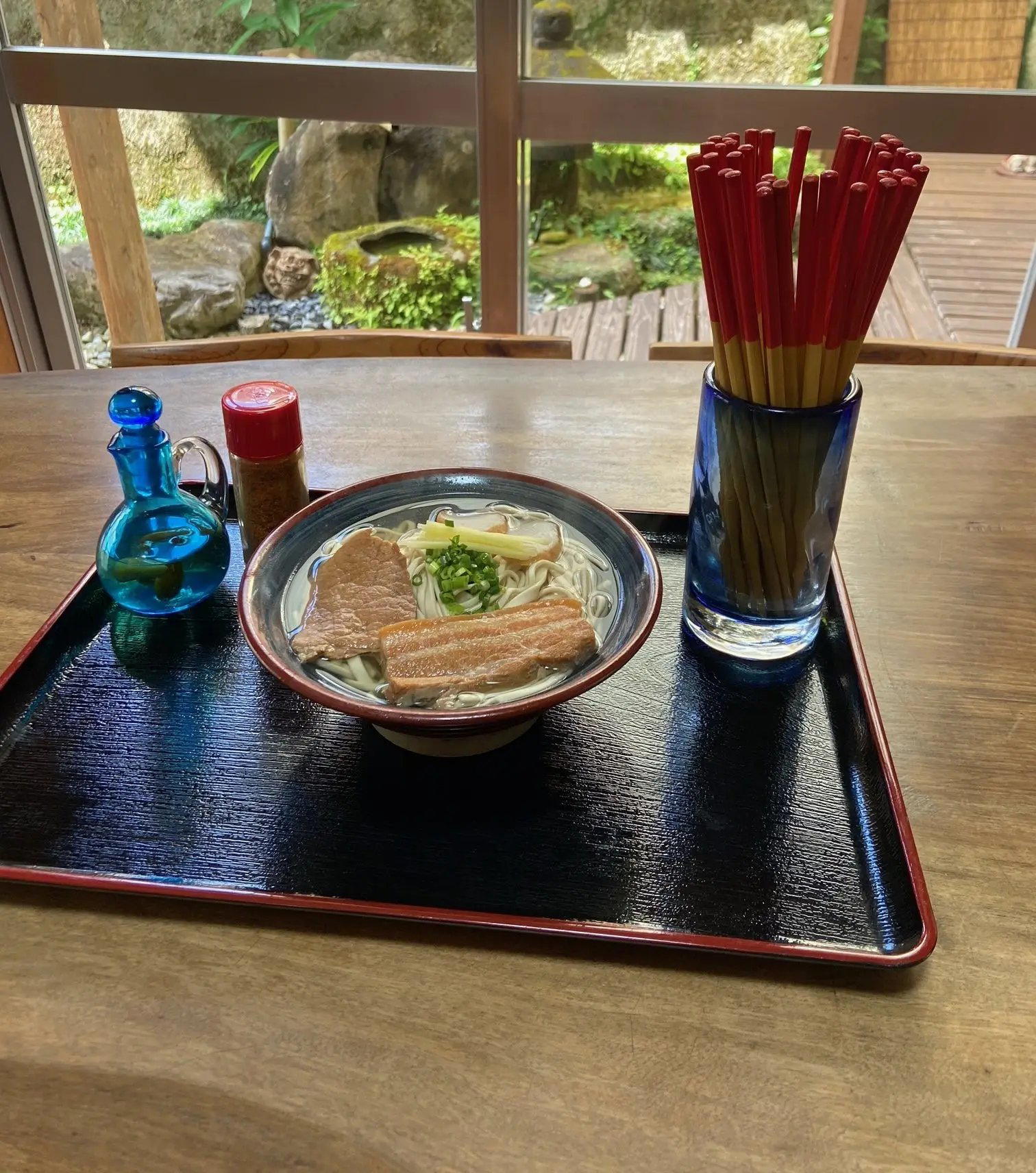
The menu
What to order
- Soki Soba
- Sanpei Soba
Where the Bowl Tells the Story of the Island
Okinawa's relationship with its own soba is a studied disagreement with the Japanese mainland. What the rest of Japan calls soba implies buckwheat. What Okinawa calls soba is wheat-based, thick, and served in a broth pulled from pork bones and katsuobushi in proportions shaped by Ryukyuan court cooking and centuries of trade with mainland China. That distinction matters before you arrive anywhere near a bowl, and it matters especially in the Shuri district, where the former royal capital sits at the top of Naha and where culinary tradition carries an almost institutional weight.
Shuri Soba operates inside that tradition with the kind of quiet consistency that Okinawan food culture respects more than spectacle. The area around Shuri Castle — a UNESCO World Heritage Site partially reconstructed after a 2019 fire — draws visitors for its history, and the dining options in its immediate vicinity reflect both local pride and the gravitational pull of tourism. Shuri Soba has navigated that tension by staying firmly oriented toward the former: the room, the format, and the bowl itself read as local institution rather than tourist stop.
The Mechanics of Okinawan Soba
Understanding what Shuri Soba does requires understanding what Okinawan soba is. The noodles are round and firm, made from wheat flour without the buckwheat that defines mainland soba, and they sit in a broth that regional cooks have refined over generations. The standard toppings, soki (stewed pork ribs) or sanmai-niku (pork belly slices), kamaboko fish cake, and pickled ginger on the side, follow a logic that is simultaneously simple and deeply considered. Nothing in the bowl is accidental.
Across Okinawa, soba shops occupy a specific social role. They are the breakfast and lunch infrastructure of the island, the places you go before midday, and the format is calibrated accordingly: fast service, communal comfort, prices accessible enough that the local population can eat there regularly. That price architecture places Okinawan soba in a different competitive tier from the kaiseki or high-end izakaya options that have drawn attention to cities like Osaka (see HAJIME in Osaka), Kyoto (see Gion Sasaki in Kyoto), or Tokyo (see Harutaka in Tokyo). The stakes are different, and so is the measure of quality.
A Room Built Around Function
The physical experience of Shuri Soba follows the grammar of a working soba-ya: utilitarian enough that the bowl remains the focus, maintained well enough that you understand it takes itself seriously. In Okinawa's culinary culture, the signal of a good soba shop is rarely found in the decor, it is found in the queue. Shuri Soba draws lines, particularly during morning and midday hours, that function as the island's most honest restaurant review. Arriving early is the only reliable booking strategy, since the format does not accommodate reservations in the conventional sense.
For visitors spending time in the Shuri area, the surrounding neighborhood offers useful context. Shuri sits above central Naha, and the walk from the castle district toward the restaurant passes through residential streets that are genuinely local in character, a contrast to the Kokusai-dori tourist corridor further down the hill. Other Okinawa dining options worth considering in the broader Naha orbit include Downtown, Captain Kangaroo, Jack's Steak House, Mexico Ginowan, and the restaurant known as 6. See our full Okinawa restaurants guide for a broader map of the island's dining options.
The Team Dynamic Behind a Bowl That Reads Effortless
In a format this focused, the collaboration between kitchen and front-of-house is less about choreography than about timing and shared ownership of a narrow brief. Okinawan soba shops run on pace. The kitchen turns bowls quickly, front-of-house manages flow, and the gap between a good shop and a great one is often measured in how smoothly those two functions communicate during the rush. Shuri Soba's sustained reputation in Okinawan dining conversation, the kind that surfaces in regional food media and travel editorial alike, points to a team that has internalized that coordination over years of operation. The bowl arrives in a window that signals control, not speed for its own sake.
That kind of institutional consistency is worth noting in the context of Japanese regional dining more broadly. Nara's akordu and Fukuoka's Goh both demonstrate how regional Japanese cities can sustain restaurants that compete above their geographic tier. Okinawa operates differently, the island's culinary identity is more insular, more protective of its own forms, but the mechanism of institutional respect is similar: years of consistent execution, a clearly defined offer, and a local audience that treats the place as part of the civic fabric.
Beyond Japan, the contrast with the fine-dining coordination of a room like Le Bernardin in New York City or the tasting menu precision at Atomix in New York City is instructive: the principles of team cohesion apply regardless of format. At Shuri Soba, the stakes are a single bowl at a price accessible to any visitor, but the discipline required to execute it at volume, consistently, without drift, is its own form of rigor. Elsewhere in Japan, similar craft-focused consistency defines places like Birdland in Sakai, 一本杉川嶋 in Nanao, 古往今来 in Sapporo, 湖畔荘 in Takashima, and 峰羽屋 in Nishikawa Machi.
Practical Notes for Planning Your Visit
Shuri Soba operates on the rhythm of morning and midday service, and the practical advice from those who know the Okinawan soba circuit is consistent: go before noon, go on a weekday if your schedule allows, and accept that a short wait is part of the format rather than a failure of logistics. The Shuri district is accessible from central Naha via the Yui Rail monorail, which stops at Shuri Station. From there, the restaurant sits within a short walk through the castle neighborhood. No bookings, no dress code, and no extended evening service in the conventional restaurant sense, Shuri Soba follows the social contract of the island's soba culture, which means the window is specific and the bowl is worth being on time for.
Frequently asked questions
Would Shuri Soba be comfortable with kids?
Yes. The counter-style, utilitarian format common to Okinawa's soba shops keeps the experience low-pressure, and the accessible price point typical of the island's soba culture removes any financial hesitation. The bowl-focused menu is straightforward for younger diners, and the morning-to-midday service window aligns well with family schedules.
What's the overall feel of Shuri Soba?
Shuri Soba operates as a working soba-ya: functional room, focused menu, no concessions to tourism theater. The Shuri district location, adjacent to the former Ryukyuan royal capital in Okinawa, gives the place a cultural grounding that most tourist-facing soba shops in the city lack. Come expecting a meal built around the bowl, not the setting.
How does Shuri Soba's location affect the soba you're eating?
Shuri is the historic seat of the Ryukyuan kingdom in Okinawa, and that context is not incidental — the district has a culinary identity shaped by centuries of royal court influence distinct from the rest of the island. Okinawan soba served in Shuri carries a provenance argument that shops in more commercial areas of Okinawa city cannot make. For anyone tracing the cuisine's origins rather than simply eating it, the address matters.
What's the signature dish at Shuri Soba?
Okinawan soba is the only serious answer — wheat noodles (no buckwheat, despite the name) served in a pork-and-bonito broth with slow-cooked pork. This is the defining format across Okinawa's soba culture, and Shuri Soba works within that tradition rather than departing from it. The craft here is in execution and broth depth, not novelty.
Cost and Credentials
Comparable venues nearby, for context on price, style, and recognition.
| Venue | Cuisine | Price | Awards | Notes |
|---|---|---|---|---|
| Shuri SobaThis venue — the venue you are viewing | Okinawan Soba | $1–10 | Not listed | Not listed |
| Shop & Cafe | Tofu-focused Japanese cafe | Not listed | Relais Chateaux Award | Yachiyo, Tofu-focused Japanese cafe |
| Miyazato Soba | Miyazato, Okinawan Soba | Not listed | Not listed | Not listed |
| Captain Kangaroo | American Burgers | $10–20 | Tabelog 100 #24 | Nago, Hearty American Burgers with Okinawan Taco Rice |
| Tsurukamedo Zenzai | Okinawan Shaved Ice (Zenzai) | $1–10 | Not listed | Yomitan Village, Okinawan Shaved Ice (Zenzai) |
| 6 | Innovative French | Not listed | Tabelog Bronze #3 | Dining |
Details
- Cozy
- Rustic
- Classic
- Casual Hangout
- Standalone
- A La Carte
Retro atmosphere of an old private house, cozy and chill with homemade feel.