
SATO Brian Nanaban puts Tokyo yakiniku into a small-format Asagaya frame: 11 seats, a solo-diner counter component, wine, and repeat Tabelog 100 recognition for yakiniku in Tokyo. It belongs to the SATO Briand orbit rather than the anonymous grill-room category, with pricing in the JPY 15,000–19,999 dinner band and a format built for close attention rather than volume.
Pearl is the En Primeur Club membership app — saves, bookings, and concierge access live there. Same editors, same standards.
- Address
- BMビル, 2 Chome-3-2 Asagayakita, Suginami City, Tokyo 166-0001, Japan
- Phone
- +81 3-6383-0730
- Website
- omakase.in
 Saves & bookings on Pearl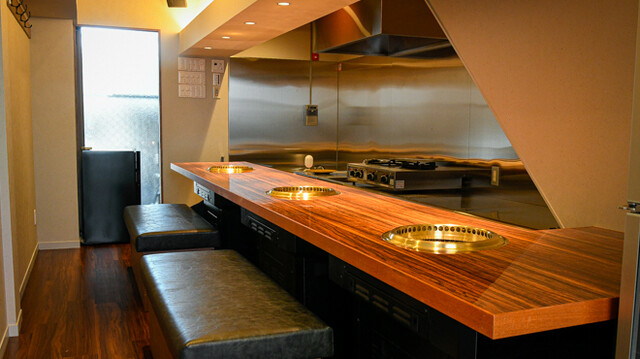
Asagaya changes the temperature of Tokyo dining before the first grill is lit. West of the central luxury circuit, the neighbourhood trades hotel-lobby polish for compact rooms, regulars, station-side routes and restaurants that rely on repeat confidence rather than spectacle. In that context, yakiniku becomes less about abundance and more about control: cut selection, pacing, smoke management, heat judgment and the small choreography between kitchen, floor and glassware.
SATO Brian Nanaban belongs to that tighter category. The room runs on 11 seats, including a first-floor counter arranged for solo diners and a second-floor table setup for small groups. That matters in Tokyo yakiniku, where a grill can turn into either a social free-for-all or a disciplined sequence depending on how the team manages the room. Here the scale points toward the latter: fewer covers, more direct control, and a dining rhythm that suits people who want beef treated as a focused evening rather than an open-ended barbecue session.
Asagaya yakiniku, scaled down to a controlled room
Tokyo has several yakiniku modes. There are high-volume local grills built around speed and beer, luxury wagyu rooms that price themselves like sushi counters, and a smaller specialist tier where the difference comes from service discipline as much as meat procurement. This address sits in that specialist tier. The Tabelog score of 3.87 and selection for Tabelog 100 Yakiniku Tokyo 2025 place it among a narrow group of Tokyo yakiniku rooms with sustained public recognition, not merely neighbourhood popularity.
The SATO Briand connection also gives the format context. The broader group includes Sato Burian, SATO Briand Nigo and Satoburi DA, names that signal a beef-led style with enough internal variation to support separate addresses rather than a single flagship narrative. Compared with Satoburi DA, which sits in the higher JPY 20,000–29,999 dinner band, this room occupies a slightly lower price bracket while keeping the small-capacity logic. That comparison is useful: the decision is less about chasing grandeur and more about choosing the right version of the group’s yakiniku language.
The solo-diner counter is the more telling detail. Tokyo has long made room for single guests at ramen shops, sushi counters and kappo restaurants, but yakiniku has usually been more group-coded. A counter built specifically for one-person covers changes the social contract. It lets the grill become observational rather than performative, and it puts more pressure on the staff to set tempo, explain sequence where needed and maintain the sense of a complete meal without the energy of a table sharing plates.
The team dynamic is the point, not a chef biography
In premium yakiniku, the named chef is often less useful to the diner than the operating team. The kitchen has to portion and stage, the floor has to read how quickly each table is cooking, and wine service has to work around smoke, fat and heat rather than compete with them. Nanaban lists wine as part of its drinks identity, which matters because yakiniku pairings can easily become blunt. The better approach is structural: acidity, tannin and temperature doing practical work against grilled beef rather than turning the evening into a label parade.
The award history reinforces that this is not a one-season curiosity. The restaurant has been selected for Tabelog Yakiniku Tokyo 100 across 2022, 2023 and 2025, with Tabelog Grill Tokyo 100 selection in 2024. Those category shifts also say something about how Tokyo classifies beef restaurants: yakiniku, grill and specialty meat cooking overlap, but the stronger rooms tend to be legible across more than one taxonomy. For diners, the signal is consistency across evaluation cycles, not a single badge.
There is a practical reason to value a compact team in this category. Unlike sushi, where the counter often centers on one hand and one voice, yakiniku requires shared responsibility. A misread grill, a delayed course, a poorly timed drink or a crowded table changes the meal quickly. With 11 seats, the room can work closer to a managed sequence than a conventional restaurant floor. That is the argument for seeking it out: not theatre, not chef mythology, but a format where small scale supports precision.
Tokyo travellers often default to Ginza sushi, Nihonbashi tempura or Roppongi counter dining when planning one serious meal. Asagaya asks for a different itinerary. The area is not remote, but it belongs to a less ceremonial side of the city, where a strong restaurant can feel embedded in daily Tokyo rather than staged for destination dining. That is part of the appeal for repeat visitors who already understand the central dining map and want a meal with local gravity.
How to place it within a Tokyo eating plan
This is a dinner to choose when beef is the point and the room’s discipline matters more than a long tasting-menu arc. It will make less sense for diners looking for vegetarian flexibility, elaborate private-room entertaining or a broad à la carte grazing format. It makes more sense for a solo traveller, a pair, or a small group willing to let the restaurant’s pacing define the evening.
For a broader Tokyo itinerary, use the restaurant as a west-side anchor rather than forcing it into a central hotel day. Nearby planning can sit alongside other Tokyo dining references such as . 鮪と炭火焼き うお炭 秋葉原店, 12/10 Shinjuku ten, 124. KAGURAZAKA (Yakitori), 2D Cafe and 3 Chome no Curry Ya San. For city-wide sorting, Our full Tokyo restaurants guide, Our full Tokyo hotels guide, Our full Tokyo bars guide, Our full Tokyo wineries guide and Our full Tokyo experiences guide give the wider map. Travellers extending the theme beyond Tokyo can compare beef, casual dining and Japanese-format meals through -Grilled beef Sukiyaki- KAMAKURA TANUKIAN 鎌倉 たぬき庵 in Kamakura.cafe in Osaka.know in Kumamoto, (Shoku) Vietnam in Kawasaki, [Curry Senmon Ten] Maruyama Kyoju. in Sapporo, [ki:] in Kyoto, Jōdo Saké Bar in Los Angeles and Onigiri Time in Pasadena.
Standing Among Peers
Comparable venues to calibrate price, style, and recognition.
| Venue | Cuisine | Price | Notes |
|---|---|---|---|
| SATO Brian NanabanThis venue — the venue you are viewing | Yakiniku (Japanese BBQ) | $$$ | Not listed |
| Komatsu | Traditional Unagi (Eel) Restaurant | $$$ | Suginami |
| Shoto Ran Kan | Refined Japanese Izakaya | $$$ | Shibuya |
| Hodori Youga ten | Yakiniku & Wagyu BBQ | $$$ | Setagaya |
| Daikanyama Yakiniku Kaneko | Yakiniku (Japanese BBQ) | $$$ | Shibuya |
| Tori Go | Yakitori Omakase | $$$ | Meguro |
Recognition history
Dated appearances from independent guides and award organizations, with the underlying list record or original source where available.
Tabelog 100 #8 · No. 8
Tabelog · Tabelog 100 - Yakiniku - TOKYO - 2025













At a Glance
- Intimate
- Sophisticated
- Classic
- Solo
- Group Dining
- Special Occasion
- Business Dinner
- Chefs Counter
- Standalone
- Corkage Allowed
- Local Sourcing
Current opening hours
- Monday
- 5–10 PM
- Tuesday
- 5–10 PM
- Wednesday
- 5–10 PM
- Thursday
- 5–10 PM
- Friday
- 5–10 PM
- Saturday
- 5–10 PM
- Sunday
- 5–10 PM
Hours can change for holidays and private events. Last verified .
Compact yakiniku space with a two-level layout; the atmosphere is focused and reservation-driven rather than casual or noisy.