
Tori Go puts Nakameguro yakitori into a compact counter format, with nine seats, non-smoking service, and a dinner price range of JPY 8,000 to JPY 9,999. Its selection for Tabelog 100 Yakitori EAST 2025 places it among the region’s closely watched grill counters, while the 2024 opening date makes it a relatively new entrant in Tokyo’s mature yakitori circuit.
Pearl is the En Primeur Club membership app — saves, bookings, and concierge access live there. Same editors, same standards.
- Address
- 東京都目黒区上目黒3-16-4
- Phone
- +819017334129
- Website
- tabelog.com
 Saves & bookings on Pearl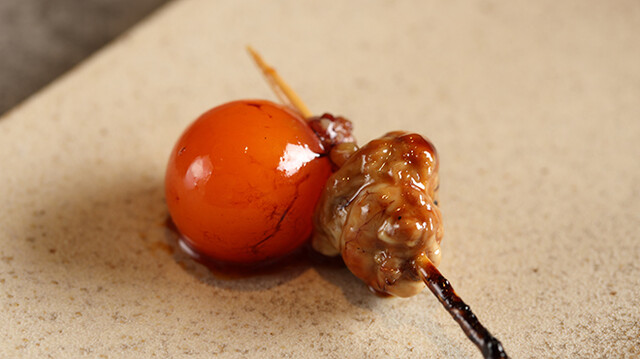
Kamimeguro changes after dark: station traffic thins, side streets take over, and dinner shifts to small counters rather than large dining rooms. Yakitori fits because it rewards proximity. The grill is not background equipment; it sets pace, turns ordering into sequencing, and makes the counter the stage.
Tori Go belongs to this evening economy, not Tokyo’s daytime value circuit. Lunch is not part of its public rhythm, so the usual split between efficient midday sets and slower night service becomes a clearer proposition: a dinner counter built around grilled chicken skewers, not a two-service restaurant chasing different audiences. That matters in Nakameguro, where casual drinking, date-night dining, and serious small-format cooking overlap within a few blocks.
Nakameguro after dark suits a nine-seat yakitori counter
Tokyo yakitori is broader than the cliché of smoke, beer, and after-work skewers. At one end are standing-room or casual shops built for speed; at the other are counter-led rooms where pacing, cut selection, and heat control carry the meal. Tori Go sits closer to the latter, with nine counter seats and a maximum seated party size of nine. That scale leaves little anonymity: the meal depends on the cadence of a small room rather than the churn of a busy izakaya.
The restaurant’s Tabelog score of 3.72 and selection for Tabelog 100 Yakitori EAST 2025 give it a clear trust signal in a category under intense local scrutiny. Tabelog’s yakitori lists matter less as a single hierarchy than as markers of rooms drawing sustained attention from diners who know the form. For a restaurant opened on 27 April 2024, appearing on the 2025 EAST list is a notable early marker.
Price locates the counter precisely. The average dinner range is JPY 8,000 to JPY 9,999, with review-based spending shown at JPY 10,000 to JPY 14,999. That sits above casual skewer houses but below Tokyo’s upper luxury counters, where omakase-style poultry menus climb much higher. The appeal is not bargain hunting; it is controlled format, compact seating, and a category-specific award signal without the tariff of the city’s trophy dining rooms.
The lunch-versus-dinner question is easy. Tokyo has many restaurants where lunch is the access point: cheaper, quicker, easier to schedule. Here, the public identity is evening only: Tuesday through Sunday from 5:00 PM to midnight, Monday closed. The mood follows: a night address for diners who want the slower grammar of skewers, drinks, and counter pacing rather than a midday set built for efficiency.
What the format says about Tokyo yakitori now
Contemporary Tokyo yakitori has moved beyond casual tavern versus formal tasting counter. The stronger middle tier now includes intimate restaurants with serious grill discipline, accessible pricing by Tokyo premium standards, and limited seating that makes reservations part of the decision. Tori Go’s nine-seat, counter-only setup matches that shift: focused, but still within reach for diners who understand yakitori as dinner rather than spectacle.
Compared with broader Tokyo dining, that specificity is the point. Spanish Ryouri Pablo occupies another lane, with listed lunch and dinner pricing for more daylong flexibility. unito shows another Tokyo pattern, with higher dinner pricing and a separate lunch range. TEN-MASA and Steak Dining Vitis sit in different cuisine categories. Yakitori asks for a narrower reading: value is measured less by course count or dining-room theatre than by how well a counter sustains attention through repeated small servings from the grill.
Nakameguro strengthens that reading. The district is polished without losing after-work informality, and its better small restaurants serve guests who have already chosen the neighbourhood for the evening. Five minutes from Nakameguro Station, the address is convenient yet removed enough from the station-front rush to feel deliberate. No parking is listed, normal for this part of Tokyo, reinforcing the rail-first logic of the meal.
The house rules define the audience. The restaurant is non-smoking, takes credit cards including Visa, Master, JCB, AMEX, and Diners, and does not accept electronic money or QR code payments. Private rooms are unavailable, while private use is listed for groups up to 20 people. Children are limited to middle-school age and older. This is not formal in the Western fine-dining sense, but it signals a counter for focused evening dining rather than family-style turnover.
How to read Tori Go in a Tokyo itinerary
For travellers, treat yakitori as a night plan, not filler between larger reservations. Tokyo rewards diners who separate categories: sushi counters, tempura counters, kappo, curry shops, cafés, bars, and grill rooms each have their own tempo. The restaurant fits a schedule built around Nakameguro and nearby wards, especially when the evening can stay compact rather than crossing the city between courses and drinks.
It also works as a counterpoint to the broader restaurant map. Readers comparing categories can scan Our full Tokyo restaurants guide, then place this meal against casual and specialist listings such as 124. KAGURAZAKA (Yakitori), 12/10 Shinjuku ten, . 鮪と炭火焼き うお炭 秋葉原店, 2D Cafe, and 3 Chome no Curry Ya San. The comparison clarifies what a counter yakitori dinner can do that a café, curry specialist, or broader grill restaurant cannot.
Planning around Tokyo extends beyond restaurants, so keep the city’s other categories separate: Our full Tokyo hotels guide, Our full Tokyo bars guide, Our full Tokyo wineries guide, and Our full Tokyo experiences guide cover surrounding itinerary decisions. For wider Japan and overseas context, EP Club also tracks restaurants such as -Grilled beef Sukiyaki- KAMAKURA TANUKIAN 鎌倉 たぬき庵 in Kamakura.cafe in Osaka.know in Kumamoto, (Shoku) Vietnam in Kawasaki, [Curry Senmon Ten] Maruyama Kyoju. in Sapporo, [ki:] in Kyoto, Jōdo Saké Bar in Los Angeles, and Onigiri Time in Pasadena.
The editorial read is simple: this is a small Tokyo yakitori counter with credible early recognition, a clear evening identity, and pricing in the serious-but-not-grand category. Choose it when the night calls for focused grilling in Nakameguro rather than a sprawling menu or daytime value play.
Similar Picks
Comparable options at the same price tier.
| Venue | Cuisine | Price | Notes |
|---|---|---|---|
| Tori GoThis venue — the venue you are viewing | Yakitori Omakase | $$$ | Not listed |
| Oni Tei | Traditional chicken yakiniku / yakitori in Shibuya | $$$ | Shibuya |
| Sasha Kanetanaka | Modern Japanese kaiseki & tea house | $$$ | Minato |
| Okashiya Ucchi | Seasonal Japanese cake & dessert shop | $$$ | Shibuya |
| Sumibi Yakiniku Horumon Maruha | Charcoal-grilled wagyu & horumon yakiniku | $$$ | Shinagawa |
| Koi Nobori | High-end Yakiniku & Horumon Counter | $$$ | Shinjuku |
Recognition history
Dated appearances from independent guides and award organizations, with the underlying list record or original source where available.
Tabelog 100 #48 · No. 48
Tabelog · Tabelog 100 - Yakitori - EAST - 2025













At a Glance
- Cozy
- Intimate
- Modern
- Date Night
- Solo
- After Work
- Casual Hangout
- Special Occasion
- Chefs Counter
- Open Kitchen
- Standalone
- Sake Program
- Local Sourcing
A small, relaxed counter-only yakitori bar tucked in a Nakameguro back alley, with a calm, low-pressure atmosphere suited to solo diners and small parties, non-smoking and focused on the grill in front of you.