
Tabelog 100 #2
Our verdict
Rock'n Three operates from a basement address in Shin-Yokohama's transit corridor and ranked seventh on Ramen Beast's Top 10 Bowls of 2025 list for its Jidori Shoyu. The recognition places it inside a small cohort of Kanagawa ramen counters earning national editorial attention. The Jidori Shoyu bowl is the clear reference point for first-time visitors.

Pearl is the En Primeur Club membership app, where members save venues, book tables and use the concierge.
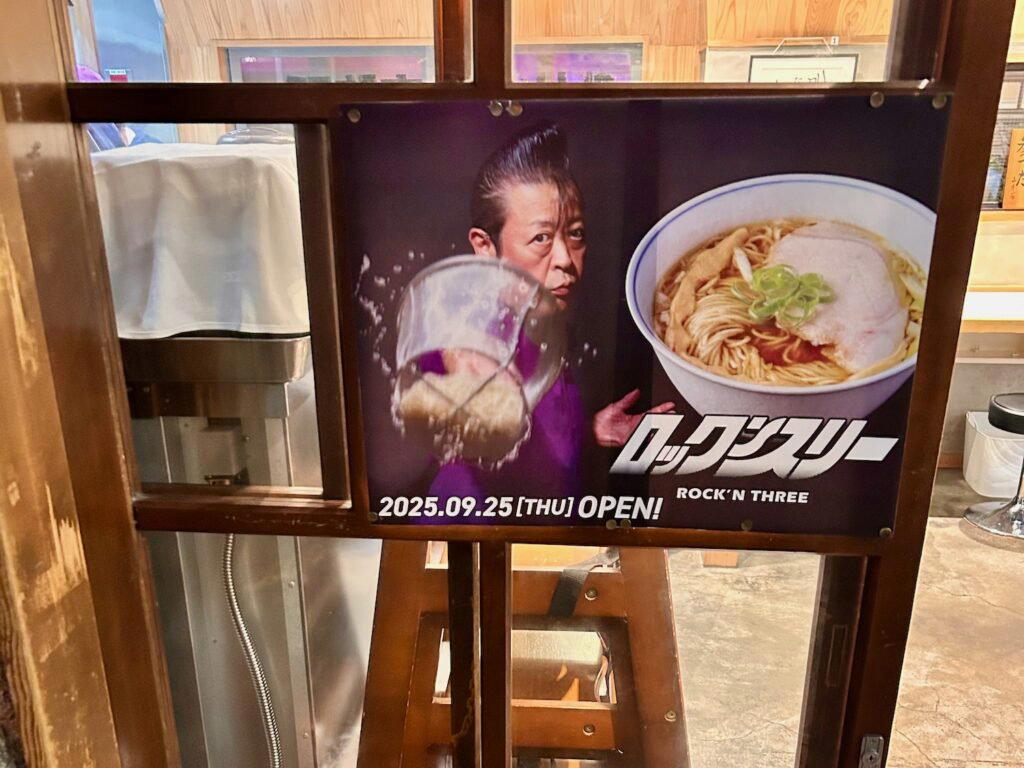
The Basement Counter and What It Signals
In Shin-Yokohama, the ramen density around the station exits is high enough that serious counters have learned to differentiate sharply. Walk the stretch of 2-chome in Kohoku Ward and you will pass several operations that read as interchangeable from street level. Rock'n Three is below it, down a staircase to a basement floor, which in Japanese ramen culture functions less as a liability than as a filter. The format tells you something before you sit down: this is not a spot optimised for passing commuter traffic.
That positioning matters because Shin-Yokohama already has one anchor institution for ramen tourism: the Shin-Yokohama Ramen Museum, which opened in 1994 and draws visitors specifically to survey ramen's regional range. Rock'n Three operates in a different register entirely, as a working neighbourhood counter rather than a curatorial attraction. The comparison clarifies where Rock'n Three sits in the local hierarchy: it is the kind of place that earns attention from specialist critics, not tourism boards.
The Jidori Shoyu and What the Recognition Means
Ramen Beast's annual ranking is one of the more credible English-language references in specialist ramen coverage. The publication's 2025 list of the leading ten bowls in Japan placed Rock'n Three at number seven, with the Jidori Shoyu named as the specific bowl behind that ranking. To place seventh on a national list drawn from a country with tens of thousands of ramen operations is a narrow credential, and the Jidori framing is significant in itself.
Jidori refers to free-range domestic chicken, a designation that carries real cost and sourcing implications in Japanese ingredient procurement. Shoyu ramen built on a jidori base sits in a different category from the mass-market chicken broths that anchor much of the mid-market shoyu segment. The style demands clarity: a well-made jidori shoyu broth is light in colour but layered in umami, with a transparency that shows the cook's confidence in the stock rather than hiding complexity behind fat or intensity. It is a demanding format to execute at high quality, and the Ramen Beast recognition suggests Rock'n Three is doing so at a level that reads nationally.
Within Japan's broader ramen conversation, shoyu has experienced a sustained rehabilitation over the past decade. After years in which tonkotsu's richness dominated critical attention, shoyu counters, particularly those working with premium poultry stocks, have reclaimed serious standing. Rock'n Three's recognition arrives in that context: it is part of a cohort of counters demonstrating that clarity and restraint can compete with intensity and weight on a national stage. For reference points in the shoyu and delicate-broth tradition operating at high levels in Japan, Chukasoba Mugen in Osaka and Chukasoba Oshitani in Nara operate in adjacent territory.
Applying a Kaiseki Lens to a Ramen Counter
The editorial angle here is not accidental. Kaiseki, Japan's multi-course seasonal tradition, operates on principles of restraint, seasonal sourcing, and the discipline to let ingredient quality carry the work. A jidori shoyu ramen counter working at the level that draws national critic attention is applying a version of that same logic within a radically compressed format: one bowl, one broth, one protein designation, executed with precision.
The kaiseki tradition, whether expressed across twelve courses at Gion Sasaki in Kyoto or in the tightly edited seasonal omakase format found at counters like HAJIME in Osaka, is fundamentally about removing what is unnecessary and letting the remaining elements carry more weight. A high-quality jidori shoyu ramen applies that logic at the counter level: the restraint in the broth, the sourcing specificity of the protein designation, the transparency of the soup itself. These are not incidental choices. They reflect a culinary philosophy that has deep roots in Japanese cooking regardless of format or price point.
This is also why specialist ramen rankings increasingly read like fine dining criticism rather than street food guides. The vocabulary of terroir, sourcing, and technique has migrated down through Japan's food culture, and counters like Rock'n Three are operating in that expanded critical space.
Yokohama's Wider Dining Range
Rock'n Three sits within a city that operates across a wider range of dining registers than its proximity to Tokyo sometimes suggests. Yokohama has its own distinct culinary identity, shaped by its history as one of Japan's first open ports and the subsequent development of a genuine Chinatown, still one of the largest in Asia. Manchinro Tenshinpo represents the dim sum tradition within that quarter. At the counter-dining end of the city's range, Nakajo covers sushi with the precision the format demands.
The city's more recent dining additions extend further: Yukiguni, Enishi, and 1000, the yakitori counter operating in the JPY 15,000 to 19,999 bracket, each represent different points in that expanded register. Rock'n Three enters this picture as the ramen counter with the most visible national editorial recognition currently operating in Kanagawa. For anyone building a serious Yokohama dining itinerary, it belongs on the list alongside those other reference points. Our full Yokohama restaurants guide maps the city's range in more detail.
For those extending beyond Yokohama into Japan's broader specialist dining circuit, counters like Harutaka in Tokyo, Goh in Fukuoka, akordu in Nara, Abon in Ashiya, affetto akita in Akita, Aji Arai in Oita, Ajidocoro in Yubari District, and Akakichi in Imabari each operate in distinct regional niches worth knowing.
Planning Your Visit
Rock'n Three is located at 2 Chome-14-21 B1F, Shinyokohama, Kohoku Ward, Yokohama, Kanagawa. Shin-Yokohama Station is the access point, served by the JR Yokohama Line, the Tokaido Shinkansen, and the Yokohama Municipal Subway Blue Line, which makes it direct to reach from central Yokohama, Tokyo, or Osaka. The basement address means the entrance requires attention: look for the staircase on 2-chome rather than assuming street-level signage will do the work. Given the national-level recognition from the 2025 Ramen Beast ranking, queue times during lunch service and on weekends are worth factoring into your timing.
Frequently asked questions
How hard is it to get a table at Rock'n Three?
Rock'n Three operates from a basement counter in Shin-Yokohama, a district with high ramen density around its station exits. Counters at this recognition level, Ramen Beast's 2025 list draws serious attention, typically draw queues, particularly at lunch and on weekends. Arriving early or at off-peak hours is the practical approach; a reservation system in the fine-dining sense is not standard format for counters of this type.
How It Stacks Up
Comparable venues nearby, for context on price, style, and recognition.
| Venue | Cuisine | Price | Awards | Notes |
|---|---|---|---|---|
| Rock'n ThreeThis venue (the venue you are viewing) | Jidori Shoyu Ramen | $10–20 | Tabelog 100 #2 | Not listed |
| KITCHEN TAKANO | Modern chicken tsukesoba ramen | $10–20 | Tabelog 100 #33 | Kanagawa |
| Alpenjiro Honten | Soup and steak curry house | $10–20 | Tabelog 100 #39 | Naka |
| Yukiguni | Miso Ramen | $10–20 | Tabelog 100 #14 | Izumi |
| Suzukiya Honten | Yokohama Iekei Ramen | $10–20 | Tabelog 100 #21 | Hodogaya |
| Sweets Garden Yuji Ajiki | Japanese Sweets Patisserie | $10–20 | Tabelog 100 #14 | Tsuzuki |
Recognition history
Dated appearances from independent guides and award organizations, with the underlying list record or original source where available.
Tabelog 100 #2 · No. 2
Tabelog · Tabelog 100 - Ramen - KANAGAWA - 2025
Continue exploring
More in Yokohama
Restaurants in Yokohama
All restaurants in Yokohama →



Bars in Yokohama
Browse all →


Details
- Trendy
- Lively
- Casual Hangout
- After Work
- Standalone
- Local Sourcing
- A La Carte
Current opening hours
- Monday
- 11 AM–8:30 PM
- Tuesday
- 11 AM–8:30 PM
- Wednesday
- 11 AM–8:30 PM
- Thursday
- 11 AM–8:30 PM
- Friday
- 11 AM–8:30 PM
- Saturday
- 10:30 AM–8:30 PM
- Sunday
- 10:30 AM–8:30 PM
Hours can change for holidays and private events. Hours as of .
Energetic ramen museum atmosphere with a focus on authentic ramen shop experience.