
1 Michelin Star
Our verdict
A Michelin-starred kappo in Nishishinsaibashi, Yuno earns its place in Osaka's serious dining tier through a deliberately unorthodox omakase format that pairs quality seasonal fish with vegetable sauces and onion condiments rather than conventional accompaniments. The approach is less about rule-breaking for its own sake and more about reading what a guest actually wants.

Pearl is the En Primeur Club membership app, where members save venues, book tables and use the concierge.
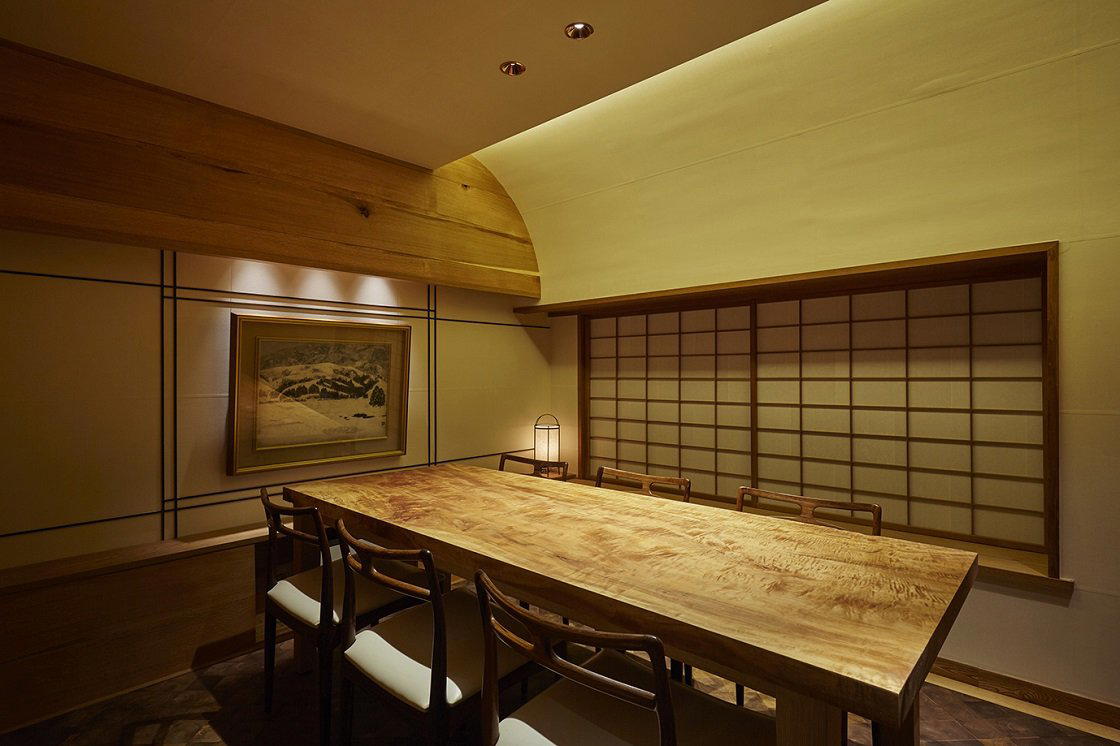
Osaka Kappo on Its Own Terms
Nishishinsaibashi is a district that functions simultaneously as a shopping corridor and one of Osaka's denser concentrations of serious restaurants. Walk far enough off the main retail drag and the storefronts give way to narrower streets where low-lit counter restaurants operate behind discreet facades. The area sits within the broader Minami zone, which has long supported Osaka's appetite for counter dining at every price point, from the cheap kushikatsu houses near Dotonbori to the white-tablecloth kaiseki operations that price against Tokyo competition. Nishishinsaibashi Yuno occupies the middle of that range in terms of price, a ¥¥¥ property in a neighbourhood that contains ¥¥¥¥ operations like Hajime and La Cime a short distance away.
Within Osaka's kappo tradition, the format at Yuno sits at an interesting intersection. Kappo, as a category, already carries more flexibility than kaiseki: the chef cooks in front of guests, adjusts the pace, and in principle reads the table rather than executing a fixed programme. What distinguishes the Yuno approach is that it amplifies this flexibility into something the restaurant itself names a free-and-easy omakase, signalling that the departure from standard kappo conventions is intentional and structural, not incidental.
Technique at the Counter: Reading Local Ingredients Differently
The editorial angle that leading explains what Yuno does is not fusion in the conventional sense. The ingredients are local and the spirit is Osakano, but the methods of presentation draw on a different logic. Sashimi, which at almost every kappo and kaiseki counter in Japan arrives with soy sauce and wasabi, appears here with onion dipping sauces or alternative condiments. Grilled fish and proteins are dressed with vegetable sauces rather than standard tare or salt finishes. The fishbone broth deployed in hot-pot preparations signals a kitchen that thinks about the whole ingredient, not just the primary cut.
These choices carry meaning beyond novelty. In the premium kappo tier, a restaurant holds a narrow range of levers: sourcing quality, knife skill, heat management, and the decision about what a particular ingredient is paired with. Yuno pulls hardest on that last lever. The condiment and sauce pairings are where the kitchen makes its argument, using methods that diverge from the kappo mainstream while drawing on produce that is recognisably of this place. For context on what a more orthodox expression of Japanese counter cuisine looks like in Osaka at the same price tier, Kashiwaya Osaka Senriyama and Tenjimbashi Aoki offer reference points on the more traditional end of the spectrum.
The zero-waste approach embedded in the fishbone broth is worth noting separately. In an era when many fine-dining operations in Japan and internationally have adopted nose-to-tail or ingredient-exhaustion principles as a marketing position, a fishbone broth appearing in a hot-pot course is quiet evidence that the kitchen thinks about ingredients at depth rather than as a set of premium cuts. Comparable moves at restaurants like Goh in Fukuoka or Yugen here in Osaka reflect a broader current in Japanese counter restaurants where intelligent use of the whole product functions as craft signal.
Where Yuno Sits in the Osaka Michelin Tier
Osaka's Michelin-starred restaurant count is substantial relative to its physical size, and the one-star tier is competitive enough that it contains real range. At the ¥¥¥¥ end, operations like Hajime and La Cime draw on French and international technique to justify their price positions. At ¥¥¥, properties like Yuno, Miyamoto, and Oimatsu Hisano compete on the strength of the counter experience and the depth of their Japanese culinary tradition. Yuno's 2024 Michelin recognition at one star confirms that the kitchen's unconventional approach functions at a level the inspectors found creditable.
Within the broader Kansai corridor, counter Japanese restaurants in this bracket can be usefully compared across cities. Gion Sasaki in Kyoto and akordu in Nara illustrate how differently regional restaurants in the same geography can approach the question of tradition versus interpretation. Tokyo's counter Japanese operations, from Harutaka to Myojaku to Azabu Kadowaki, generally sit in a more formal register. Osaka's version of counter dining has historically been less deferential and more focused on flavour directness, and Yuno's sauce-forward approach fits that civic character.
What to Expect from the Menu Format
The menu is titled Yuno's omakase, a naming convention that positions the format as the chef's personal reading of what you need rather than a fixed seasonal programme. In practice, this means the sequence of dishes will vary, with the kitchen responding to the guest and the ingredients available on a given day. This is structurally closer to what Tokyo's most experimental counter operations do, where the omakase label genuinely signals improvisation rather than a rotating fixed menu, than it is to the more codified kappo format where the order of courses is broadly predictable.
For guests accustomed to the standard sashimi-to-grilled-to-rice arc of a Japanese counter meal, the unconventional condiment pairings will be immediately legible as intentional. Onion-based sauces alongside sashimi, vegetable dressings on grilled items: these are departures that require a kitchen confident in its sourcing, because the default soy-and-wasabi format at least has the virtue of not competing with the fish's flavour. The sauces here are a bet that the fish is interesting enough to carry an additional flavour layer. That confidence is what a Michelin star at this price tier tends to validate.
Planning Your Visit
Know Before You Go
- Address: 1 Chome-10-35 Nishishinsaibashi, Chuo Ward, Osaka, 542-0086
- Price range: ¥¥¥ (mid-to-upper tier; comparable to Kashiwaya Osaka Senriyama and other one-star Osaka kappo)
- Recognition:
- Format: Omakase counter, kappo style; menu adjusts to the guest
- Booking: Advance reservation advised; Michelin-starred one-star counters in Osaka at this price tier typically book out days to weeks ahead, particularly at dinner
- Getting there: Nishishinsaibashi station (Osaka Metro Midosuji Line or Nagahori Tsurumi-ryokuchi Line) is the closest access point for this part of Chuo Ward
Further Reading
For a broader picture of Osaka's dining scene, including comparisons across price tiers and neighbourhood contexts, see our full Osaka restaurants guide. Visitors spending time in the city may also find value in our full Osaka hotels guide, our full Osaka bars guide, our full Osaka wineries guide, and our full Osaka experiences guide. Elsewhere in Japan, counter Japanese at 1000 in Yokohama and 6 in Okinawa offer regional comparisons for guests building an itinerary around serious Japanese counter dining.
Frequently asked questions
What should I eat at Nishishinsaibashi Yuno?
The kitchen's omakase format means the menu moves with the season and the chef's reading of what a guest wants, so there is no fixed list of dishes to request. What defines the experience is the departure from standard kappo condiment logic: sashimi paired with onion sauces rather than soy, grilled courses dressed with vegetable preparations rather than conventional tare, and a hot-pot course built on fishbone broth. These are the moves that earned the restaurant a 2024 Michelin star and distinguish it from more orthodox one-star kappo in the city. Come oriented toward the chef's choices rather than your own preferences.
Should I book Nishishinsaibashi Yuno in advance?
Yes. Counter restaurants in Osaka's one-star Michelin tier at the ¥¥¥ price point tend to fill well ahead of service, particularly for dinner. The omakase format and counter seating mean capacity is inherently limited, and Michelin recognition since 2024 will have raised the restaurant's international visibility among visitors to the city. Booking several weeks out is a reasonable precaution, especially if your dates in Osaka are fixed. For comparison, similarly positioned counters in Nishishinsaibashi and the broader Minami area operate at comparable demand levels.
What's Nishishinsaibashi Yuno leading at?
The restaurant's clearest strength, validated by its Michelin one-star recognition, is the kitchen's capacity to apply a genuinely different flavour logic to Japanese counter ingredients without the result feeling arbitrary. Pairing high-quality fish with vegetable or onion-based sauces is a structural risk that pays off when the sourcing is serious enough to carry the addition. The approach also reflects a broader Osaka sensibility: direct, flavour-forward, less concerned with ceremony than its Kyoto equivalents. Guests who have eaten across multiple Japanese counter formats will find Yuno most legible in that civic context.
In Context: Similar Options
| Venue | Cuisine | Price | Awards | Notes |
|---|---|---|---|---|
| Nishishinsaibashi YunoThis venue (the venue you are viewing) | Modern Kaiseki Omakase | $150–200 | 1 Michelin Star | Not listed |
| HAJIME | Avant-Garde Japanese Fine Dining | $300–500 | 3 Michelin Stars · World's 50 Best #83 | French, Innovative |
| La Cime | Modern French with Japanese Ingredients | $150–200 | 2 Michelin Stars · World's 50 Best #13 | French |
| Kashiwaya Osaka Senriyama | Seasonal Kaiseki Omakase | $200–300 | 3 Michelin Stars · La Liste Top Restaurants | Japanese |
| Taian | Traditional Japanese Kaiseki Omakase | $150–200 | 3 Michelin Stars · La Liste Top Restaurants | Kaiseki, Japanese |
| Fujiya 1935 | Modern Japanese with European influences | $100–150 | 2 Michelin Stars · La Liste Top Restaurants | Innovative |
Recognition history
Dated appearances from independent guides and award organizations, with the underlying list record or original source where available.
Michelin 1 Star
Michelin
Full recognition history (2 entries)
Michelin 1 Star
Michelin
Continue exploring
More in Osaka
Restaurants in Osaka
All restaurants in Osaka →


Bars in Osaka
All bars in Osaka →
Hotels in Osaka
All hotels in Osaka →

Wineries in Osaka
Browse all →
Details
- Cozy
- Intimate
- Elegant
- Date Night
- Special Occasion
- Private Dining
- Sake Program
- Omakase
- Sake
Current opening hours
- Monday
- Closed
- Tuesday
- 6–10 PM
- Wednesday
- 6–10 PM
- Thursday
- 6–10 PM
- Friday
- 6–10 PM
- Saturday
- 6–10 PM
- Sunday
- 6–10 PM
Hours can change for holidays and private events. Hours as of .
Cozy and intimate with counter seating and private rooms, warm hospitality, stylish and relaxing space.