
Nishino holds a Michelin star in Osaka's Nishi Ward, where the kitchen draws on a lineage traced through the revered kaiseki house Taian. The menu sequences through courses built around charcoal fire: pan-seared sashimi and grilled preparations carry an aromatic smoke that defines the experience. At the ¥¥¥¥ price tier, it sits inside Osaka's tightest bracket of serious Japanese dining.
Pearl is the En Primeur Club membership app — saves, bookings, and concierge access live there. Same editors, same standards.
- Address
- 1 Chome-9-21 Kyomachibori, Nishi Ward, Osaka, 550-0003, Japan
- Phone
- +81 6-6479-0456
- Website
- nishino-kyomachibori.jp
- Directions
- Get directions
 Saves & bookings on Pearl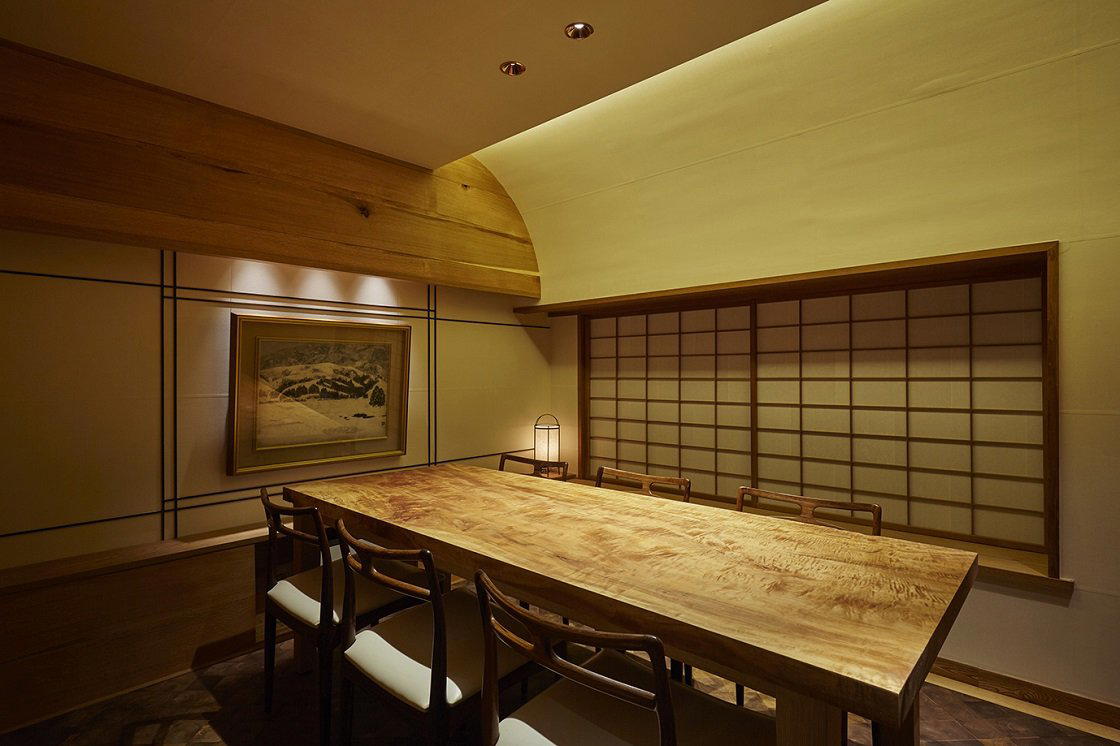
Fire and Sequence in Kyomachibori
Kyomachibori, the canal-threaded stretch of Nishi Ward in Osaka, now carries a quieter kind of prestige. The streets here lack the tourist density of Dotonbori or the self-conscious cool of Fukushima's bar scene; the buildings are low, the signage restrained. It is the sort of neighbourhood where serious restaurants operate without needing to announce themselves loudly. Nishino, on a residential side street at 1 Chome-9-21, reads exactly that way from the outside: composed, deliberate, not performing.
Inside, the meal works as a progression rather than a collection of individual dishes. That distinction matters in the context of Osaka's high-end Japanese dining scene, where the kaiseki tradition imposes a narrative logic on the sequence: the arc of temperature, texture, and intensity is the structure, and every course is a movement within it. The ingredient choice, the preparation method, the ceramic selected to carry the food, each decision feeds into a cumulative effect. This is the tradition the kitchen works within, and it is a demanding one.
The Charcoal Thread
What gives the progression here a distinct character is the sustained presence of charcoal fire. In a kaiseki sequence, live fire tends to appear as punctuation, a grilled course arriving mid-meal to shift register. At Nishino, charcoal functions as a motif. The kitchen holds a Michelin star, and the recognition specifically draws attention to the pan-seared sashimi and grilled dishes as signature expressions of the technique, both wreathed in aromatic smoke that carries through the course.
Pan-seared sashimi is a format worth understanding on its own terms. Standard sashimi asks the fish to speak for itself at raw temperature; searing the surface changes the contract. The Maillard reaction introduces new aromatic compounds, the texture at the edge shifts, and the fat responds differently than it would cold. Applied with restraint, it can pull a piece of fish into a more complex register without losing the directness that makes sashimi worth eating. Applied carelessly, it reduces the fish to a vehicle for technique. The distinction between those outcomes is entirely in execution, and execution here is the declared commitment.
The Taian lineage running through the kitchen matters in this context. Oimatsu Hisano and Tenjimbashi Aoki represent Osaka's broader pool of serious Japanese kitchens where training lineage functions as a verifiable credential, a signal about the culinary grammar the chef has absorbed. Taian, the two-Michelin-star kaiseki house in Minami, is among the city's most demanding schools in that tradition. Having served there as an apprentice is a specific formative context, not a generic biography note. The approach to ingredient selection and dishware that the Michelin assessors noted reflects that formation directly.
Where It Sits in Osaka's Tier Structure
Osaka's high-end Japanese dining scene is worth placing on a map before arriving. The city operates a dense and genuinely competitive upper tier, with multiple Michelin-starred kaiseki houses and a longer tradition of serious kappo and kaiseki than Tokyo's more recently concentrated fine-dining pile-up. At the ¥¥¥¥ price tier, Nishino sits alongside Kashiwaya Osaka Senriyama, which sits at ¥¥¥ and offers a comparison point for understanding what the price step buys. It also operates in the same broad register as Miyamoto and Yugen, both of which carry Michelin recognition and serve Japanese menus at comparable price points.
The Osaka scene at this level differs from Kyoto in one specific way: Osaka kitchens tend to be less deferential to strict kaiseki formalism, more willing to let personality and technique show through the structure. Gion Sasaki in Kyoto illustrates the contrast, a kitchen of comparable prestige but working within a more overtly Kyoto-inflected discipline. Nishino's charcoal emphasis reads as distinctly Osaka in that context: technically grounded but with a defined sensory signature that sits slightly outside pure kaiseki restraint.
For those mapping Japanese fine dining across the country, the comparison set extends further. Harutaka in Tokyo, Myojaku and Azabu Kadowaki in Tokyo, akordu in Nara, and Goh in Fukuoka all represent the spectrum of what serious Japanese cooking looks like across different cities, each with its own regional inflections. Nishino's placement within the Osaka tradition is its most specific asset: the Taian lineage is locally legible in a way that travels well as a credential but has particular resonance for diners who know the city's hierarchy.
Dishware as Evidence
One detail in the Michelin citation deserves attention: the specific mention of dishware alongside ingredient selection and preparation method. In kaiseki culture, the vessel is not decorative, it is compositional. A piece of pottery calibrated to the season, the temperature of the food, and the visual register of the course is doing active work. Kitchens that treat ceramics as presentation rather than as part of the cooking decision produce a different result from those that select ware as a genuine fourth ingredient. The fact that dishware appears as a named variable in the assessment of this kitchen is a signal about the level of attention operating below the surface of the meal.
This detail distinguishes a technically competent kaiseki sequence from one with genuine depth: the accumulated precision of small decisions that collectively determine the meal.
Explore More Osaka and Beyond
For Japanese fine dining outside Osaka, 1000 in Yokohama and 6 in Okinawa offer regional contrasts worth considering alongside any Kansai itinerary.
Peers in This Market
Comparable venues nearby, for context on price, style, and recognition.
| Venue | Cuisine | Price | Notes |
|---|---|---|---|
| NishinoThis venue — the venue you are viewing | Traditional Japanese Kaiseki | $$$$ | Not listed |
| Rakushin | Modern Kaiseki | $$$$ | Fukushima |
| Oryori Horikawa | Kaiseki | $$$$ | Kita |
| Ajikitcho Horieten | Traditional Kaiseki | $$$$ | Nishi |
| Yoshiko | Fugu Fine Dining | $$$$ | Kita |
| Nishishinsaibashi Yuno | Modern Kaiseki Omakase | $$$ | Chūō |
Recognition history
Dated appearances from independent guides and award organizations, with the underlying list record or original source where available.
Michelin 1 Star
Michelin
Michelin 1 Star
Michelin
Continue exploring
More in Osaka
Restaurants in Osaka
Browse all →




Bars in Osaka
Browse all →

Hotels in Osaka
Browse all →




Wineries in Osaka
Browse all →
At a Glance
- Elegant
- Intimate
- Serene
- Sophisticated
- Special Occasion
- Date Night
- Chefs Counter
- Sake Program
Current opening hours
- Monday
- 6–10 PM
- Tuesday
- 6–10 PM
- Wednesday
- 6–10 PM
- Thursday
- 6–10 PM
- Friday
- 6–10 PM
- Saturday
- 6–10 PM
- Sunday
- 6–10 PM
Hours can change for holidays and private events. Last verified .
Serene and relaxing counter seating for 8 with warm hospitality and stylish space.