
A compact Suginami ramen counter with a dried-sardine focus, Nishieifuku no Niboshi Bako belongs to Tokyo’s serious neighborhood ramen tier rather than the tourist-circuit format. Tabelog selected it for Ramen TOKYO “Tabelog 100” from 2022 through 2025, a signal of sustained local attention in a city where ramen reputations shift fast.
Pearl is the En Primeur Club membership app — saves, bookings, and concierge access live there. Same editors, same standards.
- Address
- Japan, 〒168-0064 Tokyo, Suginami City, Eifuku, 3 Chome−55−3 スペキエビル2F
- Phone
- +81 3-6304-7088
- Website
- x.com
 Saves & bookings on Pearl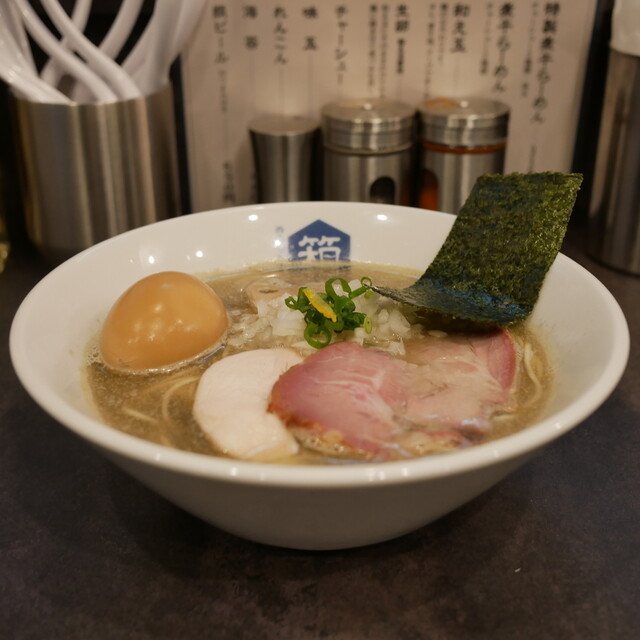
On the quieter western side of Tokyo’s ramen map, the rhythm changes. Big-station clusters trade in speed, neon, and turnover; Suginami’s stronger counters feel residential, regular-driven, and uninterested in spectacle. Nishieifuku no Niboshi Bako fits that pattern: small-room, counter-first ramen built around niboshi, the dried sardine stock that can make a bowl austere, saline, bitter-edged, or deeply savory depending on extraction.
Tokyo ramen has spent the past decade moving in two directions. One chases heavier bowls, richer emulsions, and social-media impact. The other tightens around specialist broths, cleaner formats, and narrow identities that reward repeat eating over one dramatic order. Disciplined niboshi ramen belongs to the second camp. Its appeal is not softness or crowd-pleasing sweetness, but controlled intensity: fish, grain, fat, and noodle, with little room to hide weak technique.
Suginami ramen and the return of the specialist counter
Suginami has long corrected central Tokyo dining habits. Close enough to Shinjuku and Shibuya to be practical, its better ramen rooms work by neighborhood logic: limited seating, direct menus, and customers who judge consistency over novelty. Nishieifuku no Niboshi Bako’s 8-seat format matters. Six counter seats and two table seats place the meal in the classic Tokyo ramen register, where the kitchen is close, turnover is natural, and the bowl carries the argument.
Selection for Tabelog Ramen TOKYO “Tabelog 100” in 2022, 2023, 2024, and 2025 frames the venue well. Tabelog’s ramen lists are not international trophy culture, but a local signal in a city whose ramen fans compare shops with granular seriousness. A 2025 Tabelog score of 3.78 places Nishieifuku no Niboshi Bako inside a competitive Tokyo ramen conversation without the rarefied language of luxury dining. This is not tasting-menu ramen. It is specialist everyday dining, sharp enough to attract destination eaters.
The west-side comparison set clarifies its position. Shina Soba Tantantei and Sakurajosui Funakoshi work in the same broad JPY 1,000 to JPY 1,999 ramen bracket, where the choice is style, not budget. Nearby Italian names MASSIMOTTAVIO and La Piccola Tavola, both in a higher dinner range, show how the area supports multiple kinds of regular dining. Ramen remains the compressed form: shorter meal, lower spend, higher repetition. That is where a focused niboshi counter earns its following.
Why niboshi ramen feels current again
Niboshi has never disappeared from Tokyo ramen, but its reputation has shifted. Older associations leaned toward regional directness and stronger fish aroma; newer Tokyo counters treat dried sardine as a precision instrument. The style can look minimal on paper and complex in practice. A niboshi bowl asks diners to read extraction, seasoning, noodle match, and finish, not toppings as decoration.
The small-counter format suits the genre. Pronounced dried-fish ramen depends on immediacy: tight noodle timing, broth temperature, and a bowl meant to be eaten without delay. In a larger, more theatrical room, that intensity can be diluted by production. In a compact shop, the format reinforces focus. The restaurant’s lack of private rooms and counter-centered setup keeps the experience aligned with the ramen tradition it represents.
The evolution here is not a simple old-to-new restaurant story, but a broader shift in Tokyo ramen taste. Diners are more fluent in substyles: shoyu, shio, tsukemen, chicken paitan, shellfish broths, and niboshi are no longer generic variations. They are categories with expectations. A place committed to niboshi enters an educated market, where diners arrive knowing what strong dried-sardine ramen can and cannot do.
That education changes how a small shop gains authority. Awards, online ratings, and repeat selection can move neighborhood counters into citywide circulation without a central address or chef-driven publicity machine. For travelers, the point is not that every acclaimed ramen shop demands a detour. It is that Tokyo’s ramen intelligence lives beyond central hotel zones. A Suginami counter repeatedly selected by Tabelog gives a sharper reading of contemporary ramen culture than another interchangeable station-adjacent queue.
How it fits a serious Tokyo eating itinerary
The restaurant suits travelers who treat ramen as a category to compare, not a box to tick between sushi and tempura. Its value is specificity: a small Suginami room, dried-sardine identity, and a price tier close to ramen’s everyday roots. Prioritize it when an itinerary already includes central Tokyo dining and needs a west-side ramen counter with a defined point of view.
It also suits solo dining, central to Tokyo ramen culture and one of the city’s great advantages for serious eaters. Counter ramen removes social performance; the meal is short, concentrated, and judged bowl by bowl. For visitors used to ramen abroad as a casual group meal, Tokyo’s smaller shops can feel exacting. That is the appeal. The format rewards decisiveness and attention.
Readers comparing restaurant formats can move from ramen to charcoal-grilled seafood at . 鮪と炭火焼き うお炭 秋葉原店, Shinjuku dining at 12/10 Shinjuku ten, yakitori at 124. KAGURAZAKA (Yakitori), stylized café culture at 2D Cafe, or curry at 3 Chome no Curry Ya San. For the wider city edit, use Our full Tokyo restaurants guide, alongside Our full Tokyo hotels guide, Our full Tokyo bars guide, Our full Tokyo wineries guide, and Our full Tokyo experiences guide.
Japanese dining research benefits from looking beyond Tokyo. Compare regional and international formats through -Grilled beef Sukiyaki- KAMAKURA TANUKIAN 鎌倉 たぬき庵 in Kamakura.cafe in Osaka.know in Kumamoto, (Shoku) Vietnam in Kawasaki, [Curry Senmon Ten] Maruyama Kyoju. in Sapporo, [ki:] in Kyoto, Jōdo Saké Bar in Los Angeles, and Onigiri Time in Pasadena.
The conclusion is narrow. Tokyo has more famous ramen addresses, larger queues, and louder formats. The restaurant shows a different axis of quality: repetition, specialization, and a neighborhood counter scaled to the bowl rather than the photograph. In a city where ramen evolves through hundreds of small technical choices, that is often the more revealing meal.
Cuisine-First Comparison
Comparable venues at a glance for context.
| Venue | Cuisine | Price | Notes |
|---|---|---|---|
| Nishieifuku no Niboshi BakoThis venue — the venue you are viewing | Niboshi-focused Ramen | $ | Not listed |
| Sanuki no Udon Hana wa Saku Shin nakano honten | Sanuki Udon & Tempura | $ | Nakano |
| Mendokoro Bigiya Gakugei daigaku honten | Classic Tokyo shoyu ramen shop | $ | Meguro |
| Sanuki Udon Kuranosuke | Sanuki udon noodle shop | $ | Toshima |
| Isuzu | Traditional Japanese Wagashi Shop | $ | Shinjuku |
| Nihonbashi Nishikihorin Karintou senmonten | Traditional Japanese Karintou Specialty Shop | $ | Chiyoda |
Recognition history
Dated appearances from independent guides and award organizations, with the underlying list record or original source where available.
Tabelog 100 #39 · No. 39
Tabelog · Tabelog 100 - Ramen - TOKYO - 2025













At a Glance
- Cozy
- Lively
- Solo
- Casual Hangout
- After Work
- Standalone
- Local Sourcing
Current opening hours
- Monday
- 11:30 AM–3 PM, 6–9 PM
- Tuesday
- 11:30 AM–3 PM, 6–9 PM
- Wednesday
- 11:30 AM–3 PM, 6–9 PM
- Thursday
- 11:30 AM–3 PM, 6–9 PM
- Friday
- 11:30 AM–3 PM, 6–9 PM
- Saturday
- 11:30 AM–3 PM, 6–9 PM
- Sunday
- 11:30 AM–3 PM
Hours can change for holidays and private events. Last verified .
Compact, counter-focused ramen shop with a casual neighborhood feel; non-smoking, usually busy with solo diners and ramen fans drawn by the powerful niboshi aroma and clean, simple interior.