Michelin Plate
Our verdict
Meng Du Hui brings Hui cuisine, the cooking tradition of Anhui province, to a hutong address in Dongcheng, earning consecutive Michelin Plate recognition in 2024 and 2025. At the ¥¥ price tier, it sits well below Beijing's major regional Chinese restaurants while drawing on one of China's eight classical culinary schools. A considered choice for anyone tracing the city's broader regional dining map.

Pearl is the En Primeur Club membership app, where members save venues, book tables and use the concierge.
The menu
What to order
- Braised Huizhou smelly mandarin fish
A Hutong Setting, an Anhui Kitchen
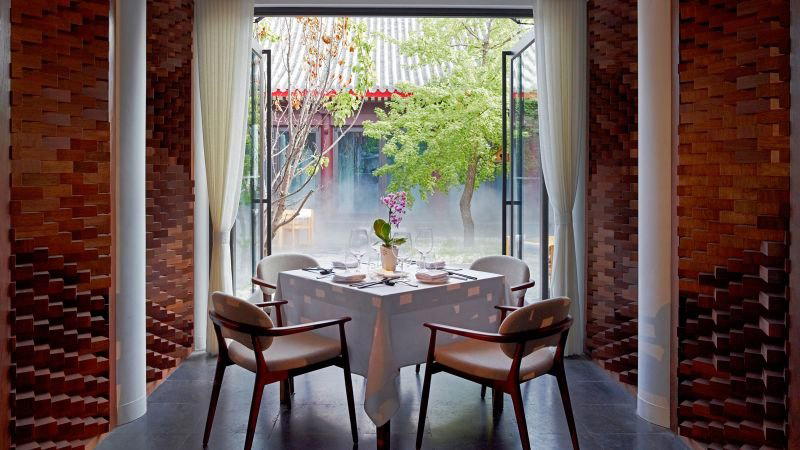
Panjiapo Hutong cuts through Dongcheng's residential fabric east of the Drum Tower corridor, far enough from the tourist circuit that arriving on foot feels like a small act of navigation. The hutong format, low grey-brick lanes, compound gates, the quiet of a neighbourhood rather than a dining district, sets a particular register before you reach the door. Restaurants that choose this kind of address are usually making a statement about priorities: the cooking is expected to speak for itself, without a polished lobby or a view to do preliminary work.
Meng Du Hui occupies that register. The cuisine it serves, Hui, belongs to one of China's eight recognised classical culinary traditions, and its presence in Beijing, a city whose restaurant identity is dominated by its own imperial cooking, by Cantonese houses, and by a growing wave of coastal Chinese cuisine, marks it as a representative of a less-trafficked tradition in the capital.
Hui Cuisine and What It Means to Serve It in Beijing
Anhui cuisine developed across a province defined less by coastline than by mountains, rivers, and the merchant networks of the Ming and Qing dynasties. Huizhou merchants, travelling trade routes that stretched from the Yangtze delta to northern China, carried their food culture with them, which is partly why Hui cooking turns up as a historical presence in cities far from its geographic source. The tradition relies heavily on preserved and fermented ingredients, salted fish, fermented tofu, air-dried meats, alongside freshwater products from the Yangtze tributaries and foraged mountain ingredients like bamboo shoots and stone fungus.
The flavour profile is not loud in the way of Sichuan, nor as refined in its textural layering as Jiangsu or Cantonese cooking. It is, in the hands of its leading practitioners, a cuisine of depth over brightness: slow braises, earthy ferments, ingredients that carry their origin in the flavour. For a Beijing diner more accustomed to Peking duck, imperial-style preparations, or the rising tide of Taizhou and Chaozhou cooking, a meal at a Hui restaurant represents genuine culinary range.
Within Beijing's regional Chinese dining market, that range is underrepresented. Compare Meng Du Hui's position to the Michelin-listed Chaozhou offer at Chao Shang Chao (Chaoyang) or the Taizhou cuisine at Xin Rong Ji (Xinyuan South Road), both operating at the ¥¥¥¥ tier with correspondingly formal dining formats. Hui cuisine at the ¥¥ level occupies a different bracket altogether: less ceremonial, more embedded in everyday cooking logic, and without the imported prestige that coastal Chinese cuisines currently carry in the capital's fine dining conversation.
Michelin Recognition and What It Signals
Consecutive Michelin Plate awards in 2024 and 2025 position Meng Du Hui within a specific tier of the Guide's recognition system. The Plate designation, sitting below star level, indicates that Michelin inspectors found the cooking to meet a quality threshold worth flagging to readers, consistent, representative of its tradition, and worth seeking out, without the degree of refinement or ambition that star designation requires. For a regional Chinese restaurant at the ¥¥ price point in a hutong address, that recognition functions less as a marker of fine dining ambition and more as a quality signal within the accessible end of the market.
Beijing's Michelin-listed regional Chinese restaurants tend to cluster at higher price points. Venues like Jingji, representing Beijing's own culinary tradition, and Lamdre at the vegetarian end, both operate at ¥¥¥¥. The Plate at ¥¥ suggests a different kind of proposition: quality cooking available at a price that doesn't require treating the meal as an occasion. That is not a trivial distinction in a city where serious regional food at accessible prices is harder to source than the number of restaurants might suggest.
That is worth factoring into any assessment: this is not yet a restaurant with a long public track record, and the Michelin recognition is therefore doing more evaluative work than the crowd-sourced data.
The Hui Cuisine Circuit Beyond Beijing
For those building a picture of Hui cuisine across China rather than encountering it in a single city, the regional representation extends well beyond Beijing. The tradition appears in a different register at Meng Du Hui in Nanjing and at Shui Mo Hui in Hangzhou, both cities with tighter geographic proximity to Anhui's source ingredients and stronger historical connections to Huizhou merchant culture. Eating Hui cuisine in its proximate cities offers a different baseline from the Beijing version, which necessarily operates at a slight remove from its supply chains.
For broader context on how regional Chinese cuisines translate into major cities across the country, the range at 102 House in Shanghai, Ru Yuan in Hangzhou, Imperial Treasure Fine Chinese Cuisine in Guangzhou, and Dai Yuet Heen in Nanjing illustrates how differently Chinese culinary traditions adapt to new urban contexts. Xin Rong Ji in Chengdu and Chef Tam's Seasons in Macau extend the map further. Taken together, they frame why a Hui restaurant in a Beijing hutong functions as more than local colour: it is part of a sustained national pattern of regional kitchens finding audiences in cities other than their own.
Closer to Meng Du Hui's address, the vegetarian programme at King's Joy and the Beijing cuisine focus at Jingji represent different points on the city's regional Chinese dining spectrum, each with distinct traditions and price structures. Placing Meng Du Hui within that set makes its ¥¥ Hui positioning clearer: it is filling a specific gap, not competing on the same terms.
Know Before You Go
| Address | 5 Panjiapo Hutong, Dongsi Subdistrict, Dongcheng, Beijing 100010 |
|---|---|
| Cuisine | Hui (Anhui) |
| Price | ¥¥ |
| Awards | Michelin Plate 2024, Michelin Plate 2025 |
| Booking | Contact details not publicly listed; visiting in person or via local booking platforms is advisable |
| Getting There | Dongcheng district; nearest metro access via Line 5 (Beixinqiao station) or Line 6 (Dongsi station) |
For a wider view of where Meng Du Hui sits within Beijing's dining options, see our full Beijing restaurants guide. The city's broader travel picture is covered in our Beijing hotels guide, bars guide, wineries guide, and experiences guide.
Frequently asked questions
What's Meng Du Hui's location?
Meng Du Hui is located at 5 Panjiapo Hu Tong, Dongsi Subdistrict, Beijing, Dongcheng, Beijing, China, 100010, Beijing.
Is Meng Du Hui expensive?
Pricing at Meng Du Hui is listed as ¥¥.
Has Meng Du Hui won any awards?
Meng Du Hui has received recognition including: Michelin Plate (2025); Michelin Plate (2024).
What's the signature dish at Meng Du Hui?
Meng Du Hui's menu centres on Hui cuisine, the regional cooking of Anhui province, which is defined by braised and slow-cooked preparations, preserved ingredients, and mountain-derived produce rather than coastal seafood. Ordering across the menu rather than anchoring to a single dish is the most reliable way to read what the kitchen does well.
What's the cuisine at Meng Du Hui?
Should I book Meng Du Hui in advance?
Meng Du Hui holds Michelin Plate status for both 2024 and 2025, and its Panjiapo Hutong address in Dongcheng draws a local following that moves faster than tourist search traffic. No booking phone or online reservation system is listed publicly, so arriving without a reservation during peak lunch or dinner hours carries real risk. Visiting in person or asking your hotel concierge to make contact directly is the practical approach given the ¥¥ price point, which keeps demand consistent.
Nearby-ish Comparables
| Venue | Cuisine | Price | Awards | Notes |
|---|---|---|---|---|
| Meng Du HuiThis venue (the venue you are viewing) | New Huizhou Cuisine | Not listed | Michelin Plate | Not listed |
| Jing | Modern French with Asian Influences | $300–500 | 1 Michelin Star · Black Pearl 1 Diamond | French Contemporary |
| Xin Rong Ji (Xinyuan South Road) | Taizhou Chinese Fine Dining | $300–500 | 3 Michelin Stars · World's 50 Best #84 | Taizhou |
| Chao Shang Chao (Chaoyang) | Modern Teochew (Chaoshan) Fine Dining | $200–300 | Michelin Plate · La Liste Top Restaurants | Chao Zhou |
| Lamdre | Modern Plant-Based Chinese Vegetarian | Not listed | 2 Michelin Stars · World's 50 Best #17 | Vegetarian |
| Jingji | Imperial Beijing Royal Cuisine | $200–300 | 2 Michelin Stars · La Liste Top Restaurants | Beijing Cuisine |
Recognition history
Dated appearances from independent guides and award organizations, with the underlying list record or original source where available.
Michelin Plate
Michelin
Full recognition history (2 entries)
Michelin Plate
Michelin