
Kichijoji’s curry culture rewards small rooms, patient queues, and menus that treat spice as an everyday craft rather than a luxury performance. LITTLE SPICE belongs to that compact Tokyo category: counter-only, reservation-free, repeatedly selected for Tabelog’s Curry TOKYO 100, and priced in the casual bracket rather than the tasting-menu economy.
Pearl is the En Primeur Club membership app — saves, bookings, and concierge access live there. Same editors, same standards.
- Address
- Japan, 〒180-0004 Tokyo, Musashino, Kichijoji Honcho, 2 Chome−14−1 山田ビル 2F
- Phone
- +81 422-20-7915
- Website
- twitter.com
 Saves & bookings on Pearl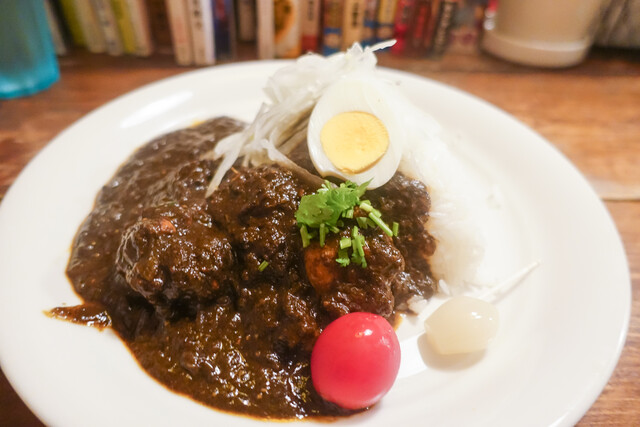
The approach is pure Kichijoji: a second-floor address above the street rhythm of Musashino, close enough to the station for a deliberate detour but removed from the department-store dining floors. Tokyo curry has always worked well in rooms of this scale. The category does not need ceremony to carry weight; it needs heat control, rice discipline, and a kitchen that can repeat its balance through a full service. LITTLE SPICE sits inside that tradition, where the occasion is less about linen and more about choosing a small, serious counter for a meal that feels earned.
For milestone dining, Tokyo usually points visitors toward sushi counters, kappo rooms, and hotel restaurants. Curry offers a different kind of occasion: lower in cost, shorter in format, but often more personal because the room leaves no buffer between guest and kitchen. That makes it a useful choice for birthdays, reunions, and informal celebrations when the point is conversation rather than choreography. The setting is compact, the category is direct, and the decision is sharper than defaulting to another omakase reservation.
Kichijoji curry works because the room stays small
Kichijoji has long balanced student energy, independent retail, park-bound weekend traffic, and neighborhood regularity. Its better casual restaurants tend to resist overproduction. In that context, a counter-only curry shop reads correctly: the format keeps attention on the plate and keeps turnover tied to the pace of the kitchen rather than the ambitions of a floor team. LITTLE SPICE is listed with nine counter seats, which places it closer to Tokyo’s specialist micro-restaurants than to the broader curry-café model.
The useful comparison is not fine dining. It is the cluster of Kichijoji addresses that make everyday food feel specific. Hikiniku to Kome Kichijouji works in the same broad casual-price lane, while Sabo Musashino Bunko and Dans Dix ans show how the neighborhood supports focused formats rather than all-purpose dining rooms. Liberte Patisserie Boulangerie Tokyo honten・kichijoji pulls the area toward French bakery culture; Chinese Sai Yunron sits at a higher dinner spend. Against that local spread, LITTLE SPICE occupies the curry specialist position: smaller, narrower, and more dependent on repeat trust.
The award signal matters because curry in Tokyo is crowded and highly opinionated. Selection for Tabelog Curry TOKYO 100 in 2024, with prior selections in 2023, 2022, 2020, 2019, and 2018, suggests durability rather than a short burst of attention. A Tabelog score of 3.73 puts it in the serious casual tier, where ratings are shaped by regular diners comparing many nearby options, not only by destination visitors. In a category where personal preference can swing wildly between Japanese curry, Indian curry, spice curry, and hybrid styles, repeated recognition is a stronger clue than a single viral recommendation.
A casual celebration, not a formal performance
Occasion angle here is important. A curry counter will not replace a private room for a family ceremony or a long wine-led dinner. It works for smaller celebrations where precision, intimacy, and a sense of discovery matter more than a long service arc. The category is especially useful for travelers who have already booked a high-ticket sushi or kaiseki meal and want another meal with local credibility without adding another expensive reservation.
The restaurant’s classification as curry and Indian curry places it within one of Tokyo’s liveliest casual traditions. The city’s curry culture is not a single lineage. It includes yoshoku-derived Japanese curry, South Asian restaurants adapted to Japanese dining habits, Osaka-influenced spice curry, and independent shops that blend techniques without needing a grand thesis. Kichijoji suits that looseness. The neighborhood rewards places that can be visited often, argued over, and folded into routines. That is why a small counter can carry as much emotional weight as a formal dining room for the right occasion.
There is also a practical social advantage to this kind of room: the meal has a defined focus. Nobody has to study a cellar, manage courses, or negotiate a tasting menu. For friends marking a promotion, a quiet anniversary before drinks, or a low-key birthday, curry provides a shared center without turning the evening into a production. The better Tokyo curry shops understand that intensity and informality are not opposites. The plate can be serious while the evening stays relaxed.
How to place it in a Tokyo itinerary
The restaurant belongs in a west-side Tokyo plan rather than a citywide checklist sprint. Kichijoji pairs naturally with Inokashira Park, independent shops, and the Chuo Line’s more lived-in dining culture. Travelers building a broader restaurant map can use Our full Tokyo restaurants guide for the citywide spread, then compare casual specialist meals with addresses such as 3 Chome no Curry Ya San, 12/10 Shinjuku ten, 124. KAGURAZAKA (Yakitori), . 鮪と炭火焼き うお炭 秋葉原店, and 2D Cafe. For the rest of the trip, the city guides to Tokyo hotels, Tokyo bars, Tokyo wineries, and Tokyo experiences help separate dinner decisions from the rest of the itinerary.
For travelers extending the food map beyond the capital, the comparison becomes useful rather than competitive. Regional casual dining in Japan can be just as focused, from -Grilled beef Sukiyaki- KAMAKURA TANUKIAN 鎌倉 たぬき庵 in Kamakura to.cafe in Osaka.know in Kumamoto, (Shoku) Vietnam in Kawasaki, [Curry Senmon Ten] Maruyama Kyoju. in Sapporo, and [ki:] in Kyoto. Even outside Japan, compact Japanese-format dining has traveled well, as seen in Jōdo Saké Bar in Los Angeles and Onigiri Time in Pasadena. The lesson for the restaurant is the same: a small format can carry cultural force when the cooking has enough repetition, restraint, and local trust behind it.
The editorial call is simple. Choose this for a compact celebration, a serious casual meal, or a Kichijoji evening built around conversation rather than display. The room’s scale, counter format, and repeated Tabelog Curry selections make it a credible alternative to Tokyo’s higher-pressure dining rituals, especially when the occasion needs flavor and focus without turning into an event with too many moving parts.
A Lean Comparison
Comparable venues by cuisine and price in the same metro.
| Venue | Cuisine | Price | Notes |
|---|---|---|---|
| LITTLE SPICEThis venue — the venue you are viewing | Kichijoji, Japanese curry house | $$ | Not listed |
| Mendokoro Honda | Akihabara, Shoyu Ramen Specialist | $$ | Not listed |
| Dashi to Men Yuei | Suginami, Modern dashi-focused ramen | $$ | Not listed |
| Rakusui En | Not listed | $$ | Nerima, Traditional Yakiniku & Tripe Izakaya |
| Kurumi Do Kissa Ten | Not listed | $$ | Kokubunji, Japanese kissaten & café with bookstore |
| Satei Zenkashoin Shibuya hikarie ShinQs ten | Shibuya, Kyoto-style Japanese Tea Cafe | $$ | Not listed |
Recognition history
Dated appearances from independent guides and award organizations, with the underlying list record or original source where available.
Tabelog 100 #71 · No. 71
Tabelog · Tabelog 100 - Curry - TOKYO - 2024
Continue exploring
More in Tokyo
Restaurants in Tokyo
Browse all →



Bars in Tokyo
Browse all →



Hotels in Tokyo
Browse all →




Wineries in Tokyo
Browse all →
At a Glance
- Cozy
- Solo
- Casual Hangout
- After Work
- Standalone
Current opening hours
- Monday
- 4–8:30 PM
- Tuesday
- 4–8:30 PM
- Wednesday
- 4–8:30 PM
- Thursday
- 4–8:30 PM
- Friday
- 4–8:30 PM
- Saturday
- 1–8:30 PM
- Sunday
- 1–8:30 PM
Hours can change for holidays and private events. Last verified .