
From April 2026, weekend and holiday access shifts to reservations, a sign of how serious Tokyo’s compact ramen counters have become about time management. Dashi to Men Yuei is a seven-seat, counter-only ramen shop in Higashi-Koenji with Tabelog Ramen TOKYO 100 selection for 2025, cashless payment, and a menu logic built around dashi rather than excess.
Pearl is the En Primeur Club membership app — saves, bookings, and concierge access live there. Same editors, same standards.
- Address
- Japan, 〒166-0003 Tokyo, Suginami City, Koenjiminami, 4 Chome−7−1 コーポカトレアビル 1F
- Phone
- +81 3-6383-2256
- Website
- tabelog.com
 Saves & bookings on Pearl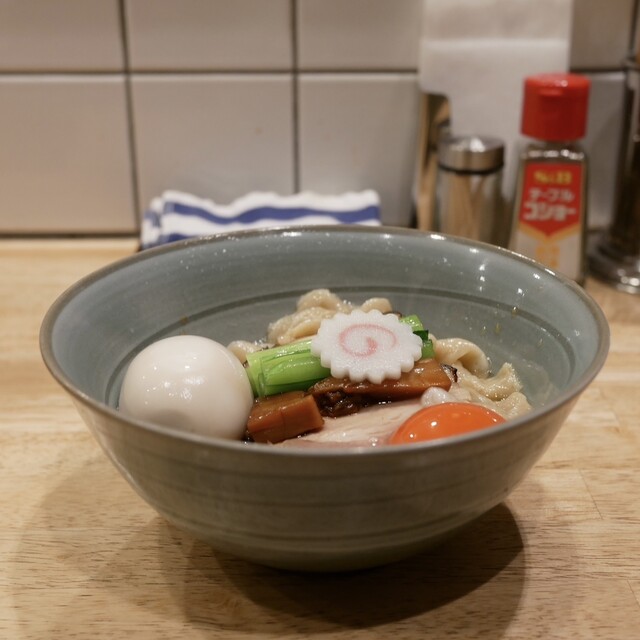
Higashi-Koenji’s ramen rooms operate at a different scale from Tokyo’s hotel dining rooms and Ginza counters: short frontage, ticket-machine rhythm, and a line that can turn lunch into a scheduling decision. Dashi to Men Yuei belongs to the compact Tokyo category where the room is almost all counter, pacing is visible, and the bowl must carry the argument without theatrical service.
Tokyo ramen has spent the past decade moving in two directions: some shops chase density, pork weight, and late-night stamina; others strip the format back to soup clarity, noodle texture, and fewer choices. The clue is in the name: dashi and noodles are the architecture. That puts the shop closer to the city’s precision-led ramen culture than to the maximalist, topping-heavy end of the genre.
A seven-seat counter built around broth discipline
The narrow format is not incidental. Seven counter seats create a room where production and eating happen in close sequence, which is why small ramen shops can feel more exacting than many tasting-menu restaurants. With little distance between kitchen timing and diner, turnover, temperature, and noodle condition become operational facts rather than atmosphere.
The menu architecture, signalled by the shop’s positioning, asks diners to read ramen through broth first. In Tokyo, that matters. Dashi-led ramen is not just a lighter alternative to richer styles; it belongs to a broader Japanese habit of building depth through extraction, restraint, and balance. When that premise is explicit, extra toppings become secondary to soup and noodle. The title does the editorial work before the first order.
Recognition followed quickly. The shop opened in 2023 and was selected for Tabelog Ramen TOKYO 100 in 2025, with a Tabelog score of 3.82. In ramen, a category with thousands of Tokyo entries and many obsessive repeat customers, that places it within the city’s serious contemporary conversation rather than the casual neighbourhood-only tier.
Koenji and Higashi-Koenji sharpen the context. This side of Suginami has long supported small, personality-driven food rooms at prices below central Tokyo’s luxury districts. In nearby Koenji, the comparison set ranges from curry at negombo33 Kouenji and ERICK SOUTH KOENJI CURRY&BIRYANI CENTRE Kouenji karē&biriyani sentā to tempura at Tensuke and yakiniku at Koenji Yakiniku Kokochi Ichiba ten. Against that mix, Dashi to Men Yuei occupies the low-price, high-focus ramen lane, where entry cost is modest but time cost can be high.
Tokyo ramen's shift from queue culture to controlled access
The operational story says as much about Tokyo dining in 2026 as the bowl. From April 2026, weekends and public holidays move to reservation-only access through TableCheck, while weekdays remain first-arrival. That is not cosmetic. It reflects a wider correction among small Japanese restaurants: demand from domestic travellers and overseas visitors has made unmanaged queues less tolerable for rooms with few seats.
The shop has stated an estimated serving pace of about 20 meals per hour and noted weekend waits approaching three hours. Those numbers explain the move better than any romance about rarity. A seven-seat counter cannot absorb surges like a larger dining room. When ramen becomes destination dining, time management becomes hospitality, even for a meal priced in the sub-¥1,000 bracket on listed budget fields.
This is where Dashi to Men Yuei differs from Tokyo restaurants built for lingering. The format is concentrated, not leisurely. Cashless payment, no representative waiting in line, and counter-only seating point to disciplined service. The request to focus once the bowl arrives fits ramen’s time-sensitive logic: noodles keep changing in hot soup, and the meal rewards attention over conversation.
For a wider Tokyo food day, treat this as a primary meal, not a casual add-on between fixed appointments. The better comparison is another compact specialist counter where capacity governs the experience, not a hotel restaurant. For broader planning, Our full Tokyo restaurants guide gives the citywide frame, while Our full Tokyo hotels guide, Our full Tokyo bars guide, Our full Tokyo wineries guide, and Our full Tokyo experiences guide help separate a ramen-focused afternoon from the rest of the itinerary.
Where it fits in a Tokyo eating itinerary
The editorial case is not luxury. It is compression: few seats, a narrow ramen proposition, and enough public recognition to make access part of the calculation. Travellers often underestimate this category. Tokyo’s lower-priced counters can demand more planning than expensive dining rooms because supply is fixed and the meal window is short.
Use it as a study in modern Tokyo ramen rather than a generic noodle stop. Around the city, different formats tell different stories: grilled fish at. 鮪と炭火焼き うお炭 秋葉原店, Shinjuku dining at 12/10 Shinjuku ten, skewers at 124. KAGURAZAKA (Yakitori), graphic café culture at 2D Cafe, and curry at 3 Chome no Curry Ya San each occupy a different part of the city’s casual dining vocabulary.
Beyond Tokyo, the lesson travels: Japan’s modest formats often carry serious specialization. The national map runs from -Grilled beef Sukiyaki- KAMAKURA TANUKIAN 鎌倉 たぬき庵 in Kamakura and.cafe in Osaka to.know in Kumamoto, (Shoku) Vietnam in Kawasaki, [Curry Senmon Ten] Maruyama Kyoju. in Sapporo, and [ki:] in Kyoto. Outside Japan, focused Japanese formats such as Jōdo Saké Bar in Los Angeles and Onigiri Time in Pasadena show how tightly defined menus can carry more authority than broad ones.
The restaurant is strongest as a window into Tokyo’s current ramen seriousness: accessible in price, constrained in capacity, and increasingly formal in access. Come for a dashi-first reading of ramen, and plan around the counter rather than expecting the counter to bend around the day.
Peers Worth Knowing
Nearby venues at a similar price tier for orientation.
| Venue | Cuisine | Price | Notes |
|---|---|---|---|
| Dashi to Men YueiThis venue — the venue you are viewing | Modern dashi-focused ramen | $$ | Not listed |
| 北京遊膳 | Japanese Izakaya | Not listed | Suginami |
| Katsu Pulipo | Tonkatsu & Pork Cutlet Bowls | $$ | Shinjuku |
| Yoshoku Bar Ultra | Yoshoku bar (Japanese-style Western comfort food) | $$ | Setagaya |
| Hishida-ya Sakaba | Chinese-influenced Izakaya with Fresh Tuna | $$ | Meguro |
| Gekko | Traditional Japanese Izakaya & Bar | $$ | Shinjuku |
Recognition history
Dated appearances from independent guides and award organizations, with the underlying list record or original source where available.
Tabelog 100 #52 · No. 52
Tabelog · Tabelog 100 - Ramen - TOKYO - 2025













At a Glance
- Cozy
- Trendy
- Intimate
- Solo
- Casual Hangout
- After Work
- Chefs Counter
- Standalone
Current opening hours
- Monday
- 11 AM–3:30 PM
- Tuesday
- 11 AM–3:30 PM
- Wednesday
- 11 AM–3:30 PM
- Thursday
- 11 AM–3:30 PM
- Friday
- 11 AM–3:30 PM
- Saturday
- 11 AM–3:30 PM
- Sunday
- 11 AM–3:30 PM
Hours can change for holidays and private events. Last verified .
Compact counter-only ramen-ya with just seven seats, a casual, energetic atmosphere, and an emphasis on watching the precise preparation of dashi-driven bowls up close.