Our verdict
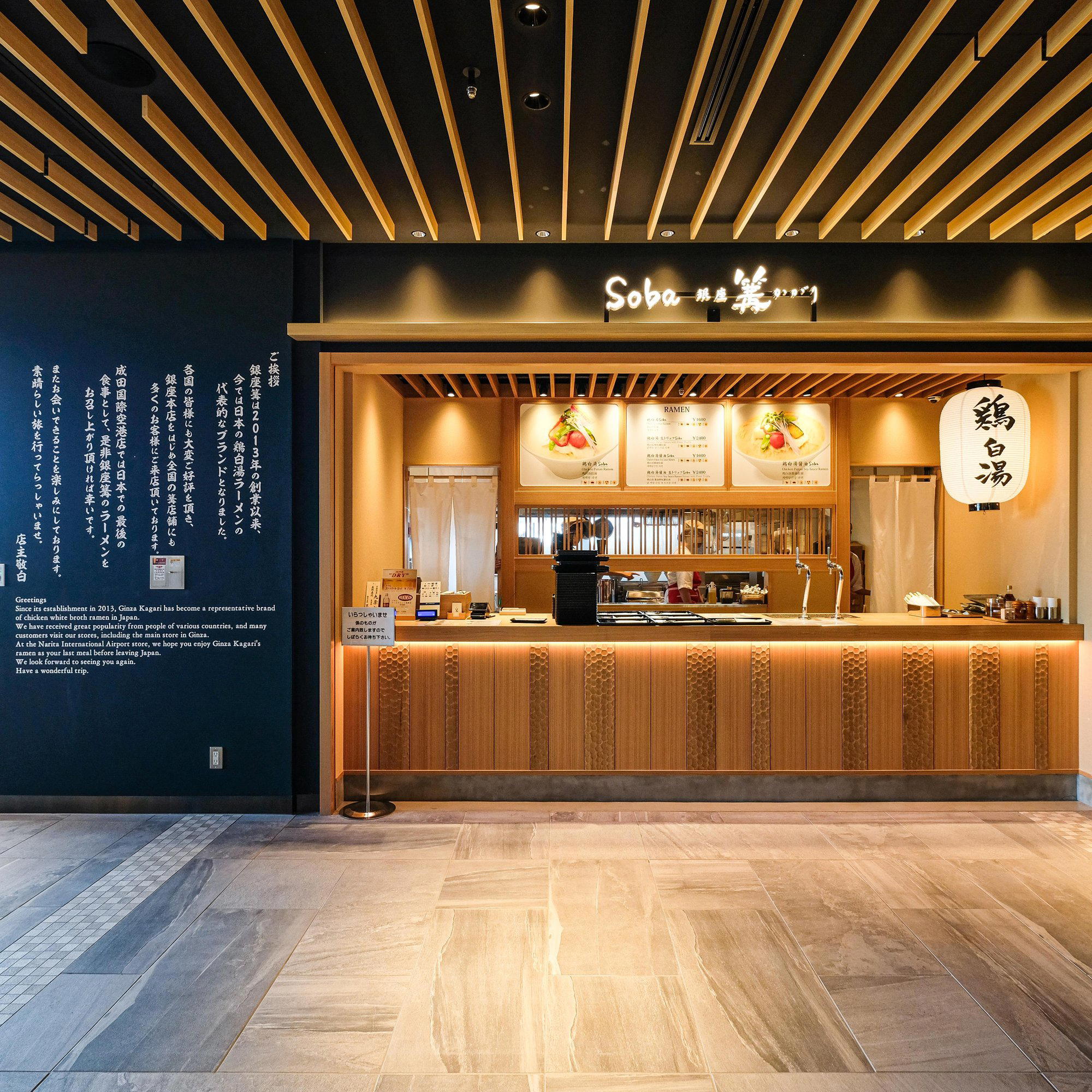
Ginza Kagari sits inside Narita Airport's Terminal 2 Japan Food Hall, bringing the refined chicken-broth ramen tradition that made the Tokyo original a destination counter to one of Asia's busiest transit hubs. For travellers with a layover and a serious appetite, it represents a direct line to a bowl that earned its reputation in one of the world's most competitive ramen markets.

Pearl is the En Primeur Club membership app, where members save venues, book tables and use the concierge.
The menu
What to order
- Tori Paitan Ramen
- Chicken White Soup Soba
- Chicken White Broth Soy Sauce Soba
Ramen at 30,000 Feet, Before You Even Board
Terminal dining at major airports has spent the last decade sorting itself into two tiers: the generic food-court fill-up and the deliberate import of a city's actual dining culture. Narita Airport's Terminal 2 Japan Food Hall sits firmly in the second category, and within that hall, Ginza Kagari occupies a specific position, a counter whose reputation was built not in a transit hub but on one of the most competitive restaurant streets in Tokyo.
The context matters. Ginza, as a dining address, filters out average operators by sheer rent and competition. Ramen houses that survive and build reputation there are not doing so on novelty. Kagari's Tokyo original developed a following around a chicken-based broth at a time when tonkotsu and soy-heavy broths dominated serious ramen conversation. That the brand now appears in the Japan Food Hall at Narita is less a sign of airport-casual compromise than a recognition that transit volume creates a large audience that might otherwise never reach the Tokyo counter.
The Sourcing Question: Why Chicken Broth Signals Restraint
The ingredient angle at Kagari requires some unpacking. In Japan's ramen hierarchy, chicken-based broths, particularly the tori paitan style, which renders poultry fat into a pale, dense, almost cream-coloured liquid, represent a different sourcing logic than pork-bone tonkotsu. Chicken broth of this calibre depends heavily on the quality and age of the bird, the fat content of the skin, and the duration and temperature of the cook. There is no masking low-quality chicken with seasoning in the same way that a bold soy tare can compensate for a thin pork broth.
Japan's poultry sourcing tradition includes regional breeds, Nagoya Cochin, Satsuma Jidori, and Chiba's own local chicken production, that produce fat-to-protein ratios suited to this style of broth. The airport location, drawing on regional supply chains that feed greater Tokyo and Chiba Prefecture, places Kagari in a geography where ingredient access is not a limiting factor. What distinguishes a serious chicken-broth counter from a middling one is not sourcing geography alone but the discipline of the cook: stock reduction times, skimming, and the ratio of bones to water are where the product is actually made.
For travellers accustomed to judging ramen primarily by noodle gauge or tare intensity, the Kagari-style broth is an education in what restraint achieves when the primary ingredient is high quality. It reads clean on the palate in a way that heavier broths do not, which also makes it more forgiving as airport food, unlikely to sit heavily on a long flight.
The Japan Food Hall Format and What It Means in Practice
The Japan Food Hall at Terminal 2 is one of the more coherent examples of airport dining curation in Asia. Rather than a single anchor restaurant, the hall assembles several Japanese food operations in a shared space, allowing travellers to encounter a cross-section of Japanese dining formats in one pass. The format favours counter seating and quick-service operations, which works in Kagari's favour, ramen is structurally a counter-dining proposition, and the bowl-to-departure-gate logic is direct.
Compared to the other ramen options available to Narita-bound travellers, Kagari occupies a different register. Ippudo brings its well-documented Hakata tonkotsu lineage to the airport, while Japanese Ramen Tomita represents the Chiba ramen tradition with a different broth philosophy. The choice between them is a choice between styles and culinary genealogies, not quality tiers. For travellers who have eaten at Ippudo's international locations and want something that reads more specifically Japanese in its restraint, Kagari's chicken broth offers a contrast worth seeking out.
Beyond ramen, the Narita dining scene within the terminal extends to other formats worth noting. Kikukawa represents the unagi tradition, Saboten covers the tonkatsu category, and Mitsumoto Tei offers a different set of Japanese comfort-food formats. The full range of what the airport supports is covered in our full Narita restaurants guide.
Placing Kagari in the Wider Japanese Dining Map
Airport outposts of serious Tokyo restaurants function as a kind of sampling mechanism for Japan's broader dining culture. A traveller passing through Narita and eating at Kagari is, in effect, accessing a product that connects to Tokyo's intensely competitive ramen scene, a scene that also exists in the same country as destination restaurants like HAJIME in Osaka, Gion Sasaki in Kyoto, and Harutaka in Tokyo. Those are different formats and different price categories, but they share the same cultural seriousness about ingredient quality and technique that Kagari's broth-first philosophy reflects.
Japan's ramen culture is sometimes misread abroad as casual and interchangeable. At the serious end of the Tokyo counter scene, it is neither. The Kagari airport location is leading understood as evidence of what happens when that seriousness scales into a higher-volume format: the broth discipline has to hold, or the brand reputation built in Ginza collapses. That pressure is, in its own way, a quality guarantee, one that transit dining elsewhere rarely offers.
Further afield, venues like Abon in Ashiya, affetto akita in Akita, Aji Arai in Oita, Ajidocoro in Yubari District, and Akakichi in Imabari illustrate how deeply regional specificity runs in Japanese food culture. By contrast, international reference points like Le Bernardin in New York City or Lazy Bear in San Francisco show how similarly ingredient-led philosophies operate in entirely different cultural and economic contexts.
Planning Your Visit
Frequently asked questions
Is Ginza Kagari (銀座 篝) good for families?
The Japan Food Hall format at Narita Terminal 2 is open and low-pressure, which suits families travelling with children. Ramen is a broadly accessible format in Japanese dining, and the counter-style setup at Kagari does not require extended sitting time. That said, the venue is inside a secured departures area, so access requires a valid boarding pass for Terminal 2.
Is Ginza Kagari (銀座 篝) formal or casual?
Kagari at Narita sits firmly on the casual end of the spectrum. It operates as part of the Japan Food Hall within Terminal 2 at 三里塚御料牧場1-1, a curated airport dining zone rather than a standalone restaurant. Expect counter seating and a focused menu rather than tablecloths or lengthy service rituals.
Is Ginza Kagari at Narita Airport the same as the original Ginza location in Tokyo?
The Narita Terminal 2 outpost shares the tori paitan identity of the original Ginza 篝, which built a following in Tokyo for its chicken-based broth ramen. Airport placements of this kind function as accessible sampling points for travellers who won't make it to the source restaurant in Ginza.
What's the signature dish at Ginza Kagari (銀座 篝)?
Kagari built its Tokyo reputation on tori paitan, a rich, opaque chicken broth ramen that sits apart from the pork-heavy tonkotsu style dominant in many ramen chains. The Narita Terminal 2 location carries this same identity, making it the reference point for anyone who wants to understand what the Japan Food Hall outpost is actually about.
What part of town is Ginza Kagari (銀座 篝) in?
Ginza Kagari (銀座 篝) is located at 三里塚御料牧場1-1 (第2ターミナル/JAPAN FOOD HALL), 成田市, 千葉県, 282-0004, Narita.
Quick Comparison
| Venue | Cuisine | Price |
|---|---|---|
| Ginza Kagari (銀座 篝)This venue (the venue you are viewing) | Chicken Paitan Ramen | $10–20 |
| Ippudo (一風堂) | Tonkotsu Ramen | $10–20 |
| Japanese Ramen Tomita (日本の中華そば富田) | Japanese Ramen and Tsukemen | $10–20 |
| Kikukawa (うなぎ四代目菊川) | Traditional Japanese Unagi (Grilled Eel) | $30–50 |
| Mitsumoto Tei (三本亭) | Yoshoku (Japanese Western Cuisine) | $20–30 |
| Saboten (新宿さぼてん) | Tonkatsu (Japanese Pork Cutlet) | $10–20 |
Continue exploring
More in Narita
Details
- Intimate
- Classic
- Solo
- Casual Hangout
- After Work
- Open Kitchen
- Local Sourcing
- Counter Dining
- A La Carte
- Vegetarian Friendly
- Pescatarian Friendly
Intimate hidden alley setting with a small Japanese restaurant atmosphere; modest exterior belying its culinary reputation; consistently busy with long queues.