Our verdict
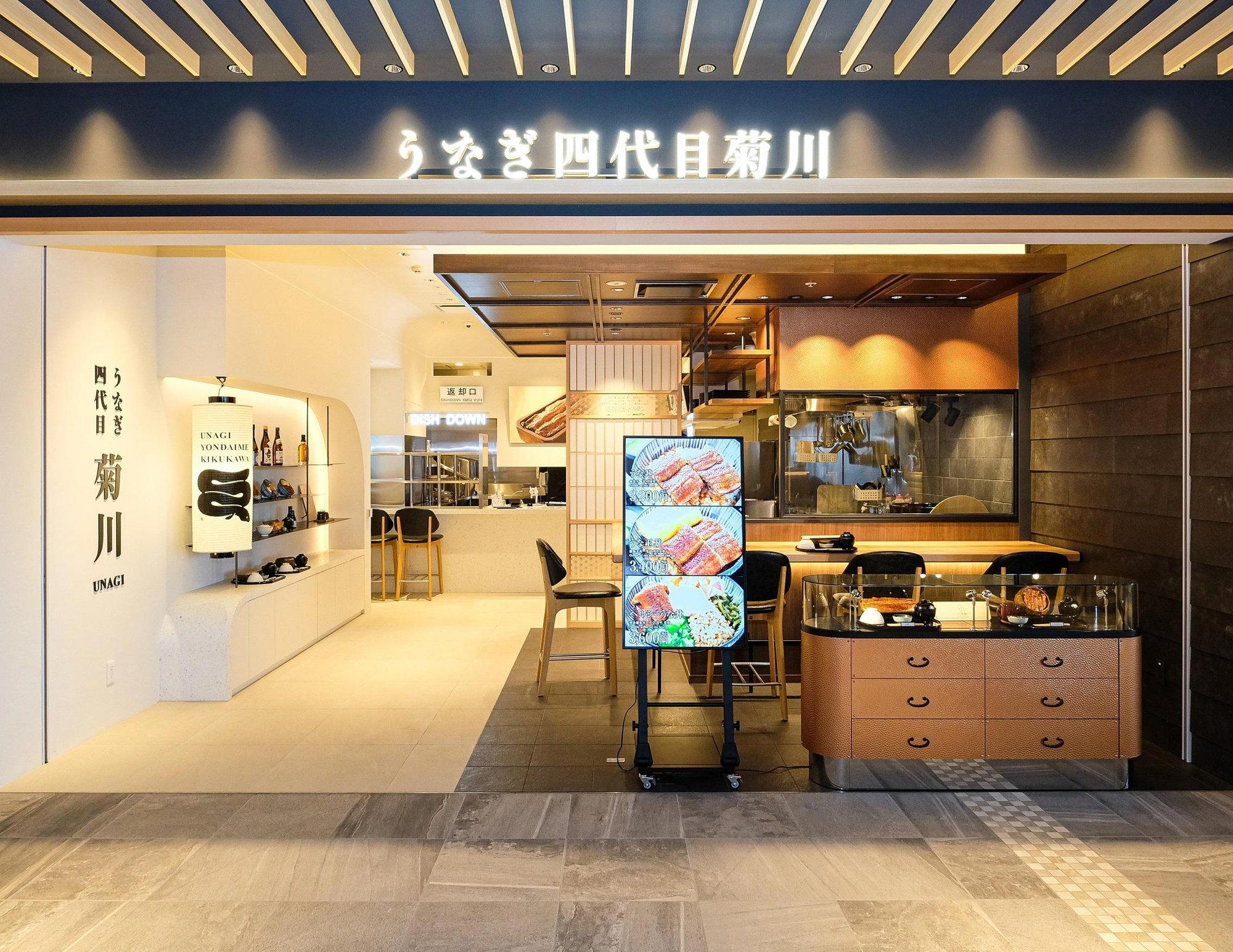
Kikukawa (うなぎ四代目菊川) brings a four-generation unagi tradition to Narita Airport's Terminal 2 Japan Food Hall, making it one of the few places in the airport complex where a deeply rooted Japanese culinary craft is available to travellers in transit. The format suits both solo diners and small groups pausing between flights, with grilled freshwater eel as the central focus.

Pearl is the En Primeur Club membership app, where members save venues, book tables and use the concierge.
The menu
What to order
- Ippon Unagi
- Hitsumabushi
Unagi at the Airport: Where a Craft Tradition Meets the Transit Corridor
Most airport dining operates on a logic of volume and speed, optimised for turnover rather than craft. Japan Food Hall at Narita's Terminal 2 is a deliberate exception to that pattern. The hall gathers a curated set of regional Japanese restaurant concepts under one roof, and within that format, Kikukawa (うなぎ四代目菊川) occupies a specific and culturally weighted position: it is an unagi-ya, a restaurant dedicated to the preparation and service of freshwater eel, a culinary tradition that carries centuries of craft history in Japan and sits at the more considered end of what the Japan Food Hall offers.
The name itself signals lineage. 四代目 means "fourth generation," and in Japanese food culture, generational continuity is a form of credential. Techniques for handling, splitting, and grilling eel, along with the preparation of the tare sauce that glazes it, are passed within families and houses over decades. That inheritance is what separates a specialist unagi-ya from a general Japanese restaurant that happens to serve eel. Arriving at an airport version of such a restaurant, the reasonable question is how faithfully that craft translates into a transit context. The Japan Food Hall format, which places multiple specialist concepts in a shared environment, has a track record in Japan of maintaining reasonable fidelity to the parent dining tradition while adapting for accessibility.
The Craft Behind the Counter: What Unagi Actually Means
Freshwater eel, prepared as unaju (eel over rice in a lacquered box) or unadon (eel over rice in a bowl), has been a fixture of Japanese summer dining since at least the Edo period, when it was associated with stamina and recovery from heat. The preparation process is labour-intensive in ways that most diners outside Japan do not encounter: eel is split, skewered, steamed (in the Kanto tradition), and then grilled over charcoal, with repeated basting in tare, a reduction of soy, mirin, and sake that darkens and concentrates over years of continuous use in a working kitchen. The depth of that tare, built up over time, is one of the primary ways that long-established unagi restaurants distinguish themselves from newer entrants.
A fourth-generation house implies that the tare, the technique, and the sourcing relationships have been refined across roughly a century of operation, depending on when the lineage was established. That depth is what makes the generational framing meaningful rather than merely decorative. For travellers who have eaten at dedicated unagi restaurants in Tokyo or Nagoya, where the category commands serious attention and long queues, the Kikukawa format at Narita represents a more accessible entry point to the same culinary tradition. For those encountering unagi for the first time, the airport setting removes some of the formality that can make specialist Japanese restaurants feel opaque to non-Japanese diners.
Terminal 2, Japan Food Hall: Reading the Setting
The address, 三里塚御料牧場1-1, places Kikukawa within the Terminal 2 landside or airside food hall complex at Narita International Airport. Japan Food Hall aggregates multiple restaurant concepts in a format that functions somewhere between a curated food court and a standalone dining destination. Other operators in comparable Narita food hall environments include Ginza Kagari (銀座 篝), known for its chicken broth ramen, Ippudo (一風堂) with its Hakata-style tonkotsu, Japanese Ramen Tomita (日本の中華そば富田), Mitsumoto Tei (三本亭), and Saboten (新宿さぼてん) for tonkatsu.
The shared-hall environment means the physical experience differs from a standalone unagi-ya in a Tokyo neighbourhood, where the smell of charcoal and grilling eel announced the restaurant from the street and the dining room carried the quiet formality of a specialist house. Here, the context is transit: fellow diners are likely a mix of Japanese domestic travellers, international visitors making a final meal before departure, and airport staff. The food hall format is well suited to solo dining, a practical consideration given that traditional unagi restaurants often skew toward set menus designed for individual portions anyway.
Planning a Meal at Kikukawa
No booking data, hours, or pricing information is confirmed in the EP Club database for Kikukawa at Narita, which is typical for airport food hall operators where walk-in service is the standard format and advance reservations are rarely required or offered. Visitors should treat this as a walk-in proposition, factoring in that peak transit periods, particularly morning departure rushes and afternoon international connection windows, will see higher foot traffic across all Japan Food Hall operators. Arriving at an off-peak window, mid-morning or mid-afternoon, generally gives more comfortable access to seating and service across food hall environments of this type.
For travellers planning a broader itinerary through Japan's dining culture, Narita sits at the entry point of a country with one of the most documented and decorated restaurant scenes in the world. Properties like HAJIME in Osaka, Harutaka in Tokyo, and Gion Sasaki in Kyoto represent the formal, reservation-dependent tier of Japanese dining, while regional specialists like akordu in Nara and Goh in Fukuoka illustrate how the country's culinary range extends well beyond its major cities. Kikukawa at Narita functions as a practical, culturally grounded first or last meal for that broader journey, not a destination in isolation. For those building a more complete picture of the airport's dining options, our full Narita restaurants guide maps the category across price points and formats.
Beyond Japan, EP Club covers specialist dining across international markets, from Le Bernardin in New York City to Atomix in New York City, and regional Japanese specialists including 一本木 in Nanao, 古仁屋山乃 in Sapporo, 湖畔荘 in Takashima, 庄羽屋 in Nishikawa Machi, and Birdland in Sakai.
Frequently asked questions
Is Kikukawa (うなぎ四代目菊川) a family-friendly restaurant?
Kikukawa sits within Japan Food Hall at Narita Terminal 2, a food hall format that tends to be open, accessible, and low on formality, conditions that generally suit families in transit. The unaju and unadon format, rice-based and served in single portions, is approachable for children.
What's the vibe at Kikukawa (うなぎ四代目菊川)?
The setting is Japan Food Hall inside Narita's Terminal 2, a curated airport food hall concept that sits closer to a specialist dining precinct than a standard departure-lounge canteen. Kikukawa's focus on a single craft tradition, unagi, keeps the counter specific and purposeful rather than generalist. Expect a functional, food-forward atmosphere calibrated for travellers who want something substantive before a flight.
Is Kikukawa at Narita Airport open to departing and arriving passengers?
Airport food hall positions in Terminal 2 vary by operator, so confirming access before clearing immigration or security is worth doing if you are arriving rather than departing.
What's the must-try dish at Kikukawa (うなぎ四代目菊川)?
Kikukawa is an unagi specialist, so the central order is either unaju, grilled freshwater eel over rice served in a lacquered box, or unadon, the same combination in a bowl. These two formats define the restaurant's entire identity, and ordering anything else would miss the point of the counter entirely.
What's Kikukawa (うなぎ四代目菊川)'s location?
Kikukawa (うなぎ四代目菊川) is located at 三里塚御料牧場1-1 (第2ターミナル/JAPAN FOOD HALL), 成田市, 千葉県, 282-0004, Narita.
What's the best way to book Kikukawa (うなぎ四代目菊川)?
Airport food hall operations at Narita Terminal 2 typically function on a walk-in basis, so arrival timing relative to your flight is the main variable to plan around. Checking the Narita International Airport official site for Japan Food Hall operating hours before travel is advisable.
What's the signature at Kikukawa (うなぎ四代目菊川)?
The name itself answers the question: 四代目 means fourth generation, positioning unagi preparation as the inherited craft that defines the restaurant's identity. Unaju, eel lacquered with tare sauce, grilled over charcoal, and laid over steamed rice in a bento-style box, is the format this lineage is built around. That generational framing separates Kikukawa from generic airport dining in a way that a single-location concept cannot replicate.
A Pricing-First Comparison
| Venue | Cuisine | Price |
|---|---|---|
| Kikukawa (うなぎ四代目菊川)This venue (the venue you are viewing) | Traditional Japanese Unagi (Grilled Eel) | $30–50 |
| Ippudo (一風堂) | Tonkotsu Ramen | $10–20 |
| Ginza Kagari (銀座 篝) | Chicken Paitan Ramen | $10–20 |
| Mitsumoto Tei (三本亭) | Yoshoku (Japanese Western Cuisine) | $20–30 |
| Japanese Ramen Tomita (日本の中華そば富田) | Japanese Ramen and Tsukemen | $10–20 |
| Saboten (新宿さぼてん) | Tonkatsu (Japanese Pork Cutlet) | $10–20 |
Continue exploring
More in Narita
Details
- Classic
- Solo
- Business Dinner
- Sake Program
- A La Carte
- Sake
Airport food court setting with a focus on traditional Japanese eel grilling, offering a classic and authentic atmosphere amid the bustle of international travel.