de zoute kater
De Zoute Kater occupies a quiet address on Zoutmanstraat in The Hague's Zeeheldenkwartier, a neighbourhood that has steadily drawn the city's more considered dining options away from the tourist-facing centre. With a name that translates loosely as 'the salty hangover,' the venue signals a certain wry self-awareness that sets a tone before you've ordered anything. It sits in a tier of The Hague's neighbourhood restaurants defined less by formal accolades than by local reputation and repeat custom.
Pearl is the En Primeur Club membership app — saves, bookings, and concierge access live there. Same editors, same standards.
- Address
- Zoutmanstraat 53C, 2518 GM Den Haag, Netherlands
- Phone
- +31641485993
- Website
- dezoutekater.nl
- Directions
- Get directions
 Saves & bookings on Pearl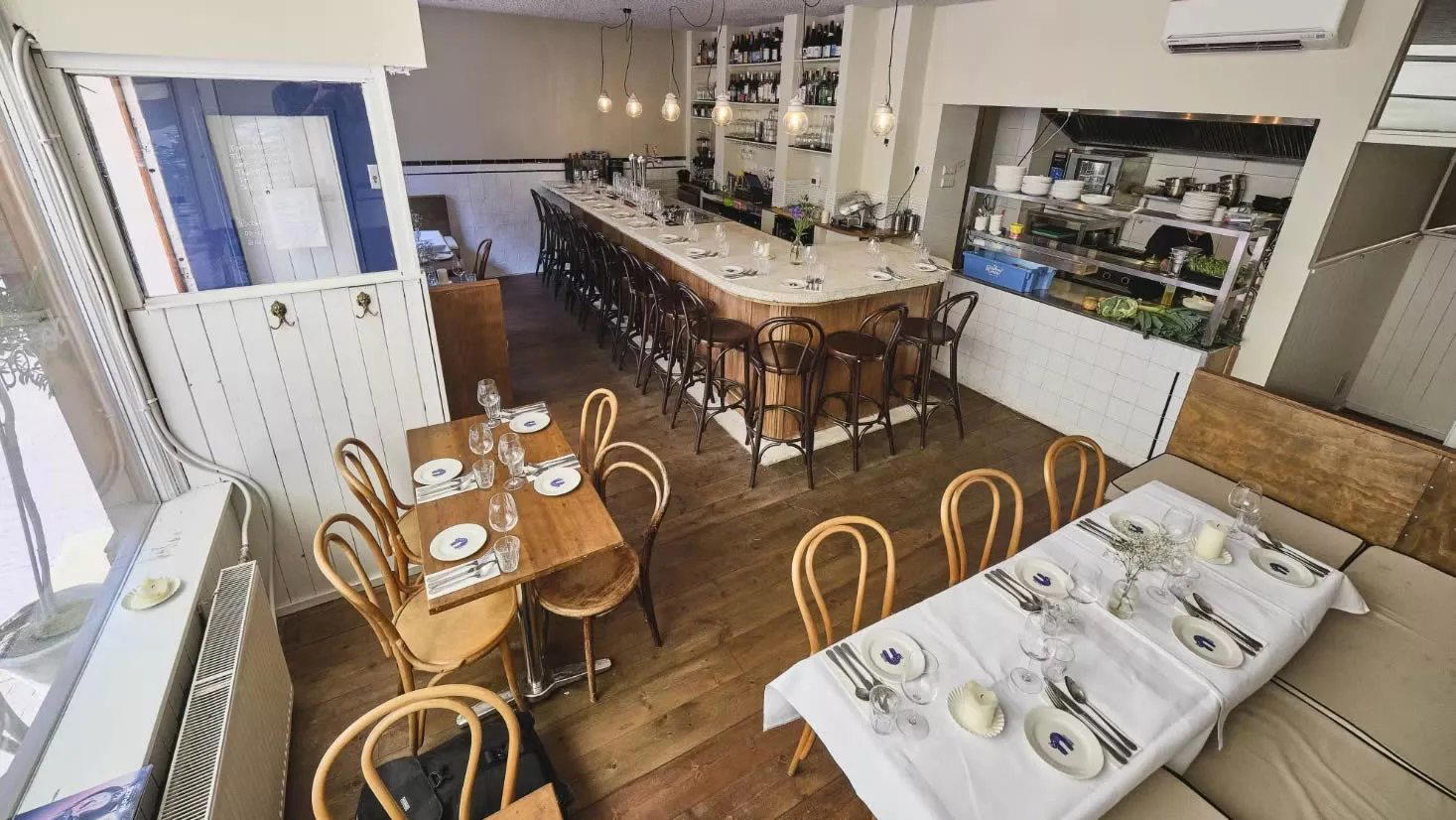
A Street-Level Proposition in the Zeeheldenkwartier
The Zeeheldenkwartier, the 'Sea Heroes Quarter', has become one of The Hague's more reliable stretches for neighbourhood dining that operates outside the diplomatic-circuit formality that defines much of the city's restaurant trade. Zoutmanstraat runs through its quieter edge, and it is here that De Zoute Kater has established itself as part of a small cohort of venues whose following is built on word-of-mouth rather than award-season momentum. The name itself, a Dutch phrase carrying connotations of salty excess and the morning after, positions the place deliberately outside the earnest fine-dining register. That tonal choice is an editorial statement as much as a branding decision.
The Hague's dining scene has historically operated in the shadow of Amsterdam and Rotterdam, but that position has generated a kind of productive independence. While Amsterdam's restaurant economy has tilted toward international visibility and Rotterdam's has leaned into architectural swagger, The Hague's better neighbourhood spots have doubled down on the kind of consistent, locally-rooted cooking that doesn't require a press cycle to stay full. De Zoute Kater sits inside that pattern.
The Arc of an Evening: How the Meal Tends to Move
Neighbourhood restaurants in this part of The Hague tend to structure their evenings around a rhythm that resists the formal tasting-menu architecture you'd find at the city's upper tier. At Calla's, the Creative French format at the €€€€ level demands a certain deliberate pacing, courses announced, wines matched, the occasion foregrounded. De Zoute Kater operates in a different register entirely. The progression here is less about orchestration and more about accumulation: the kind of meal where the next thing arrives before you've quite finished deciding what you thought of the last.
That approach to sequencing, looser in structure, denser in sociability, characterises a broader movement in Dutch neighbourhood dining. The influence of the Dutch 'eetcafé' tradition, in which the boundary between drinking and eating is deliberately blurred, runs through venues like this. The meal doesn't have a defined opening chapter and a closing one so much as a continuous middle, punctuated by whatever the kitchen is running that evening. It is a format that suits the Zeeheldenkwartier's demographic well: the neighbourhood draws residents rather than occasion diners, and residents want to eat well without the apparatus of ceremony.
For comparison, Basaal at the €€ level approaches seasonal cuisine with a somewhat more composed hand, while 6&24 in the Modern Cuisine bracket occupies a middle ground between the neighbourhood and the formal. The restaurant's positioning, by contrast, leans toward the convivial end of that spectrum, a place where the meal's arc is shaped as much by the table's mood as by the kitchen's sequence.
The Wider Dutch Context: Where Province Meets City
It is worth situating the restaurant within the broader geography of Dutch dining, because The Hague's neighbourhood restaurants exist in a country where particularly technically rigorous cooking happens well outside the major cities. De Librije in Zwolle and Inter Scaldes in Kruiningen operate at a level of formal ambition that defines one end of the Dutch spectrum. De Nieuwe Winkel in Nijmegen and De Lindenhof in Giethoorn represent the provincial fine-dining tradition. Venues such as Tribeca in Heeze, De Groene Lantaarn in Staphorst, Brut172 in Reijmerstok, De Lindehof in Nuenen, De Bokkedoorns in Overveen, and De Treeswijkhoeve in Waalre each anchor a regional identity that feeds national dining culture from the periphery inward.
Against that backdrop, a venue like De Zoute Kater occupies the urban neighbourhood tier: not chasing provincial prestige, not playing for international coverage, but functioning as the kind of place that a city's own residents consider theirs. Internationally, that role is filled by venues with different stylistic profiles, Le Bernardin in New York City and Lazy Bear in San Francisco each represent formalized versions of communal dining ambition at far greater scale and visibility, but the underlying instinct, feeding a local community with conviction, connects across price tiers and continents.
Neighbourhood Peers and How to Place De Zoute Kater
Within The Hague specifically, the more useful peer references are the venues that serve a similar residential function. Bistro Veen and Botanica occupy adjacent positions in the city's neighbourhood-dining fabric, each with a slightly different tonal register. The Zeeheldenkwartier's dining options collectively form a counter-narrative to the more formal addresses clustered around the Binnenhof and the diplomatic quarter: less ceremony, more consistency, and a working assumption that the people at the table already know what they want.
The restaurant's address on Zoutmanstraat 53C places it at the residential heart of that neighbourhood. Getting there is direct by tram from The Hague Centraal, and the street itself rewards the kind of unhurried arrival that suits the venue's character. Evenings tend to fill with local regulars, which means early or off-peak visits are more likely to yield the unhurried pace that suits the venue.
Planning a Visit
Reservations are recommended. Visitors arriving in The Hague specifically to eat should factor the restaurant into an evening that begins or ends in the Zeeheldenkwartier, pairing it with a walk through a neighbourhood whose independent character remains intact despite the city's broader development pressures.
Credentials Lens
Comparable venues nearby, for context on price, style, and recognition.
| Venue | Cuisine | Price | Notes |
|---|---|---|---|
| de zoute katerThis venue — the venue you are viewing | Seasonal Fusion Bistro | $$$ | Not listed |
| Dekxels | Asian-Mediterranean Fusion Small Plates | $$$ | Voorhout |
| Café Restaurant Flora | Seasonal Modern European | $$$ | Den Haag (The Hague) |
| Oker | Asian-inspired Fusion Small Plates | $$ | Voorhout |
| Cottontree City by Dimitri | Contemporary French Bistro | $$$ | Voorhout |
| Restaurant Bogor | Authentic Indonesian | $$ | quiet neighbourhood |
Continue exploring
More in The Hague
Restaurants in The Hague
Browse all →
Bars in The Hague
Browse all →
Hotels in The Hague
Browse all →
Wineries in The Hague
Browse all →
At a Glance
- Trendy
- Intimate
- Cozy
- Date Night
- Casual Hangout
- Open Kitchen
- Natural Wine
- Local Sourcing
- Organic
Current opening hours
- Monday
- 6 PM–12 AM
- Tuesday
- Closed
- Wednesday
- 6 PM–12 AM
- Thursday
- 6 PM–1 AM
- Friday
- 6 PM–1 AM
- Saturday
- 6 PM–1 AM
- Sunday
- 6 PM–12 AM
Hours can change for holidays and private events. Last verified .
Intimate setting radiating good energy with a focus on local, seasonal ingredients.