Café Restaurant Flora

Set inside a converted telephone exchange building in The Hague's Frederiksdorp quarter, Café Restaurant Flora shares its address with an art cinema, placing it firmly in the city's cultural rather than strictly gastronomic circuit. The combination of wide, open interiors and an arts-adjacent crowd gives it a character distinct from the tighter fine-dining rooms elsewhere in Den Haag.
Pearl is the En Primeur Club membership app — saves, bookings, and concierge access live there. Same editors, same standards.
- Address
- De Constant Rebecquestraat 55, 2518 RC Den Haag, Netherlands
- Phone
- +31 6 35689214
- Website
- caferestaurantflora.nl
- Directions
- Get directions
 Saves & bookings on Pearl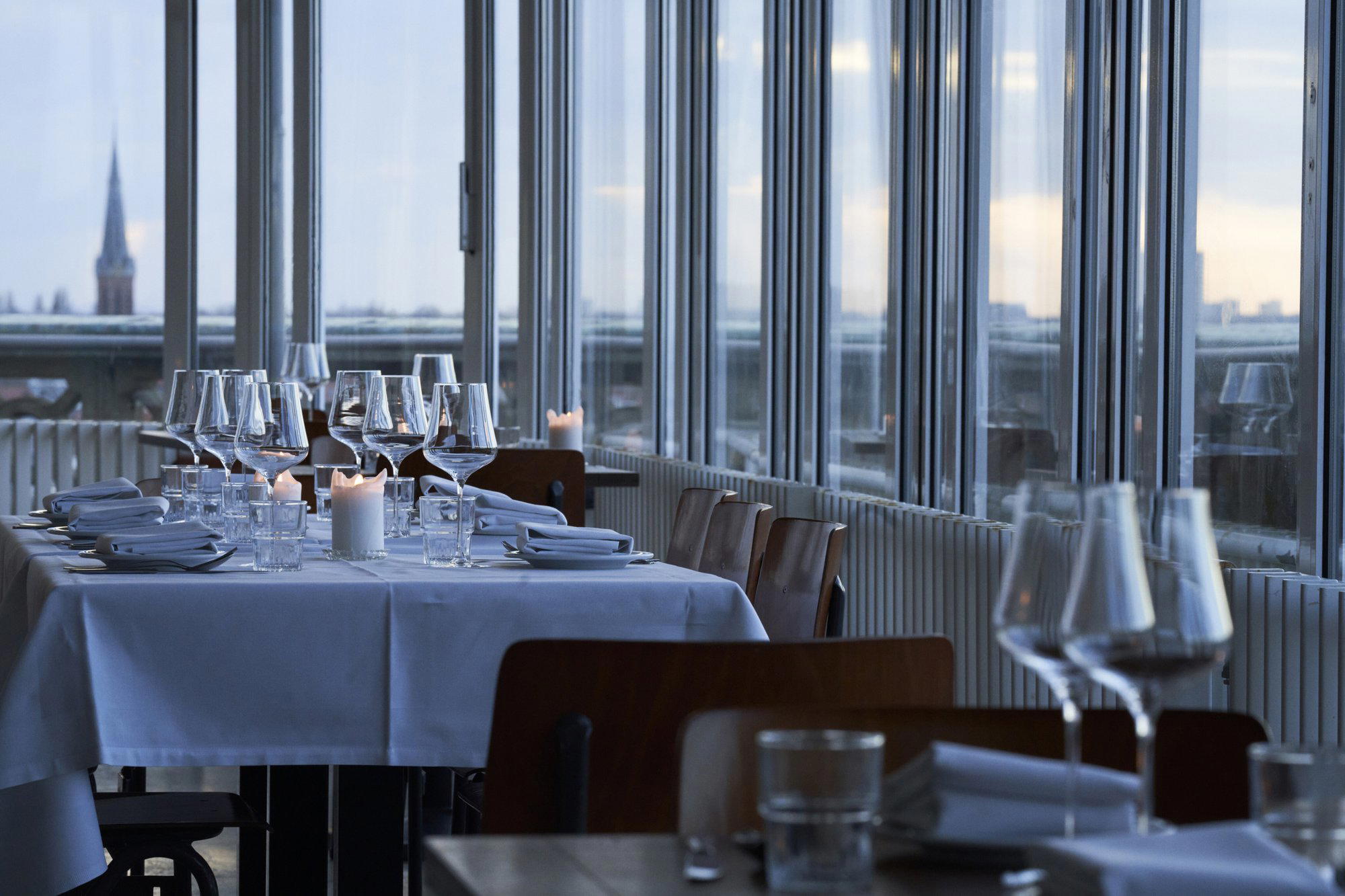
A Building That Sets the Tone
The Hague's dining scene has long operated in the shadow of Amsterdam's restaurant density and Rotterdam's industrial-cool credentials. What it has developed instead is a quieter, more considered set of venues that reward local knowledge over trend-following. Café Restaurant Flora sits inside that pattern, and its address tells you most of what you need to know before you've ordered anything.
The building is a former telephone exchange factory in the De Constant Rebecquestraat, a street that sits between the diplomatic corridor and the older residential fabric of the Frederiksdorp neighbourhood. The structure's industrial bones, high ceilings, generous floor plates, materials that predate the renovation economy, give the interior a different spatial logic than the compact Dutch townhouse dining rooms that define much of the city's restaurant stock. An art cinema occupies part of the same building, and the relationship between the two is more than symbolic. The crowd that arrives for a screening and stays for dinner, or reverses that sequence, shapes the atmosphere in ways that a standalone restaurant seldom achieves. Cultural venues and food venues have always fed each other in European cities; here the proximity is literal.
What Den Haag's Mid-Tier Does Well
City's restaurant market has developed a competent mid-tier that doesn't require Michelin validation to justify its prices. Basaal anchors the seasonal end of that bracket; Bøg pushes into creative territory at a similar price point. At the higher end, Calla's operates in the Creative French register at the summit of the city's price range, and 6&24 covers Modern Cuisine in the middle tier. Flora sits within this local ecosystem, drawing from a neighbourhood catchment that skews culturally literate rather than expense-account driven.
That positioning matters for context. The Hague has historically been more a city of institutions, international courts, government ministries, diplomatic missions, than a city of food culture. The restaurant infrastructure has evolved to serve that population but has increasingly developed venues that reflect the resident creative class rather than the visiting diplomat. Flora is part of that second wave, and its co-habitation with a cinema is the clearest architectural statement of where its loyalties lie.
The Cultural Roots of the Café-Restaurant Format
The café-restaurant as a format has deep roots in Dutch urban culture, distinct from the brown café (bruine kroeg) at one end and the formal restaurant at the other. It occupies the middle ground where lingering is expected, where a single glass of wine is as acceptable as a three-course dinner, and where the room is designed for extended occupation rather than efficient table turns. In cities like Amsterdam and Rotterdam, this format has been refined into a reliable urban institution. In The Hague, the tradition has been slower to develop at scale, which is part of why Flora's reception, described in early public commentary as filling a gap the city had long needed to fill, carries weight.
The wide interior referenced in early coverage aligns with this format's spatial requirements. A café-restaurant needs room to breathe, for groups to gather without pressing against neighbouring tables, for the bar to function independently from the dining floor, for the energy to settle at different registers across different corners of the room. Industrial conversions suit this format well, and the telephone exchange building provides the kind of uninterrupted square footage that converted warehouses and factory floors consistently deliver.
For comparison, some of the Netherlands' most discussed restaurant addresses involve similar adaptive reuse: venues where the building's previous life adds interpretive depth to the experience. De Librije in Zwolle occupies a former city library; Brut172 in Reijmerstok works within an older rural structure. The architecture becomes part of the proposition. At Flora, the former exchange building does similar work, lending the space a sense of place that purpose-built restaurant rooms rarely achieve.
Placing Flora in Its Dutch Context
The Netherlands' serious dining sits largely outside The Hague. Ciel Bleu in Amsterdam and Aan de Poel in Amstelveen represent the Michelin tier; De Bokkedoorns in Overveen and 't Nonnetje in Harderwijk extend the high-end geography further. Den Haag has not yet produced a comparable anchor, which means its better casual and mid-level venues carry proportionally more of the city's dining identity than they would in a city with a deeper fine-dining infrastructure.
Flora, as a cultural-destination café-restaurant rather than a tasting-menu operation, operates in a different part of that identity. It is not competing with the Michelin-tier addresses elsewhere in the Netherlands any more than a well-run Paris brasserie competes with its arrondissement's three-star tables. The comparison set is local and format-specific: venues in The Hague that serve a culturally engaged, neighbourhood-based crowd in a space worth spending time in. Against that comparable set, the converted telephone exchange with an art cinema upstairs is a structural advantage.
Internationally, the model has parallels. Emeril's in New Orleans built its early reputation partly on a similarly charged cultural neighbourhood proposition, and Le Bernardin in New York City demonstrates how a room's physical gravity can anchor a dining identity across decades. The scale and ambition differ; the principle, that a venue's spatial and cultural context shapes the experience as much as the kitchen, does not.
Planning a Visit
The De Constant Rebecquestraat address sits within walking distance of The Hague's central tram network, making it accessible from the city centre without requiring specific navigation. Given the building's dual function as cinema and restaurant, timing a visit to coincide with a screening upstairs can extend the evening and deepen the venue's cultural logic. For broader orientation across the city's food and hospitality options, the full The Hague restaurants guide maps the current scene by format and price tier. Complementary resources include the The Hague bars guide, the hotels guide, the wineries guide, and the experiences guide for the wider city.
Current hours and booking details are available from the venue directly. Also worth noting: Bouzy operates nearby and offers a complementary evening option if Flora's capacity is limited on a given night.
Price and Recognition
Comparable venues nearby, for context on price, style, and recognition.
| Venue | Cuisine | Price | Notes |
|---|---|---|---|
| Café Restaurant FloraThis venue — the venue you are viewing | Not listed | $$$ | Not listed |
| Silvi Gastrobar | Not listed | $$$ | The Hague, Mediterranean Shared Dining Gastrobar |
| De Kwartel | Not listed | $$ | Zuiderstrand, Dutch Beach Pavilion with Seafood |
| Walter Benedict | Denneweg, French Bistro & Brasserie | $$ | Not listed |
| CRU | Scheveningen, Modern French Fine Dining | $$$$ | Not listed |
| Harpoon | Noordeinde, Modern Seafood Bistro | $$ | Not listed |
Recognition history
Dated appearances from independent guides and award organizations, with the underlying list record or original source where available.
Star Wine List
Star Wine List
Continue exploring
More in The Hague
Restaurants in The Hague
Browse all →
Bars in The Hague
Browse all →
Hotels in The Hague
Browse all →
Wineries in The Hague
Browse all →
At a Glance
- Scenic
- Modern
- Cozy
- Elegant
- Date Night
- Casual Hangout
- After Work
- Terrace
- Panoramic View
- Historic Building
- Rooftop
- Natural Wine
- Craft Cocktails
- Local Sourcing
- Organic
- Skyline
- Waterfront
Current opening hours
- Monday
- 2:30 PM–12 AM
- Tuesday
- 2:30 PM–12 AM
- Wednesday
- 2:30 PM–12 AM
- Thursday
- 2:30 PM–12 AM
- Friday
- 12 PM–1 AM
- Saturday
- 12 PM–1 AM
- Sunday
- 12–10 PM
Hours can change for holidays and private events. Last verified .
Bright, airy, and suspended-in-time atmosphere with abundant natural light from expansive glass walls; elegant yet informal with a modern sensibility and warm, welcoming energy.