
Dashin Soan places Tokyo’s soba ritual in a quieter Setagaya register, away from the city’s counter-dining arms race. Its Tabelog 100 Soba EAST 2025 selection, 50-seat format, tatami room, sake and shochu program, and long-running presence since 2006 point to a serious buckwheat house built for paced meals rather than quick noodle turnover.
Pearl is the En Primeur Club membership app — saves, bookings, and concierge access live there. Same editors, same standards.
- Address
- 3 Chome-7-14 Daizawa, Setagaya City, Tokyo 155-0032, Japan
- Phone
- +81 3-5431-0141
- Website
- dashinsoan.jp
 Saves & bookings on Pearl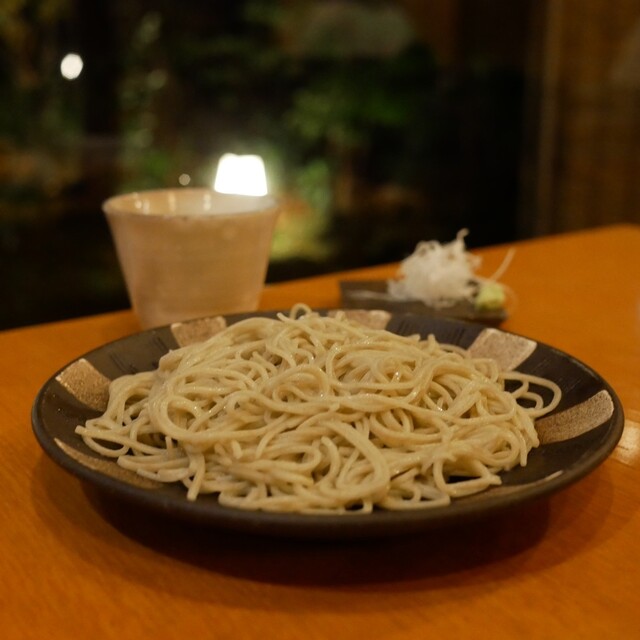
A serious soba meal in Tokyo is quieter than the theatre around sushi or kappo. The room matters not as decoration, but because tables, tatami, smoke-free air, and space for families or small groups turn buckwheat noodles from fast lunch into a measured meal. In Setagaya, near the Shimokitazawa orbit but outside its youth-culture crush, Dashin Soan belongs to this slower Tokyo category, where soba is both staple and ritual.
Tokyo’s restaurant conversation often rewards scarcity: eight-seat counters, months-ahead reservations, chef-led menus, and prices that rise with ceremony. Soba works differently. Its seriousness comes through repetition, texture, broth, dipping, pacing, and ending with sobayu rather than dessert theatre. That is why a Tabelog 100 Soba EAST 2025 selection matters: it signals recognition inside a specialist field, not a general luxury bracket.
Soba in Setagaya, paced as a meal rather than a pit stop
Dashin Soan sits between two Tokyo extremes. At one end are premium counters such as Kozasa Sushi, where format, price band, and ceremony belong to a narrower reservation economy. At the other are casual neighbourhood rooms like KAISO, Café Trois Chambres, or Kyu Yamu Tei Shimokita sou, where Shimokitazawa’s appeal is everyday accessibility. Soba houses like this occupy the middle: not grand dining, not convenience food, but a disciplined Japanese meal whose value depends on restraint.
The ritual has grammar. Soba asks diners to pay attention before adding anything. Noodles are judged by cut, aroma, temperature, and how cleanly they hold against the dip. Tempura, if ordered, is not a side attraction but a pacing device, breaking the noodles’ cool grain with heat and oil. Sake and shochu fit because soba is about intervals as much as appetite: a small drink, a shared plate, then noodles when the meal tightens rather than sprawls.
Room size therefore matters. A 50-seat soba restaurant, with table seating and a second-floor Japanese-style room, differs from the counter-only model that dominates Tokyo’s international dining myth. It supports group meals, family meals, and longer lunches without becoming banquet dining. Private rooms for 10 to 20 people also put it in a category visitors often overlook: serious Tokyo food that works for a mixed party without becoming hotel-restaurant compromise.
Recognition here comes from category discipline, not luxury signals
Tabelog’s Hyakumeiten lists are useful for foods with deep local specialization. A Michelin star may frame a room through service ambition and global fine-dining codes; a soba category selection points to consistency inside a native Japanese form. Dashin Soan’s repeated appearances across Tabelog 100 Soba cycles, including 2017, 2018, 2019, 2021, 2022, 2024, and 2025, show the continuity that matters in a craft where small drift is easy to detect.
Tokyo soba is not a consolation prize for diners who cannot get into omakase. It is a separate decision. The city’s better soba rooms ask for less spectacle and more fluency: when to eat quickly, when to pause, how to handle dipping sauce, and why the meal often ends in a plain vessel rather than on a decorated plate. This restaurant rewards diners who want that grammar, not a chef biography.
The Shimokitazawa-adjacent setting matters too. The area’s dining culture is productively fragmented: curry specialists, coffee rooms, small bars, music-led late nights, and casual Japanese restaurants sit closer together than in more corporate districts. サーモンアンドトラウト represents a contemporary, idiosyncratic side of the area’s dining reputation, while soba returns the meal to older customs of grain, broth, and seasonal appetite. For broader planning, Our full Tokyo restaurants guide helps map this neighbourhood eating against Ginza counters and hotel dining rooms.
How to place it within a Tokyo dining itinerary
The restaurant works as a deliberate soba meal, not filler between bigger reservations. The category is quieter, but the meal has structure: drinks, shared dishes, noodles, broth, and a closing pace that feels distinctly Japanese without ceremony for its own sake. Sake and shochu confirm the tempo. This is not merely a noodle stop; it is where drinking and buckwheat sit in balance.
For Tokyo itineraries, the decision is contrast. A trip heavy with sushi, wagyu, or tasting menus benefits from soba because it resets the palate around grain, dashi, and texture. Nearby or same-city entries serve different appetites: . 鮪と炭火焼き うお炭 秋葉原店 for tuna and charcoal grilling, 12/10 Shinjuku ten for a Shinjuku address, 124. KAGURAZAKA (Yakitori) for skewers in a more old-town pocket, 2D Cafe for graphic café culture, and 3 Chome no Curry Ya San for another specialist lane.
Its practical appeal is structural: larger seating capacity, non-smoking status, children welcome, and a Japanese-style room make the format easier for groups than many small Tokyo counters. That does not make the meal casual in intent. Seriousness is carried by soba practice rather than exclusivity. In a city where prestige often arrives through tiny rooms and opaque booking systems, that distinction changes who can join a high-quality dining ritual.
For a wider Japan route, use contrast rather than chasing sameness. Kamakura’s beef sukiyaki idiom at -Grilled beef Sukiyaki- KAMAKURA TANUKIAN 鎌倉 たぬき庵 in Kamakura, Osaka café culture at.cafe in Osaka, Kumamoto’s.know in Kumamoto, Kawasaki’s (Shoku) Vietnam in Kawasaki, Sapporo curry at [Curry Senmon Ten] Maruyama Kyoju. in Sapporo, and Kyoto’s [ki:] in Kyoto each frame a different local appetite. Across the Pacific, Jōdo Saké Bar in Los Angeles and Onigiri Time in Pasadena show how Japanese drinking and rice culture translate abroad, but Tokyo soba remains rooted in tighter customs.
Travel planning should stay simple. Pair the restaurant with a Setagaya or Shimokitazawa afternoon rather than forcing it between distant reservations. For where to stay, drink, and structure time around the city, consult Our full Tokyo hotels guide, Our full Tokyo bars guide, Our full Tokyo wineries guide, and Our full Tokyo experiences guide. The point is not to make soba compete with Tokyo’s louder meals, but to let it occupy its own hour, with enough quiet around it for the ritual to register.
A Lean Comparison
Nearby venues at a similar price tier for orientation.
| Venue | Cuisine | Price | Notes |
|---|---|---|---|
| Dashin SoanThis venue — the venue you are viewing | Setagaya, Traditional Soba & Kaiseki | $$$ | Not listed |
| 楽亭 | Kagurazaka, Handmade Soba | $$$ | Not listed |
| Sorano Shibuya | Not listed | $$$ | Shibuya, Traditional Japanese Tofu Cuisine |
| Pretty Pork Factory & Katsu Puripo | Not listed | $$$ | Shibuya, Pork-focused Japanese shabu-shabu, samgyeopsal & tonkatsu |
| Toranoana Ebisu Ten | Shibuya, Yakiniku Horumon | $$$ | Not listed |
| Hinomaru | Shinjuku, Kaiseki Omakase | $$$ | Not listed |
Recognition history
Dated appearances from independent guides and award organizations, with the underlying list record or original source where available.
Tabelog 100 #61 · No. 61
Tabelog · Tabelog 100 - Soba - EAST - 2025












At a Glance
- Quiet
- Cozy
- Classic
- Intimate
- Date Night
- Group Dining
- Solo
- Casual Hangout
- Special Occasion
- Garden
- Standalone
- Private Dining
- Sake Program
- Beer Program
- Garden
Current opening hours
- Monday
- 11:30 AM–9 PM
- Tuesday
- Closed
- Wednesday
- 11:30 AM–9 PM
- Thursday
- 11:30 AM–9 PM
- Friday
- 11:30 AM–9 PM
- Saturday
- 11:30 AM–9 PM
- Sunday
- 11:30 AM–9 PM
Hours can change for holidays and private events. Last verified .
An understated, traditional soba house with simple wood interiors, a quiet room-like feel, and a serene atmosphere that feels tucked away in a residential area with greenery, suited to calm, unhurried meals.