
A nine-seat counter curry shop in Koenji’s Daiichi Market, CURRY SHOP Kujira Kouenji belongs to Tokyo’s serious spice-curry circuit rather than the city’s luxury dining lane. Its Tabelog Curry TOKYO 100 selections across 2019, 2020, 2022, 2023, and 2024 make it a compact but credentialed stop for diners tracking Tokyo curry beyond hotel dining rooms and ramen queues.
Pearl is the En Primeur Club membership app — saves, bookings, and concierge access live there. Same editors, same standards.
- Address
- 3 Chome-22-8 Koenjikita, Suginami City, Tokyo 166-0002, Japan
- Phone
- +81 3-3336-6566
- Website
- instagram.com
 Saves & bookings on Pearl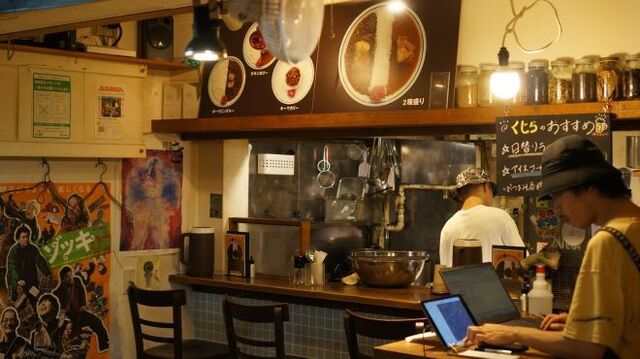
Koenji’s curry culture avoids grand entrances. It lives in shopping streets, market corridors, and small counters where attention stays on the plate. CURRY SHOP Kujira Kouenji sits inside Daiichi Market, a compact everyday setting that explains why Tokyo curry is now a serious category: not just old-school yoshoku gravy or convenience lunch, but Indian-influenced spice work, Japanese rice-plate logic, and tiny specialist counters.
That context matters. Tokyo’s higher-profile dining can demand planning, language confidence, and ceremony. Curry counters reward appetite, timing, and curiosity about how heat, rice, sauce, garnish, and turnover become a fast meal with critical weight. A nine-seat counter makes that clear: with little room for excess, the menu architecture must work.
A nine-seat curry counter in Tokyo's spice-curry bracket
Tokyo curry argues against equating culinary seriousness with expense. A modestly priced restaurant can still face a demanding field where regulars care about balance, texture, spice layering, and rice as much as prestige. CURRY SHOP Kujira Kouenji is listed for Indian curry and curry, signalling a Tokyo interpretation rather than a purist regional Indian restaurant. The cooking belongs to the city’s hybrid curry grammar: spice-driven, rice-centered, casual, and precise enough for repeat recognition.
The clearest trust signal is Tabelog’s Curry TOKYO 100 selection in 2024, with prior selections in 2019, 2020, 2022, and 2023. In Tokyo’s crowded curry field, that matters: the Tabelog 100 format tends to reward durable local attention over short-lived novelty. It does not place the shop beside tasting-menu restaurants or sushi counters; it places this small room inside a competitive citywide curry conversation, where a counter can carry destination logic like a larger, higher-spend address.
Koenji sharpens the reading. Compared with central Tokyo expense-account districts, this part of Suginami has a looser, independent rhythm: music bars, secondhand shops, casual restaurants, and station-side alleys where compact businesses keep character. Locally, Koenji Yakiniku Kokochi Ichiba ten occupies a higher-spend lane, Shigekuniya 55 Bakery sits in a bakery-snack register, and Tensuke shows how a specialist format anchors neighbourhood reputation. Kujira’s role differs: it gives curry the compact-counter seriousness usually associated with ramen, tempura, or yakitori.
Menu structure is the argument, not ornament
The ideal way to read a Tokyo curry shop is to see how much the menu explains. In this category, the plate is a system: sauce or sauces, rice, toppings, heat level, optional additions, and a rhythm that lets the kitchen serve quickly without feeling generic. With nine seats and counter service, CURRY SHOP Kujira Kouenji has little margin for sprawl. Its strength is compression: choices must be legible, the kitchen must keep pace, and the customer must grasp the house style without a briefing.
That is why Tokyo curry rewards repeat diners. Differences between shops are often architectural rather than decorative. Some lean into thick Japanese-style roux, some into South Asian spice reference points, some into multiple-curry plates, and some into the sharper, drier, more aromatic register of modern spice curry. The Indian curry and curry listing suggests a shop between influence and adaptation, often where Tokyo’s more interesting counters sit. The question is not authenticity as a fixed label, but whether the plate has internal logic.
Recognition across five Tabelog selection years suggests that logic has held. Durability matters more than one annual nod, especially where small shops can surge on social attention and fade. For a visitor, the appeal is not a long meal; it is seeing Tokyo treat curry as specialist craft at everyday scale: short menu, tight counter, fast rhythm, and enough precision to draw scrutiny from diners who take the category seriously.
There is useful contrast with other Tokyo casual forms. Ramen shops such as Hayashi are discussed through broth, noodle, tare, and queue discipline. Tempura counters such as Tensuke turn speed and frying sequence into the experience. Curry counters sit between them: less performative than tempura, less codified than ramen, and more open to personal house structure. That flexibility makes Tokyo curry compelling: the format is humble, the decisions numerous.
How to place it in a Tokyo dining day
This is not for a formal fine-dining evening. It works as a focused Koenji stop, especially for travellers who know Tokyo’s food culture is as strong in small specialist rooms as in reservation-only dining. Counter format and limited seating mean timing matters. Treat it as a popular neighbourhood specialist, not a linger-over-wine restaurant. The surrounding area rewards walking, and the meal fits an afternoon or early evening built around Koenji rather than a cross-city dash between luxury venues.
Payment flexibility and non-smoking status ease logistics compared with some older small shops, while the no-reservation format keeps it close to Tokyo’s casual counter tradition. Children are welcome, and the venue is marked pet friendly, notable for a compact Tokyo restaurant. Private rooms and private use are not part of the format. The point is the counter, the curry, and the quick-turn discipline of a small room.
For broader Tokyo itineraries, Kujira pairs well with specialist stops rather than full-evening restaurants. Compare it with curry-focused 3 Chome no Curry Ya San, casual Tokyo entries such as 2D Cafe, or drinking and dining formats in 12/10 Shinjuku ten, 124. KAGURAZAKA (Yakitori), and . 鮪と炭火焼き うお炭 秋葉原店. For the wider city edit, use Our full Tokyo restaurants guide, alongside Our full Tokyo hotels guide, Our full Tokyo bars guide, Our full Tokyo wineries guide, and Our full Tokyo experiences guide.
The same specialist logic extends beyond Tokyo: [Curry Senmon Ten] Maruyama Kyoju. in Sapporo shows how curry travels through regional Japanese dining, while -Grilled beef Sukiyaki- KAMAKURA TANUKIAN 鎌倉 たぬき庵 in Kamakura.cafe in Osaka.know in Kumamoto, (Shoku) Vietnam in Kawasaki, and [ki:] in Kyoto show how compact formats differ by city. Outside Japan, Jōdo Saké Bar in Los Angeles and Onigiri Time in Pasadena offer comparison for how Japanese casual forms translate abroad.
The editorial case for CURRY SHOP Kujira Kouenji is simple: it gives a small Koenji curry counter the seriousness usually reserved for higher-cost Tokyo dining. The room is compact, the category competitive, and repeat Tabelog Curry selections give the visit a concrete reason beyond neighbourhood charm. For travellers trying to understand Tokyo through specialist counters, this is a sharper lesson than another polished dining room.
Budget Reality Check
Comparable venues at a glance for context.
| Venue | Cuisine | Price |
|---|---|---|
| CURRY SHOP Kujira KouenjiThis venue — the venue you are viewing | Suginami, Japanese Curry | $ |
| Arry 8Bites | Tokyo, Japanese Small Bites | $ |
| Nishieifuku no Niboshi Bako | Suginami, Niboshi-focused Ramen | $ |
| Toki Ya Shinjuku odakyu haruku ten | Shinjuku, Japanese sweets cafe | $ |
| BERG | Shinjuku, Beer Cafe | $ |
| Musashino Enza | Nerima, Traditional Musashino Udon | $ |
Recognition history
Dated appearances from independent guides and award organizations, with the underlying list record or original source where available.
Tabelog 100 #8 · No. 8
Tabelog · Tabelog 100 - Curry - TOKYO - 2024













At a Glance
- Cozy
- Trendy
- Rustic
- Solo
- Casual Hangout
- Standalone
- Street Scene
Current opening hours
- Monday
- 11:30 AM–8 PM
- Tuesday
- 11:30 AM–8 PM
- Wednesday
- 11:30 AM–8 PM
- Thursday
- 11:30 AM–8 PM
- Friday
- 11:30 AM–8 PM
- Saturday
- 11:30 AM–8 PM
- Sunday
- 11:30 AM–8 PM
Hours can change for holidays and private events. Last verified .
Cozy, small-scale, and tucked away in a market building, with a relaxed hidden-spice-shop atmosphere.