
Curry no Mise Pusan sits in Tokyo’s serious everyday-curry tier: low-priced, small-scale, and repeatedly selected for Tabelog Curry TOKYO “Tabelog 100,” including 2024. Its appeal is less about ceremony than menu architecture: a curry specialist format with counter seats, table seats, take-out, and a house-restaurant setting in Koganei rather than a central-city dining corridor.
Pearl is the En Primeur Club membership app — saves, bookings, and concierge access live there. Same editors, same standards.
- Address
- 3 Chome-40-27 Maeharacho, Koganei, Tokyo 184-0013, Japan
- Phone
- +81 42-384-7055
- Website
- hotpepper.jp
 Saves & bookings on Pearl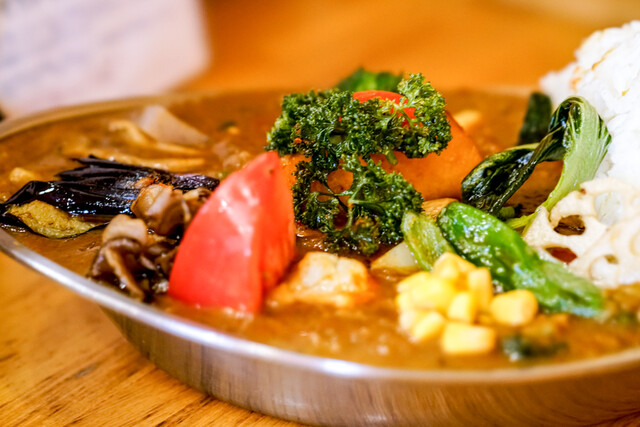
The approach to a suburban Tokyo curry counter changes the reader’s expectations before the first order is placed. Koganei is not Ginza, Aoyama, or the hotel dining belt; it belongs to the city’s commuter-west rhythm, where specialist restaurants often survive by repeat local use rather than spectacle. In that setting, Curry no Mise Pusan occupies a familiar but increasingly valuable Tokyo category: the compact curry house whose menu has to explain itself quickly, feed efficiently, and keep regulars returning without the choreography of a tasting counter.
Tokyo’s curry culture has never been one thing. It runs from railway-station speed to spice-led independents, from yoshoku comfort to South Asian lineages and Japanese curry houses with their own internal logic. The useful way to read this address is through structure, not hype. A curry specialist with a modest spend, counter seating, table seating, and take-out is built for decision density: one core cuisine, fast comprehension, and a room scaled for people who already know what they came for.
A curry menu built for regulars, not ceremony
The strongest signal here is concentration. A restaurant categorized simply as curry, with a 20-seat room split between 8 counter seats and 12 table seats, belongs to a format where menu architecture matters more than décor. In Tokyo, that usually means choices are framed around base curry, add-ons, portioning, heat, or combinations rather than a sprawling multi-cuisine list. The discipline is the point: a narrow category lets a small kitchen move with consistency, and diners can read the place in minutes.
That structure also explains why curry specialists at this level can carry authority without luxury pricing. Curry no Mise Pusan was selected for Tabelog Curry TOKYO “Tabelog 100” in 2024, with prior selections listed across 2023, 2022, 2020, 2019, 2018, and 2017. For a low-ticket restaurant outside central Tokyo’s usual visitor routes, that history is meaningful. It suggests durability inside a crowded category where convenience alone is not enough.
Compared with everyday Tokyo peers in the same price band, the distinction is format rather than expense. Goto Udon Bizenya and Kurumi Do Kissa Ten sit in a similar spend range but point to different dayparts and cravings; Kodaira Udon Kodaira honten and Boulangerie Passage à Niveau show how the western suburbs reward focused specialists at lower prices; Chuka Soba Hirai makes the parallel case in ramen. The lesson is local: serious eating in Tokyo is not confined to high-price counters, and the city’s outer wards and municipalities often reward single-category restaurants with loyal traffic.
Koganei makes the case for Tokyo beyond the central circuit
Koganei’s dining character is quieter than the east-side market streets or west-side nightlife clusters, but that is part of the value. The area around Musashi-Koganei sits on the JR Chuo Line, a corridor with deep everyday-food credibility: udon, ramen, bakeries, kissaten, curry shops, and family-run rooms that serve residents first. Curry no Mise Pusan fits that ecology. The setting is described as a house restaurant, which places it closer to neighbourhood routine than destination theatre.
The room’s practical shape supports that reading. Counter seating gives solo diners the usual Tokyo efficiency; tables make it workable for friends and families; children are welcomed, including babies, preschoolers, and school-age children. Private rooms and private use are not part of the format, which keeps the experience public, compact, and casual. Non-smoking status and take-out service add to its everyday utility. Payment is cash-led, with credit cards, electronic money, and QR code payments not accepted, so the planning burden is simple: arrive prepared and treat it as a specialist local meal rather than a frictionless app-driven stop.
Reservation unavailability is another clue. In Tokyo, no-reservation restaurants can mean anything from transient lunch counters to serious queues, but here it reinforces the genre: compact seating, steady turnover, and a menu designed for direct ordering. For visitors building a day around western Tokyo, it works better as part of a Chuo Line food itinerary than as a stand-alone luxury reservation. The address is close to Musashi-Koganei Station, and the official guidance places it a short walk from the south exit, which makes the detour manageable for readers already moving through the area.
How to place it within a Tokyo dining day
The editorial decision is clear: come for a focused curry meal that shows how Tokyo’s specialist dining culture operates below the fine-dining price tier. This is not the restaurant to choose for chef biography, wine service, private-room hosting, or a long evening built around courses. It is better read as a compact answer to a specific craving, backed by repeated category recognition and a room format that suits solo dining, pairs, families, and take-out.
Readers mapping a wider Tokyo itinerary can use it as a counterweight to the city’s more theatrical dining. For a broader restaurant sweep, see Our full Tokyo restaurants guide, or compare other city formats such as 3 Chome no Curry Ya San, . 鮪と炭火焼き うお炭 秋葉原店, 12/10 Shinjuku ten, 124. KAGURAZAKA (Yakitori), and 2D Cafe. Tokyo planning does not stop at restaurants: the city rails also connect well with Our full Tokyo hotels guide, Our full Tokyo bars guide, Our full Tokyo wineries guide, and Our full Tokyo experiences guide.
For readers comparing Japanese regional food formats, the same editorial question applies: what does a narrow menu reveal about place? That question links the restaurant to addresses as different as -Grilled beef Sukiyaki- KAMAKURA TANUKIAN 鎌倉 たぬき庵 in Kamakura.cafe in Osaka.know in Kumamoto, (Shoku) Vietnam in Kawasaki, [Curry Senmon Ten] Maruyama Kyoju. in Sapporo, [ki:] in Kyoto, Jōdo Saké Bar in Los Angeles, and Onigiri Time in Pasadena. The common thread is not glamour; it is whether a place uses a tight format to make its argument clearly.
- Vegetable Curry
- Vegetable Chicken Curry
- Beef Curry
- Vegetable Dal Curry
- Homemade Lassi
- Homemade Chai
Snapshot
Comparable venues for context, by category and price tier.
| Venue | Cuisine | Price | Notes |
|---|---|---|---|
| Curry no Mise PusanThis venue — the venue you are viewing | Casual Indian‑style Curry House | $$ | Not listed |
| MarieIranganee | Sri Lankan Curry | $$ | Shibuya |
| Bangera's Kitchen | Mangalorean South Indian coastal cuisine | $$ | Chiyoda |
| Rahi Punjabi Kitchen | Traditional Pakistani & North Indian Curry House | $$ | Suginami |
| Accha Kana | European-style curry house in Futakotamagawa | $$ | Setagaya |
| SUNVALLEY HOTEL | Traditional South & North Indian | $$ | Setagaya |
Recognition history
Dated appearances from independent guides and award organizations, with the underlying list record or original source where available.
Tabelog 100 #57 · No. 57
Tabelog · Tabelog 100 - Curry - TOKYO - 2024
Continue exploring
More in Tokyo
Restaurants in Tokyo
Browse all →



Bars in Tokyo
Browse all →



Hotels in Tokyo
Browse all →




Wineries in Tokyo
Browse all →
At a Glance
- Cozy
- Quiet
- Classic
- Solo
- Family
- After Work
- Casual Hangout
- Standalone
Current opening hours
- Monday
- 11 AM–10 PM
- Tuesday
- Closed
- Wednesday
- 11 AM–10 PM
- Thursday
- 11 AM–10 PM
- Friday
- 11 AM–10 PM
- Saturday
- 11 AM–10 PM
- Sunday
- 11 AM–10 PM
Hours can change for holidays and private events. Last verified .
A small, house‑like curry shop with an at‑home feel, soft indirect lighting, counter and simple table seating where guests quietly enjoy aromatic, spice‑laden curries in a relaxed, unpretentious setting.