On the edge of Vienna's historic Börsenplatz, Alles Wurscht occupies a corner of the first district where the city's appetite for sausage culture meets its tradition of outdoor civic dining. The name itself, a Viennese idiom meaning 'it doesn't matter', signals the register: relaxed, irreverent, and rooted in the kind of unpretentious eating that the city has always balanced against its grander culinary ambitions.
Pearl is the En Primeur Club membership app — saves, bookings, and concierge access live there. Same editors, same standards.
- Address
- Börsepl. 1, 1010 Wien, Austria
- Phone
- +436607408251
- Website
- alleswurscht.at
- Directions
- Get directions
 Saves & bookings on Pearl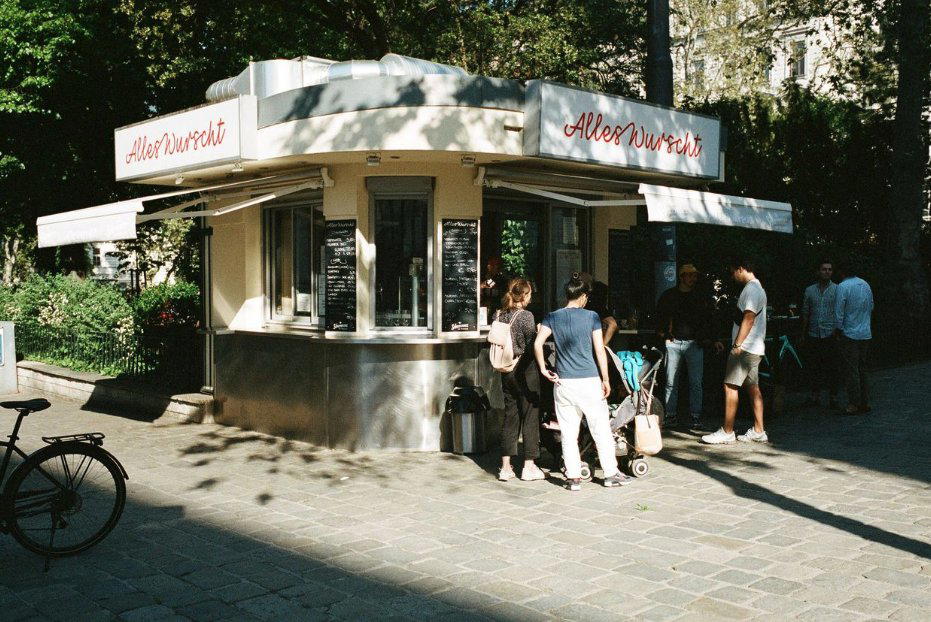
Börsenplatz and the Grammar of Viennese Street Eating
Vienna's first district does not lack for ceremony. Within a few minutes' walk of Alles Wurscht at Börsepl. 1, you can find some of Austria's most formally constructed tasting menus, Steirereck im Stadtpark, Konstantin Filippou, or the boundary-pushing kitchen at Mraz & Sohn. But Vienna has always run a parallel track alongside its haute cuisine circuit, one built on the Würstelstand, the sausage stand, and the social contract it represents: food that requires no reservation, no dress code, and no particular occasion.
Alles Wurscht sits inside that tradition. The name is itself a piece of Viennese cultural vocabulary: the phrase translates loosely as 'it doesn't matter' or 'I couldn't care less,' a shrug embedded in the language that captures something real about how the city approaches casual eating. The choice of that name for a sausage-oriented venue on one of the inner city's more trafficked squares is not accidental. It positions the place immediately within a register of deliberate informality, a counterpoint to the white-tablecloth gravity that the first district so often projects.
What Börsenplatz Means for the Experience
The address at Börsepl. 1 places Alles Wurscht at the edge of Vienna's old stock exchange building, the Börse, a late nineteenth-century Theophil Hansen structure that now functions largely as an event venue. The square itself sits at the intersection of the first and ninth districts, close enough to the Ringstrasse to draw the foot traffic of tourists and office workers moving between the centre and the Schottentor U-Bahn station. This is not the tucked-away-courtyard kind of Vienna address; it is a thoroughfare location, which shapes both the clientele and the pace of service.
That urban positioning is part of what defines the Würstelstand model across the city. Vienna's sausage culture has historically operated at the intersections of transit and public life, outside U-Bahn exits, at the edges of markets, beside the opera and the parliament, precisely because the format is calibrated for the standing customer between one thing and the next. The Börsenplatz location follows that spatial logic. You are unlikely to linger here over a three-hour lunch; you are more likely to stop on your way somewhere else, which is, in the Viennese framework, exactly the point.
For context on how this format sits relative to the wider Austrian dining scene, the distance between a Würstelstand and a destination restaurant in Austria can be measured in more than price. Places like Döllerer in Golling an der Salzach, Obauer in Werfen, or the alpine precision of Griggeler Stuba in Lech represent a tradition of serious, often rural-rooted Austrian cooking that requires planning, travel, and commitment. The Würstelstand is the structural opposite: no planning, no travel, and a transaction measured in minutes. Both are expressions of Austrian food culture; they simply occupy different axes entirely.
The Würstelstand as Cultural Institution
To understand Alles Wurscht as a dining proposition, it helps to understand what the Würstelstand means in Vienna beyond the food itself. These stands have functioned as social infrastructure in the city for well over a century. They are among the few public eating formats in Vienna where the implicit rules flatten social distinctions, a phenomenon the city itself has acknowledged by granting some stands a kind of informal landmark status. Their late hours make them a fixture for post-theatre crowds, shift workers, and anyone moving through the city's odd hours. The format is not fast food in the international sense; it is civic food, embedded in a specific urban rhythm.
The sausage varieties available at Viennese stands carry their own taxonomy that visitors sometimes underestimate. The Käsekrainer, a pork sausage with cheese pockets that release under heat, is especially locally specific; the Burenwurst is coarser and typically boiled; the Frankfurter, thinner and snappier, is what most of the world incorrectly pictures when it imagines a 'Viennese sausage.' Condiment conventions are equally codified: mustard (sharp or sweet), a bread roll, and nothing fussy. The Viennese take these distinctions seriously in the way that serious food cultures tend to take their humblest preparations seriously, as a marker of who actually knows the city versus who is passing through it.
Placing Alles Wurscht in Vienna's Broader Dining Picture
Vienna's dining scene in the first district has consolidated around a relatively small number of high-commitment restaurants at the upper end and a much larger casual infrastructure below. The gap between those two tiers is real. Creative Austrian cooking at venues like Amador or the technically rigorous menus at Doubek demand a different kind of engagement from a diner, pre-booked, purposeful, sustained. The Würstelstand format makes no such demands, and that is a feature rather than a limitation.
For a traveller working through Vienna's dining registers, from the committed tasting menus of the inner city to the mountain-kitchen traditions represented by spots like Gourmetrestaurant Tannenhof in Sankt Anton am Arlberg or Ikarus in Salzburg, a stop at a well-placed Würstelstand is not a compromise. It is a different chapter of the same reading. The name the restaurant captures the philosophy: arrive, eat, move on, and don't overthink it. That is a Viennese instruction as much as a casual dining pitch.
Those building a fuller picture of Austrian dining beyond the capital can also consider the herb-driven approach at Kräuterreich by Vitus Winkler in Sankt Veit im Pongau, the riverside setting of Landhaus Bacher in Mautern an der Donau, or the precision cooking at Restaurant 141 by Joachim Jaud in Mieming and Schwarzer Adler in Hall in Tirol. The range of what Austrian cuisine means across its regions and formats is considerably wider than the Michelin circuit alone suggests, and the Würstelstand sits at one genuine pole of that range. For international comparison, the gap between this format and the composed ambition of Le Bernardin in New York City or the course-by-course rigour at Atomix in New York City is as wide as dining gets, and that contrast is instructive. Also consider Ois in Neufelden for a quieter Austrian dining register further from the capital.
Quick reference: the restaurant, Börsepl. 1, 1010 Wien. Walk-in format; no booking required.
Cuisine-First Comparison
Comparable venues nearby, for context on price, style, and recognition.
| Venue | Cuisine | Price | Notes |
|---|---|---|---|
| Alles WurschtThis venue — the venue you are viewing | Modern Viennese Sausage Stand | $ | Not listed |
| Gasthaus Haller | Traditional Viennese & Hungarian | $ | Brigittenau |
| eh scho wuascht | Traditional Austrian Würstelstand | $ | Kaiserebersdorf |
| Leo's Sausage Stand | Traditional Austrian Sausage Stand | $ | Doebling |
| Big Mama | Austrian Sausage Stand | $ | Grossfeldsiedlung |
| Marienhof | Traditional Viennese Cuisine | $$ | Hofburg |
Continue exploring
More in Vienna
Restaurants in Vienna
Browse all →
Bars in Vienna
Browse all →
Hotels in Vienna
Browse all →
At a Glance
- Trendy
- Lively
- Casual Hangout
- Local Sourcing
- Street Scene
Current opening hours
- Monday
- 11:30 AM–10 PM
- Tuesday
- 11:30 AM–10 PM
- Wednesday
- 11:30 AM–10 PM
- Thursday
- 11:30 AM–10 PM
- Friday
- 11:30 AM–10 PM
- Saturday
- 11:30 AM–10 PM
- Sunday
- Closed
Hours can change for holidays and private events. Last verified .
Casual street food kiosk atmosphere with beautifully presented dishes in a lively urban park setting.