Our verdict
Leo's Sausage Stand occupies a spot on Döblinger Gürtel in Vienna's 9th district, placing it inside the city's long tradition of street-level sausage culture. The Würstelstand format sits at the base of Viennese food life, a democratic institution that operates independently of the fine-dining circuit running from Steirereck to Konstantin Filippou. For visitors orienting to Vienna's eating habits, this is where the street register begins.

Pearl is the En Primeur Club membership app, where members save venues, book tables and use the concierge.
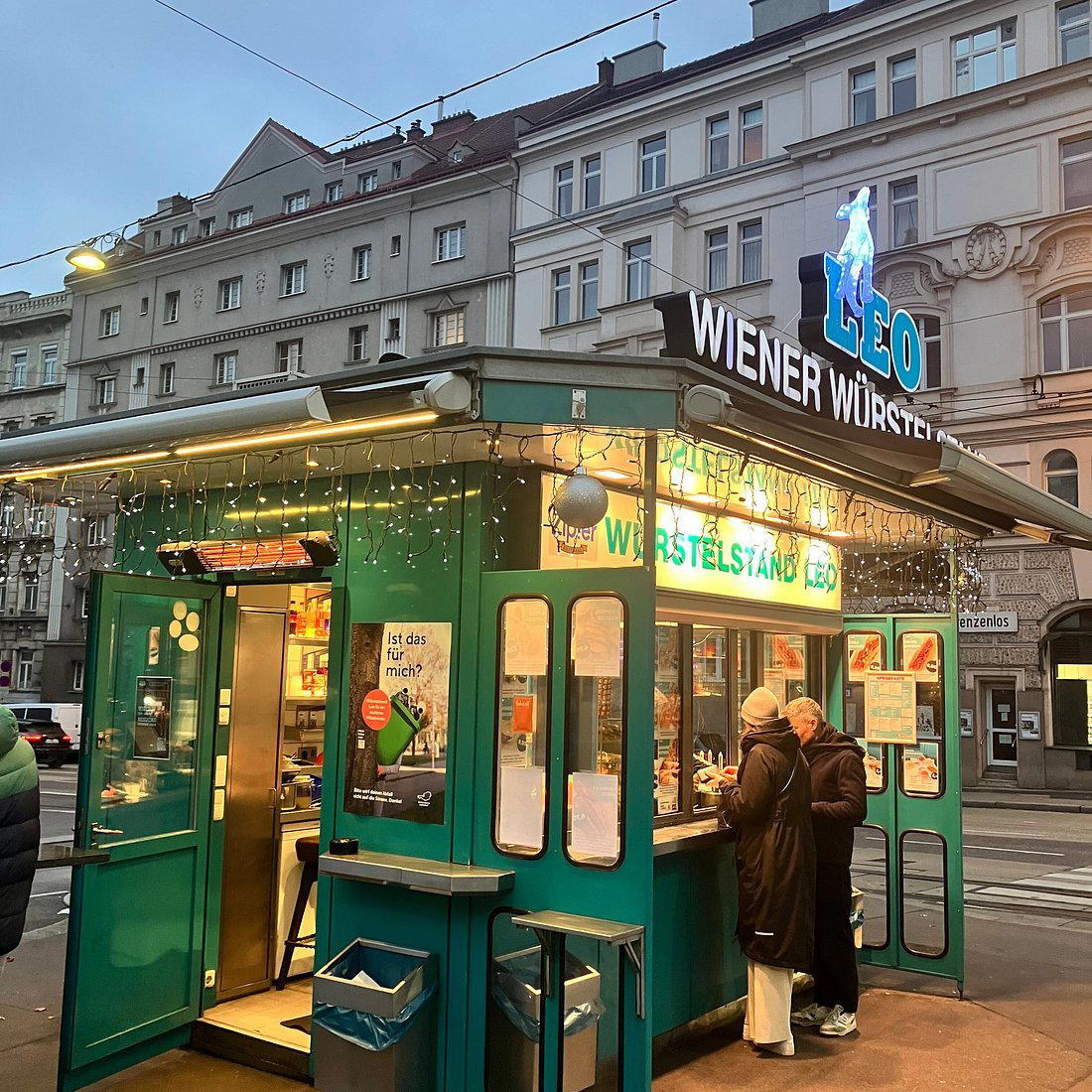
The Würstelstand in Vienna's Food Order
Vienna's eating culture runs on two parallel tracks that rarely intersect. At one end, a concentration of €€€€ tasting-menu restaurants Steirereck im Stadtpark, Amador, Konstantin Filippou, and Mraz & Sohn, forms the city's high-end creative circuit. At the other, the Würstelstand: an outdoor sausage kiosk format with roots in the city going back centuries, operating on pavement corners, near U-Bahn exits, and along the Gürtel ring roads. Leo's Sausage Stand at Döblinger Gürtel 2 in the 9th district belongs to this second track entirely.
The Würstelstand is not a simplified version of Austrian cuisine, it is its own category, with its own vocabulary. Regulars do not order in the way a restaurant guest would. They already know the menu, the naming conventions (a Käsekrainer differs from a Burenwurst in texture, casing, and fat composition), and the unwritten etiquette of the counter. This is a format built on local ritual as much as food, and Leo's sits inside that tradition on one of the city's main arterial roads.
Location and the Gürtel Setting
Döblinger Gürtel runs along the outer ring of Vienna's inner districts, a wide boulevard that marks a transition between the compact residential neighbourhoods of the 9th and 18th districts. The address, number 2 on Döblinger Gürtel, puts Leo's at the northern end of this stretch, near where the Gürtel meets the D-Tram line and the edge of Währing. This is not a tourist corridor. The foot traffic here is Viennese: commuters, shift workers, residents. A sausage stand at this junction is a transit-point institution, not a destination in the tourism sense.
That placement matters because it affects the experience. A Würstelstand on the tourist axis of the 1st district operates differently from one on a working commuter road. The Gürtel stands tend to run later, draw a more local crowd, and carry less performative quality. They function as infrastructure. Leo's on Döblinger Gürtel fits this profile.
The Format and What It Means for the Visit
The Würstelstand format across Vienna follows a loose but recognisable structure. A small kiosk, usually enclosed, heated, often with a serving counter at standing height, operates with a tight team. At most stands, one or two people handle orders, grill management, and the mustard-and-bread assembly simultaneously. This is a format where the team dynamic is compressed by necessity: there is no division between kitchen and floor. Whoever is at the grill is also taking your order, handing over the bread roll, and managing the queue. The coordination required is unglamorous but exact. At a busy Gürtel stand during the morning or late-night rush, the operational pace is comparable to short-order cooking anywhere in the world.
This contrasts with how team dynamics function at the €€€€ end of Vienna's dining scene. At Doubek or at destination restaurants in the Austrian alpine circuit, Döllerer in Golling an der Salzach, Ikarus in Salzburg, Obauer in Werfen, the separation of roles is elaborately maintained. Chef, sommelier, and floor team operate in distinct lanes. The Würstelstand collapses all of that. The result is a different kind of efficiency: faster, less formal, and calibrated entirely to throughput.
Where Leo's Sits in the Wider Austrian Picture
Vienna's fine-dining circuit draws from the same broader Austrian food culture that produces alpine destination restaurants like Griggeler Stuba in Lech, Gourmetrestaurant Tannenhof in Sankt Anton am Arlberg, Kräuterreich by Vitus Winkler in Sankt Veit im Pongau, Schwarzer Adler in Hall in Tirol, Restaurant 141 by Joachim Jaud in Mieming, Landhaus Bacher in Mautern an der Donau, and Ois in Neufelden. That circuit is defined by sourcing provenance, seasonal menus, and long tasting formats. The Würstelstand shares almost none of those characteristics. It draws from a separate lineage: the imperial-era street food economy of a large Central European capital, where feeding workers and late-night crowds required speed, fat, and salt rather than refinement.
The two tracks coexist without much overlap. Visitors who spend an evening at Steirereck and then stop at a Würstelstand afterward are not moving between categories of quality so much as between entirely different registers of Viennese food life. Both are coherent. Neither explains the other. For context on the full Vienna dining picture, see our full Vienna restaurants guide.
It is worth noting that Vienna's Würstelstand culture has no direct parallel in other major European capitals. Paris has its crêpe stands; New York has its hot dog carts (the contrast with Le Bernardin or Atomix is equally stark). But the Viennese Würstelstand carries a cultural weight that goes beyond the food itself. It has a consistent presence across the city's districts, a recognised social role, and a vocabulary of products, Käsekrainer, Debreziner, Frankfurter, that are specific to Vienna's version of the format.
Planning Your Visit
Know Before You Go
- Address: Döblinger Gürtel 2, 1090 Wien, Austria
- District: 9th district (Alsergrund), near Döbling boundary
- Format: Outdoor/semi-enclosed Würstelstand kiosk
- Price tier: Street food pricing; cash standard at most Vienna stands
- Booking: Walk-in only; no reservations
- Transport: Accessible via tram lines running along the Gürtel; D-Tram nearby
- Leading timing: Morning commute hours and late evening are peak Würstelstand periods across Vienna
Frequently asked questions
What should I order at Leo's Sausage Stand?
The core menu at any Viennese Würstelstand runs through a short list of sausage types that have defined the format for generations. The Käsekrainer, a pork sausage with cheese pockets that burst on the grill, is the most distinctly Viennese option and the reference point for the category. A Burenwurst offers a coarser grind and stronger smoke. Both are typically served with a bread roll and mustard. The ordering convention is direct: name the sausage, specify how you want it (grilled or in hot water), and the rest follows. The cuisine here references a specifically Austrian street tradition rather than the €€€€ creative register of venues like Amador or the modern Austrian approach at Mraz & Sohn.
Do they take walk-ins at Leo's Sausage Stand?
Walk-ins are the only format the Würstelstand operates on. There are no reservations, no booking systems, and no waiting lists. The entire logic of the format is counter-service immediacy. In Vienna's higher price tiers, the €€€€ restaurants that carry critical recognition, booking windows of four to eight weeks are common. Leo's on Döblinger Gürtel operates on the opposite principle: you arrive, you order, you eat standing at the counter or on the pavement. This accessibility is part of what makes the Würstelstand a persistent institution in a city with a highly stratified dining scene.
What is Leo's Sausage Stand leading at?
The Würstelstand format is optimised for one thing: fast, consistent delivery of a short sausage menu to a high volume of passing customers. Leo's on Döblinger Gürtel, sitting on a major arterial road in a residential district, fits that function precisely. It is not a venue for extended meals or drink pairings, the cuisine and format are built around a five-minute transaction. What it represents within Vienna's food culture is the democratic base of the city's eating habits, a counterpoint to the tasting-menu density of the 1st district's fine-dining addresses and the award-recognised creative cooking at venues like Doubek.
Is Leo's Sausage Stand different from other Vienna Würstelstände?
Its location on Döblinger Gürtel in the 9th district places it away from the tourist-facing sausage stands near the Naschmarkt or the 1st district, which means its customer base skews strongly local. In Vienna, the Würstelstand closest to residential and commuter corridors tends to have the most consistent regular trade and the least variation in quality, since the clientele returns daily rather than visiting once. The Gürtel address also connects Leo's to a cluster of neighbourhood food culture in Alsergrund and Währing that operates independently of the city's central dining axis.
Style and Standing
Comparable venues nearby, for context on price, style, and recognition.
| Venue | Cuisine | Price | Notes |
|---|---|---|---|
| Leo's Sausage StandThis venue (the venue you are viewing) | Traditional Austrian Sausage Stand | $10–20 | Not listed |
| Gasthaus Haller | Traditional Viennese & Hungarian | $10–20 | Brigittenau |
| Würstlstand Burgring | Traditional Viennese Sausage Stand | $1–10 | Hofburg |
| Hermann's Würstelstand | Viennese Sausage Stand | $10–20 | Hofburg |
| Fladerei Otto Bauer Gasse | Austrian Flatbread (Fladenbrot) | $10–20 | Mariahilf |
| Wiener Würstl | Austrian Sausage Stand | $1–10 | Staatsoper |
Continue exploring
More in Vienna
Restaurants in Vienna
All restaurants in Vienna →
Bars in Vienna
All bars in Vienna →
Hotels in Vienna
All hotels in Vienna →
Details
- Classic
- Well Known
- Lively
- Casual Hangout
- Late Night
- After Work
- Standalone
- Beer Program
- Local Sourcing
- A La Carte
- Beer
- Vegetarian Friendly
Current opening hours
- Monday
- 10:30 AM–4:30 AM
- Tuesday
- 10:30 AM–4:30 AM
- Wednesday
- 10:30 AM–4:30 AM
- Thursday
- 10:30 AM–4:30 AM
- Friday
- 10:30 AM–5:30 AM
- Saturday
- 10:30 AM–5:30 AM
- Sunday
- 12 PM–12 AM
Hours can change for holidays and private events. Hours as of .
Casual street food atmosphere at a historic turquoise and white stand, popular day and night with a bustling late-night vibe.