Our verdict
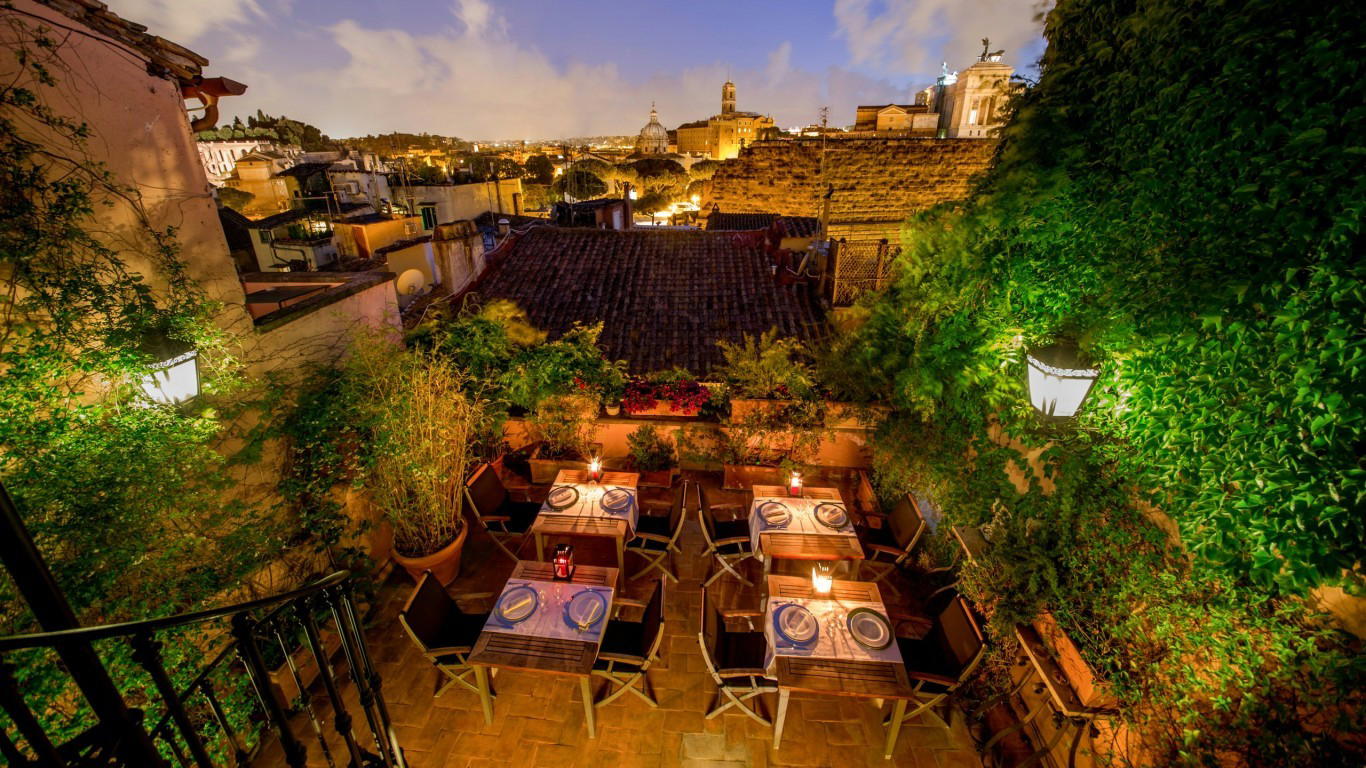
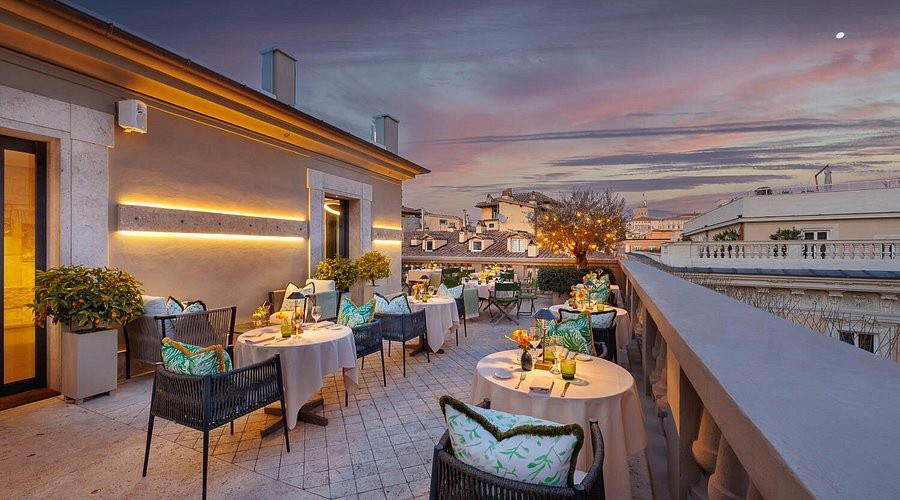
The 8th Floor Rooftop at Trilussa Palace Hotel occupies one of Trastevere's most commanding refined positions, setting the aperitivo hour and dinner service against a panorama that takes in the Tiber bend and the terracotta rooflines of medieval Rome. In a neighbourhood better known for trattorias at street level, the rooftop format repositions the area's dining register considerably upward.

Pearl is the En Primeur Club membership app, where members save venues, book tables and use the concierge.

The menu
What to order
- Tonnarelli cacio e pepe
- Rigatoni all'amatriciana
- Saltimbocca alla romana
- Potato gnocchi with octopus
- Carbonara with truffles
Rome from the Leading: What a Rooftop Venue Asks of the City Below
Every major European capital has its rooftop dining debate. The skeptical position is well-known: the view becomes a distraction, the kitchen plays second string, and the premium charged reflects altitude rather than craft. The counterargument, when a rooftop actually earns it, comes from venues that treat the panorama as architectural context rather than the product itself. The 8th Floor Rooftop at Trilussa Palace Hotel, positioned above Piazza Ippolito Nievo 27 in Trastevere, sits inside that more demanding second category. The neighbourhood it looks down on, dense, medieval, largely unchanged in silhouette since the seventeenth century, does much of the editorial work simply by being there.
Trastevere as a dining district operates almost entirely at street level. The area's identity is built around convivial trattorias, narrow cobbled lanes, and the kind of informality that Roman neighbourhood eating has exported as a model across the country. An refined venue at the eighth floor, then, represents a deliberate break from the local register, not a continuation of it. That gap between what the neighbourhood offers at grade and what a rooftop format offers in the air is where the 8th Floor's proposition lives.
The Aperitivo Opening: How the Meal Begins Before It Begins
In Italian dining culture, the aperitivo is not a preamble to be rushed through. It is a register-setter, a pace-controller, and at rooftop venues with strong sightlines, it is often where the most memorable moments of the evening are built. The Roman version of aperitivo leans toward Campari-based formats and vermouth pours rather than the Milanese spritz template, reflecting the city's distinct cocktail identity. Arriving at the 8th Floor before sunset, when the light moves from white to amber across the dome of Sant'Agostino and the stone of the Gianicolo hillside, positions the drink in its leading possible context.
Across Italy's fine-dining circuit, venues like Le Calandre in Rubano and Piazza Duomo in Alba have demonstrated that the transition from aperitivo to first course carries narrative weight. The question for any rooftop venue is whether the meal's arc holds once guests move from the visual spectacle of the opening to the demands of a sequence of dishes. That is the challenge the format sets for itself.
The Trastevere Position: Location as Editorial Argument
Rome's premium dining addresses are distributed unevenly across the city. The heaviest concentration of serious kitchens sits north of the Tiber: La Pergola, the city's benchmark three-Michelin-star address, operates from the Monte Mario hillside. Creative programs like Il Pagliaccio and Acquolina are rooted in the centro storico and Prati respectively. Enoteca La Torre operates from a hotel setting in Prati, and Achilli al Parlamento anchors itself to the parliamentary quarter's professional lunch trade.
Trastevere, by contrast, has historically resisted that format. Its tourism volume, its deeply embedded trattoria culture, and its relative distance from the business-lunch circuits have kept hotel-based fine dining at arm's length. The Trilussa Palace's decision to position a rooftop venue here rather than in the centro storico reads as a deliberate neighborhood arbitrage: premium format, non-premium address, with the view providing the justification for the price differential against street-level competition.
Mid-Course: How Roman Fine Dining Handles the City's Ingredient Story
The ingredient architecture of serious Roman cooking differs from the northern Italian templates that dominate Italy's international reputation. Where Osteria Francescana in Modena or Enoteca Pinchiorri in Florence work within their own regional contexts, Rome's fine-dining kitchens operate in a more complex negotiation between the city's ancient peasant traditions, offal, legumes, cured pork, and the modern European fine-dining grammar of small plates and precision technique. Enrico Bartolini in Milan represents one model of how Italian contemporary cooking resolves that tension; Roman kitchens often find a different resolution, one that is more invested in historical ingredient lineage.
Hotel rooftop kitchens across Europe sit in a specific commercial position within this conversation. They serve a mixed audience: hotel guests who may not have specifically sought out a serious food destination, destination diners who have, and walk-in visitors drawn by the view. Quattro Passi in Marina del Cantone and Uliassi in Senigallia demonstrate that coastal Italian venues can hold serious culinary ambition alongside a strong atmosphere play; the 8th Floor operates on a comparable structural logic, substituting the cityscape panorama for the maritime one.
The Close: What the View Delivers at Night
The tasting progression at rooftop venues almost always ends with the same asset it began with: the panorama, now transformed by darkness and artificial light into a different and arguably more dramatic composition. Rome's nighttime roofline, with the lit facades of the Vittoriano, the floodlit columns of the Forum, and the warm glow rising from the Trastevere streets below, provides a closing sequence that no kitchen dessert course can quite match in terms of sheer visual scale. The question serious diners will ask is whether the courses that preceded it gave them enough to think about gastronomically to make the evening feel complete as a meal, rather than primarily as a viewpoint.
For context on where Italian fine dining has set the bar for closing sequences, venues like Reale in Castel di Sangro, Dal Pescatore in Runate, and Atelier Moessmer Norbert Niederkofler in Brunico have all demonstrated that the final courses of an Italian tasting menu carry the weight of the whole structure. Internationally, the closing discipline at venues like Le Bernardin in New York City and Atomix in New York City provides a useful reference for what a committed kitchen-first operation asks of its final act.
Planning a Visit
The 8th Floor Rooftop is located at Trilussa Palace Hotel, Piazza Ippolito Nievo 27, in the Trastevere district on the west bank of the Tiber. Trastevere is reachable by tram from Largo di Torre Argentina in roughly fifteen minutes, or on foot from Ponte Sisto in about five minutes from the centro storico. Given the rooftop format and the premium positioning relative to the surrounding neighbourhood, reservations are the advisable approach rather than walking in, particularly during spring and summer evenings when Trastevere's piazzas reach peak visitor density. Arriving before sunset maximizes the transition from aperitivo light to dinner light, which represents the strongest atmospheric argument for the venue's format. For a broader picture of where the 8th Floor sits within Rome's dining offer, see our full Rome restaurants guide.
Frequently asked questions
Where is 8th Floor Rooftop in Rome?
8th Floor Rooftop is located at Trilussa Palace Hotel, Piazza Ippolito Nievo, 27, 00153 Roma RM, Italy, Rome.
Is the 8th Floor Rooftop worth visiting if you're not staying at the Trilussa Palace Hotel in Trastevere?
The venue is attached to the Trilussa Palace Hotel at Piazza Ippolito Nievo 27, but rooftop dining in Rome is not restricted to hotel guests as a category. Trastevere's west-bank position gives the 8th Floor a vantage point across the city that most centrally located restaurants cannot replicate. For visitors staying elsewhere in Rome, the cross-city journey into Trastevere adds context to the meal: the neighbourhood itself is part of what the rooftop looks out over.
What's the best thing to order at 8th Floor Rooftop?
Given the Trastevere address and the Roman fine dining context, the aperitivo course is the logical starting point: rooftop venues in this district treat the pre-dinner ritual as a structural part of the meal, not a preliminary. Order to the rhythm of the room and let the kitchen's seasonal Roman ingredient sourcing guide the progression.
How hard is it to get a table at 8th Floor Rooftop?
Demand at the 8th Floor Rooftop follows Rome's broader tourism calendar: peak windows run April through October, with summer weekends at the higher end of wait times. Hotel rooftop venues draw both in-house guests and outside reservations, which compresses availability further. Booking several days ahead is reasonable outside peak season; two weeks or more during summer is the safer margin.
What has 8th Floor Rooftop built its reputation on?
The venue's positioning rests on its rooftop format above the Trilussa Palace Hotel at Piazza Ippolito Nievo 27, placing it on the west bank of the Tiber in Trastevere. That address is an editorial argument in itself: Trastevere sits outside Rome's northern concentration of formally decorated restaurants, which means the 8th Floor competes on setting and experience rather than proximity to the city's Michelin-listed peer group. The panoramic view of Rome from the eighth floor is the primary draw that differentiates it within the local rooftop category.
Can 8th Floor Rooftop accommodate dietary restrictions?
No confirmed dietary policy is documented. Italian hotel restaurants at this tier routinely handle dietary requirements when notified at the time of booking, and the Trilussa Palace Hotel context suggests that level of service infrastructure is in place. check the venue's official channels at Piazza Ippolito Nievo 27 to confirm specific accommodation before arrival.
Accolades, Compared
Comparable venues nearby, for context on price, style, and recognition.
| Venue | Cuisine | Price | Notes |
|---|---|---|---|
| 8th Floor RooftopThis venue (the venue you are viewing) | Contemporary Roman Cuisine | $50–100 | Not listed |
| Contempo | Modern Roman Italian | $50–100 | Trastevere |
| VII Coorte | Roman Seafood with Sicilian Influences | $30–50 | Trastevere |
| Assunta Madre | Classic Roman Osteria with Fresh Seafood | $50–100 | Regola |
| Sora Lella | Traditional Roman Trattoria | $50–100 | San Angelo |
| Clementino Ristorante & Bistrot | Contemporary Roman Cuisine | $50–100 | Colonna |
Continue exploring
More in Rome
Restaurants in Rome
All restaurants in Rome →
Bars in Rome
All bars in Rome →

8th Floor Rooftop
The wine
- Extensive wine list
- Sommelier-led
- Craft cocktails
Details
- Romantic
- Elegant
- Sophisticated
- Scenic
- Date Night
- Celebration
- Special Occasion
- Group Dining
- Rooftop
- Panoramic View
- Terrace
- Hotel Restaurant
- Craft Cocktails
- Extensive Wine List
- Sommelier Led
- Local Sourcing
- Skyline
- A La Carte
- Tasting Menu
- Craft Cocktails
- Wine
- Sparkling Wine
- Vegetarian Friendly
- Allergy Accommodating
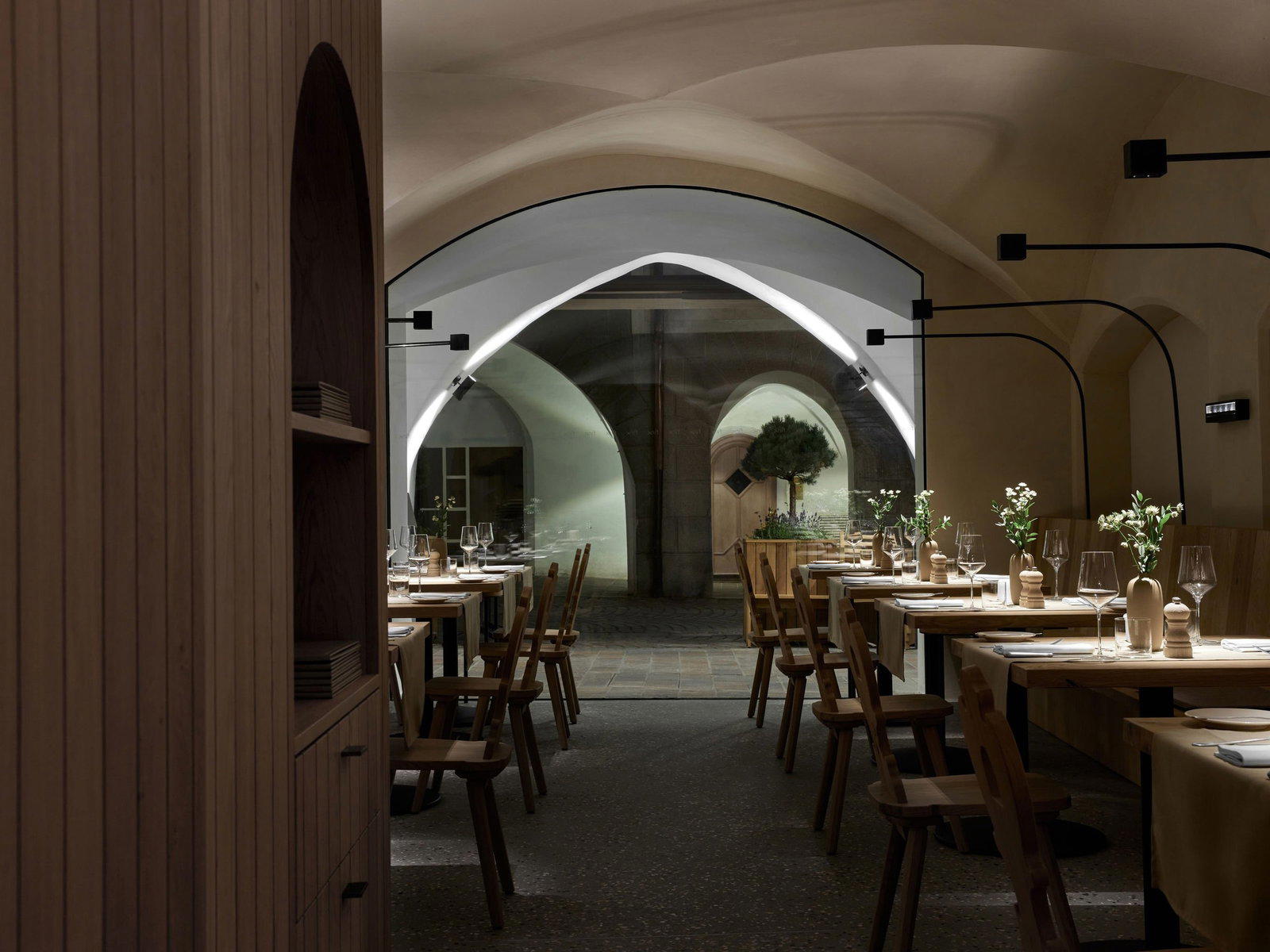
Elegant and refined with soft lighting and pleasant background music; calm yet sophisticated atmosphere enhanced by panoramic city views and sunset vistas.