Bar San Calisto occupies a corner of Trastevere's central piazza where the aperitivo ritual predates the neighbourhood's current fame by several decades. Marble tables, grappa-spiked espresso, and a crowd that skews local over tourist mark it as one of the few surviving examples of the old Roman bar format. The wine list is short, the prices are lower than anywhere nearby, and the atmosphere is entirely unrehearsed.
Pearl is the En Primeur Club membership app — saves, bookings, and concierge access live there. Same editors, same standards.
- Address
- Piazza di S. Calisto, 3, 00153 Roma RM, Italy
- Phone
- +39 06 583 5869
- Website
- barsancalisto.it
- Directions
- Get directions
 Saves & bookings on Pearl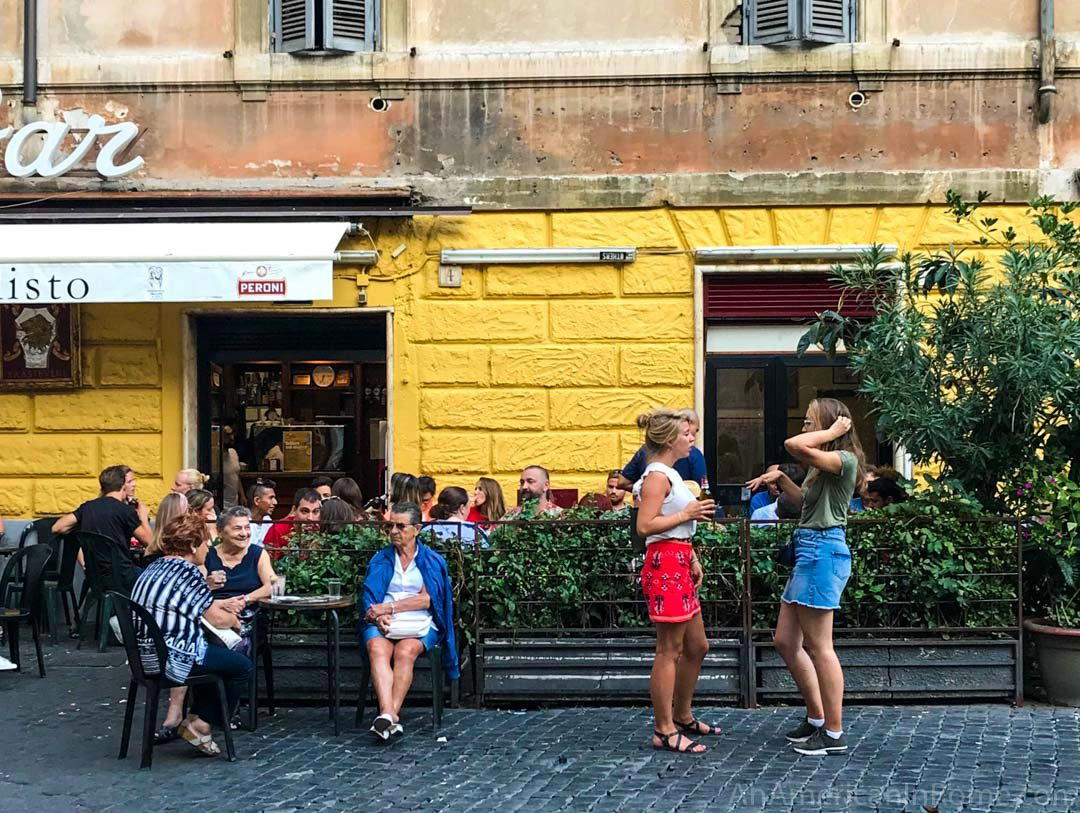
A Piazza That Has Not Moved On, and Why That Matters
Trastevere operates on two speeds. The upper gear belongs to the restaurants filling tables with menus printed in five languages and the aperitivo bars where a Spritz costs what a full meal once did. Bar San Calisto runs on the other speed entirely. Positioned at the edge of Piazza di Santa Maria in Trastevere, one of Rome's most photographed squares, it draws a crowd that arrives not for the spectacle of the piazza but for the fact that a glass of wine or a beer here costs a fraction of what the surrounding establishments charge. That gap in pricing is not accidental, it is the bar's central argument.
The Roman neighbourhood bar format that San Calisto represents was once common across the city. It is a format built around function over atmosphere: espresso at the counter, a handful of bottles behind the bar, seating that spills onto the street or piazza regardless of season, and a clientele that includes students, retirees, and anyone who cannot afford or does not want the theatre of the modernised bar scene. The format has been compressed out of most central Roman neighbourhoods by rent pressure and tourism economics. Trastevere, despite its transformation into one of the city's primary nightlife destinations, still has one.
What the Bar Stocks and How It Pours
The wine selection at Bar San Calisto is not curated in the manner of, say, Al Covino in Venice, where natural wine producers and regional producers form a deliberate editorial argument. Nor does it approach the wine depth of Enoteca Storica Faccioli in Bologna, where the cellar is the entire point of the visit. What San Calisto offers instead is the Italian neighbourhood bar list: a small, rotating selection of house wines poured by the glass or carafe, local beers, and the full spectrum of Italian spirits from grappa to amaro. The bar's signature is arguably the cioccolata calda con panna, hot chocolate with cream, which during winter months becomes one of the main reasons locals return. The espresso, spiked on request with grappa, is the other.
This is not a sommelier-led operation, and framing it as such would misread what the bar is trying to do. The wine served here functions as a social lubricant within a particular price bracket, not as a vehicle for producer discovery or regional expression. In that context, the curation philosophy is about accessibility and consistency rather than depth. For visitors arriving from the craft cocktail bars that have reshaped Rome's drinking culture, places like Drink Kong or Jerry Thomas Speakeasy, the shift in register at San Calisto is considerable. The bar operates on different premises entirely.
Trastevere's Drinking Scene and Where San Calisto Sits
Rome's bar scene has bifurcated over the past decade. One branch has developed toward internationally competitive cocktail programs, technical precision, and price points that approach those of comparable venues in London or New York. Boeme and Freni e Frizioni represent different points along that branch, each operating within Trastevere itself. The other branch, smaller and harder to find as the neighbourhood evolves, is the unreconstructed local bar: cheap, functional, and socially mixed in a way that the craft bar scene rarely achieves.
San Calisto sits clearly in the second category. It is one of the reference points in Rome for what that category still looks like. Visitors who arrive in Trastevere through the lens of the neighbourhood's contemporary nightlife economy sometimes encounter it as a surprise, a bar where the price of a glass of wine sits below the price of a coffee at many of the specialty café operations that have opened nearby. That price differential is a direct reflection of what the bar refuses to become.
The comparison with other European neighbourhood-bar survivors is instructive. Rome has fewer examples than Naples, where the neighbourhood bar format remains embedded in the social fabric of districts like Spaccanapoli and the Quartieri Spagnoli, and L'Antiquario in Naples points to how that city's bar scene mixes historical depth with a different kind of contemporary ambition. Rome's version of the neighbourhood bar tends to be scruffier and more static, and San Calisto is a reasonable exemplar of that tendency.
The Crowd and the Hours
The bar's clientele shifts through the day in a pattern typical of the format. The morning counter belongs to espresso drinkers on their way through the piazza. By afternoon the outdoor tables fill with a mixture of students from the nearby university faculties, older neighbourhood residents, and travellers who have been tipped off by word of mouth. After dark the composition shifts again, younger and louder, the piazza behind providing an ambient backdrop that no designed interior could replicate.
Outdoor seating is the bar's main stage. The interior is functional rather than atmospheric, which is precisely the point, the design investment went nowhere, and that is not a criticism. Bars in this format do not compete on interior design. They compete on price, consistency, and the social fact of their continued existence in a location where the economics increasingly favour their replacement. San Calisto has existed in this format for decades, which is itself a form of credential in a city where neighbourhood bars of this type are becoming harder to locate in central areas.
Getting there requires no booking and no planning beyond finding the piazza. Tram lines connect Trastevere to the centro storico, and the bar is a short walk from the main Viale di Trastevere artery. The absence of a reservation system is structural: the bar does not operate at that level of occupancy management. You arrive, you find a table or a place at the counter, and you order. The process is not complicated, which is another reason regulars return. Visitors looking for the kind of streamlined digital-reservation experience associated with Bar Leather Apron in Honolulu or the cocktail programs at Gucci Giardino in Florence will find San Calisto operating on a different set of logistical assumptions entirely. The door is open; the bar is there.
For a broader map of where San Calisto fits within Rome's drinking and dining scene, see our full Rome restaurants guide. And for context on how the neighbourhood bar format compares with specialist wine programs across the Mediterranean, the contrast with Lost and Found in Nicosia illustrates how different cities have resolved the same tension between accessibility and curation. Also worth noting is how 1930 in Milan represents the opposite end of the Italian bar spectrum: a speakeasy-format operation defined by controlled access and technical ambition, where San Calisto is defined by the absence of both.
Planning Your Visit
No reservation is required or possible. The bar sits at Piazza di Santa Maria in Trastevere, directly accessible from Viale di Trastevere. Price points are among the lowest in the neighbourhood for wine and spirits. The cioccolata calda is a cold-season order worth making; the grappa-spiked espresso operates year-round. Expect outdoor seating to fill quickly on summer evenings when the piazza is at its most active, though turnover is constant and waits are short.
A Quick Peer Check
| Venue | Cuisine |
|---|---|
| Bar San Calisto | RomaThis venue — the venue you are viewing | This venue |
| Drink Kong | World's 50 Best |
| Freni e Frizioni | World's 50 Best |
| Jerry Thomas Speakeasy | World's 50 Best |
| Salotto 42 | World's 50 Best |
| Boeme | World's 50 Best |
Continue exploring
More in Rome
Bars in Rome
Browse all →
Restaurants in Rome
Browse all →
Hotels in Rome
Browse all →

At a Glance
- Classic
- Cozy
- Well Known
- Lively
- Casual Hangout
- Late Night
- Historic Building
- Outdoor Terrace
- Seated Bar
- Classic Cocktails
- Street Scene
Current opening hours
- Monday
- 6:30 AM–1:30 AM
- Tuesday
- 6:30 AM–1:30 AM
- Wednesday
- 6:30 AM–1:30 AM
- Thursday
- 6:30 AM–1:30 AM
- Friday
- 6:30 AM–1:30 AM
- Saturday
- 6:30 AM–1:30 AM
- Sunday
- 6:30 AM–1:30 AM
Hours can change for holidays and private events. Last verified .
Relaxed, no-frills atmosphere with battered tables, lively chatter, and spillover crowds in the piazza.
Know Before You Go
- Getting there
- Piazza di S. Calisto, 3, 00153 Roma RM, Italy