Our verdict
Located in Nihonbashimuromachi, one of Tokyo's oldest commercial districts, this restaurant draws a loyal local following that returns not for novelty but for consistency. The address alone signals something, Nihonbashi has been a gathering point for serious dining since the Edo period, and venues here compete on depth rather than spectacle. A reservation here places you inside a tradition, not a trend.

Pearl is the En Primeur Club membership app, where members save venues, book tables and use the concierge.
What Nihonbashimuromachi Tells You Before You Walk In
Approach Nihonbashimuromachi on a weekday morning and the neighbourhood reads like a district that has never needed to announce itself. The streets around 2 Chome retain the compressed, purposeful character of old merchant Tokyo: low signage, narrow frontages, a preference for understatement that carries through into the dining rooms that open here. This is not the flashpoint ward of Shinjuku or the design-showcase blocks of Minami-Aoyama. Nihonbashi has been a centre of commerce and hospitality since the Tokugawa shogunate made it the origin point of Japan's highway network, and the restaurants that survive here tend to earn their standing through repeat custom rather than first-impression spectacle.
That context matters when reading any venue in this postcode. The clientele in Nihonbashimuromachi skews toward people who work nearby, the financial and trading firms that have occupied these blocks for generations, and toward regulars who have been returning to the same counter or table for years. Novelty is not the currency. Consistency is.
The Regulars' Logic
In Tokyo's premium dining tier, the distinction between a venue that attracts tourists and one that holds a regular clientele is meaningful and usually visible within minutes. The regulars' restaurant tends to run quieter, with less theatre at the pass and more shorthand between the front-of-house and the kitchen. Orders come out without the explanatory preamble that tourist-facing rooms have perfected. The pacing is negotiated, not prescribed.
Nihonbashimuromachi's dining rooms generally operate on this second model. The neighbourhood's proximity to Mitsukoshi's historic flagship and the surrounding financial district means lunchtime and early evening trade draws heavily from people making a deliberate return trip, not a first-time exploration. That dynamic shapes what a kitchen prioritises: it is not trying to impress a table that will never come back. It is trying to satisfy people who will compare today's visit against six previous ones.
For the visitor who books with that understanding, who arrives looking for the kind of quiet, practised hospitality that does not perform for the room, Nihonbashimuromachi is among the more reliable bets in central Tokyo. The competitive pressure on venues here comes from their own history with returning guests, which is a more demanding standard than most award panels apply.
Where This Address Sits in Tokyo's Dining Tiers
Tokyo's restaurant scene has increasingly separated into two legible groups at the premium end: the internationally marketed, awards-positioned counters that sell partly on credentials, and the neighbourhood-anchored rooms that sell on accumulated trust. Harutaka and RyuGin sit clearly in the first group, with Michelin recognition and booking windows that extend months out. L'Effervescence and Sézanne occupy a similar position in the French-in-Tokyo tier, where international press coverage generates sustained foreign demand. Crony represents the newer innovative-French cohort that has emerged in the past decade.
The Nihonbashimuromachi address places a venue in a different competitive set: one where the peer pressure is local and longitudinal rather than global and immediate. That is neither a disadvantage nor a consolation prize, it is simply a different axis of quality, and one that experienced Tokyo visitors increasingly seek out once they have covered the headline counters.
For comparison across Japan's wider dining geography, the same principle holds at venues like Gion Sasaki in Kyoto and HAJIME in Osaka, where local loyalty coexists with international recognition but the room does not tilt toward the camera. Further afield, akordu in Nara and Goh in Fukuoka demonstrate that Japan's most consistent dining experiences are rarely concentrated in one city or price bracket.
Planning a Visit: What the Neighbourhood Requires
Nihonbashimuromachi is direct to reach by Tokyo Metro, Mitsukoshimae Station on the Ginza and Hanzomon lines puts you within a short walk of the 2 Chome address. The neighbourhood is compact and flat, which makes it easier to navigate than the hillier precincts of Minato or Shibuya. Dress codes in this district tend toward smart-casual as a floor, reflecting the office and business lunch culture that shapes the clientele.
Booking practice in this part of Tokyo varies by venue, but the general rule for quality rooms in Nihonbashi applies: advance reservation is expected, walk-ins are rarely accommodated at premium establishments, and the most-requested tables or counter seats fill first. If you are planning a trip to Tokyo specifically around dining, our full Tokyo restaurants guide maps the premium tier by neighbourhood and cuisine type to help sequence the itinerary.
Logistics at a Glance
| Venue | Neighbourhood | Cuisine | Price Tier | Booking Lead Time |
|---|---|---|---|---|
| 鮨 æ¥æ¬æ© é°¤é | Nihonbashimuromachi | Not confirmed | Not confirmed | Recommend advance booking |
| Harutaka | Ginza | Sushi | ¥¥¥¥ | Months in advance |
| RyuGin | Roppongi | Kaiseki | ¥¥¥¥ | Months in advance |
| L'Effervescence | Nishiazabu | French | ¥¥¥¥ | Weeks to months |
| Crony | Tokyo | Innovative French | ¥¥¥¥ | Weeks ahead |
For visitors building a broader Japan dining itinerary, the range extends well beyond Tokyo. Abon in Ashiya, affetto akita in Akita, Aji Arai in Oita, Ajidocoro in Yubari District, Akakichi in Imabari, and aki nagao in Sapporo each represent the kind of region-rooted quality that does not always surface in Tokyo-centric coverage. Internationally, the same regulars-first philosophy that defines Nihonbashi's better rooms appears at counters like Le Bernardin in New York City and Lazy Bear in San Francisco, where sustained return trade shapes the kitchen's priorities as much as any external rating.
Frequently asked questions
Where exactly is 鮨 æ¥æ¬æ© é°¤é?
鮨 æ¥æ¬æ© é°¤é is located at 2 Chome-5-1 Nihonbashimuromachi, Chuo City, Tokyo 103-0022, Japan, Tokyo.
What do people recommend at 鮨 日本橋蛸虎?
Nihonbashimuromachi sushi counters in this address tier typically centre the experience on seasonal nigiri, and the neighbourhood's long-standing clientele of Chuo City professionals tends to favour concise, lunch-format courses. The address at 2 Chome-5-1 places the venue in one of Tokyo's most consistent dining corridors.
How hard is it to get a table at 鮨 æ¥æ¬æ© é°¤é?
Reservations are recommended for 鮨 æ¥æ¬æ© é°¤é in Tokyo. Confirm current policy via the venue's official channels.
What is 鮨 æ¥æ¬æ© é°¤é known for?
鮨 æ¥æ¬æ© é°¤é is best approached by focusing on the core concept and signature offerings.
Cuisine and Awards Snapshot
| Venue | Cuisine | Price | Awards | Notes |
|---|---|---|---|---|
| 鮨 æ¥æ¬æ© é°¤éThis venue (the venue you are viewing) | Traditional Edomae Sushi | $150–200 | Not listed | Not listed |
| Harutaka | Edo-Style Omakase Sushi | $200–300 | 3 Michelin Stars · World's 50 Best #76 | Sushi |
| L'Effervescence | Modern French with Japanese Influences | $200–300 | 3 Michelin Stars · World's 50 Best #69 | French |
| RyuGin | Modern Kaiseki | $500+ | 3 Michelin Stars · World's 50 Best #41 | Kaiseki, Japanese |
| Crony | Modern French with Japanese Influences | $150–200 | 2 Michelin Stars · World's 50 Best #34 | Innovative, French |
| Den | Modern Japanese Kaiseki | $150–200 | 2 Michelin Stars · World's 50 Best #51 | Innovative, Japanese |
Continue exploring
More in Tokyo
Restaurants in Tokyo
All restaurants in Tokyo →

Bars in Tokyo
All bars in Tokyo →


Details
- Elegant
- Classic
- Sophisticated
- Intimate
- Business Dinner
- Date Night
- Special Occasion
- Solo
- Celebration
- Chefs Counter
- Private Dining
- Extensive Wine List
- Omakase
- Counter Dining
- Set Menu
- Champagne
- Wine
- Pescatarian Friendly
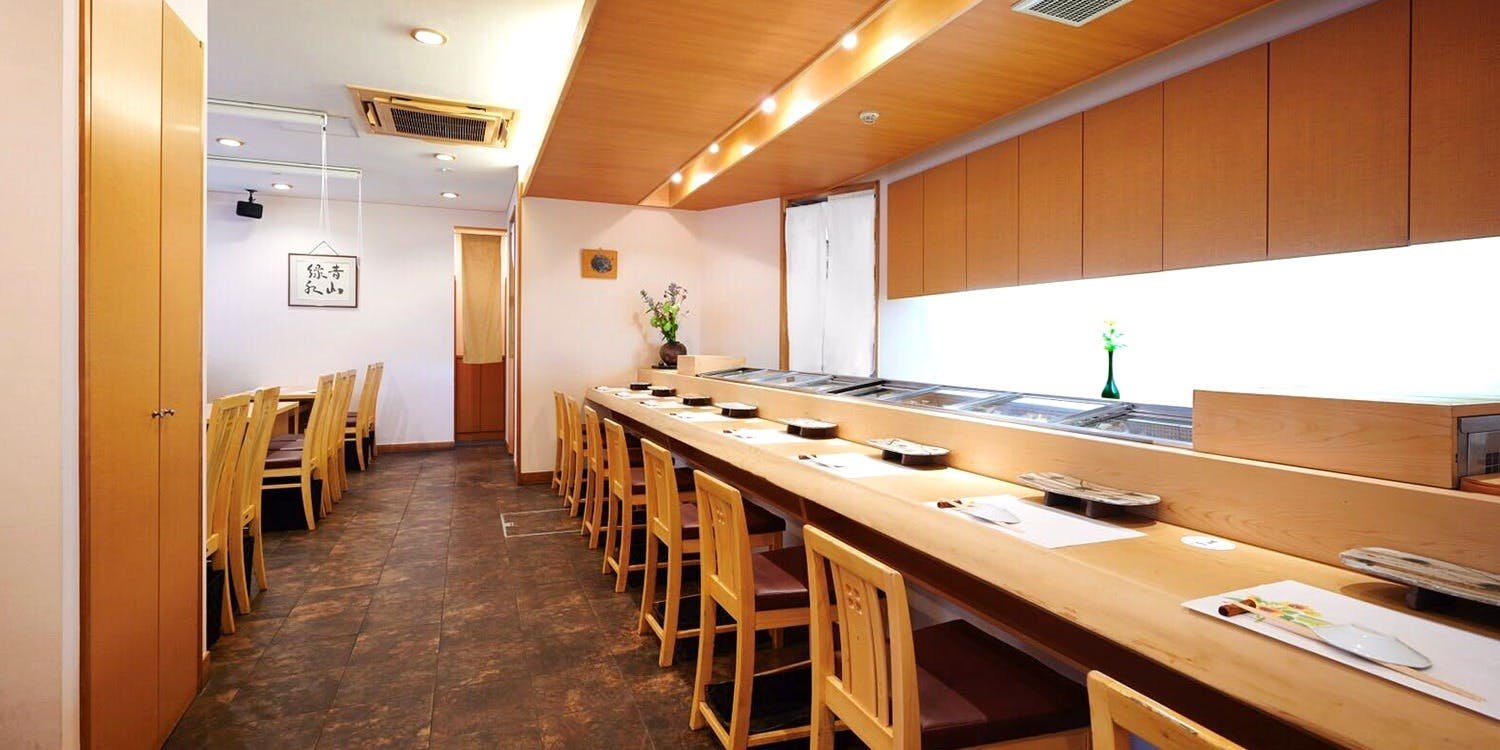
A calm Japanese setting with a fragrant wood counter, comfortable brightness, and private rooms designed to preserve some of the live sushi-counter atmosphere.