
Michelin Plate
Our verdict
The kitchen roasts a crossbreed of Cherry Valley and local white duck over date wood, a sourcing decision that sits at the centre of its approach to Beijing's most scrutinised dish.

Pearl is the En Primeur Club membership app, where members save venues, book tables and use the concierge.
The gong announces the duck. It is a small theatrical moment, but it orients every table toward the ceremony at hand, which is appropriate given how much weight Beijing places on Peking duck as a measure of a kitchen's seriousness. In a city where the dish appears at every price tier from ¥50 canteens to multi-course formal dinners, the restaurants that occupy the upper end of that range are judged on sourcing as much as technique.
The Duck, and Where It Comes From
The sourcing question at the centre of Peking duck has been contested for decades. Traditional accounts point to the white Pekin duck raised around Beijing, but the commercial pressures of volume service pushed many kitchens toward faster-growing hybrid breeds with higher fat content and lower cost. 1949 - Duck de Chine addresses this directly by using a crossbreed of Cherry Valley and local white duck, a choice that tries to split the difference between modern consistency and the richer flavour profile associated with slower-raised birds.
Cherry Valley ducks, developed in the United Kingdom in the mid-twentieth century from Pekin stock, became globally dominant in commercial duck production because of their feed-conversion efficiency and rapid growth rate. Using them in combination with local Beijing white duck is a sourcing strategy that attempts to retain some of the regional character of the traditional bird while managing the supply reliability that a high-volume operation requires. It is a pragmatic compromise, and an honest one, in a category where many restaurants say less about the bird than they should.
The fuel matters as much as the breed. Date wood fires burn hotter and with more aromatic intensity than the fruit woods used in some alternative preparations, and the choice connects to older northern Chinese roasting traditions. The combination of duck breed, wood fuel, and the enclosed oven technique that defines Beijing-style roasting (as distinct from the hung-oven methods used elsewhere) determines how the skin crisps and how the fat renders. These are technical variables, not decorative ones, and the kitchen at 1949 - Duck de Chine has structured its menu around them.
Before the Duck Arrives
The kitchen offers starting dishes that occupy the waiting time while the duck roasts. Deep-fried king oyster mushrooms and mustard duck web are among the listed items, both choices that keep the flavour register within the same northern Chinese reference frame. King oyster mushrooms hold their structure under high-heat frying in a way that softer varieties do not, and the mustard preparation of duck web belongs to a longer tradition of using the less immediately appealing parts of the bird with serious culinary attention. These are dishes that ask something of the diner, which is consistent with the restaurant's overall register.
Beijing's premium Chinese dining tier has fragmented in interesting ways over the past decade. Taizhou-inflected seafood from kitchens like Xin Rong Ji (Xinyuan South Road) competes for the same formal-dinner occasion as Chaozhou specialists like Chao Shang Chao (Chaoyang), while vegetarian-focused rooms like Lamdre and King's Joy have carved a distinct niche at the higher end of the market. Beijing-cuisine specialists, including Jingji, address the capital's own culinary inheritance more directly. Within that set, 1949 - Duck de Chine occupies a specific position: it is a single-dish specialist working inside an imperial aesthetic, and it prices and presents itself accordingly.
Across greater China, the divide between heritage-format restaurants and those pursuing regional cuisine specialisation has become more pronounced. In Shanghai, 102 House works a similar tension between architectural grandeur and culinary tradition. In Macau, Chef Tam's Seasons operates at the formal Cantonese end of the spectrum. Further south, Imperial Treasure Fine Chinese Cuisine in Guangzhou applies a different set of standards to Cantonese fine dining. The Beijing courtyard-restaurant format that 1949 - Duck de Chine employs has its own distinct logic, rooted in the architecture of the northern capital rather than the commercial hotel dining rooms that dominate much of the region's premium Chinese scene. Other Chinese culinary traditions with strong regional sourcing identities can be found at Ru Yuan in Hangzhou, Xin Rong Ji in Chengdu, and Dai Yuet Heen in Nanjing. Given the theatrical format and the gong ceremony, this is a room that rewards arriving at a considered pace rather than treating it as a quick dinner. Booking ahead is advisable; the courtyard-house format imposes natural capacity limits that make walk-in availability inconsistent, particularly on weekend evenings and during peak tourist periods in spring and autumn. For a broader picture of what Beijing's dining scene offers across price points and cuisines, see our full Beijing restaurants guide, as well as our Beijing hotels guide, bars guide, wineries guide, and experiences guide.
Frequently asked questions
Would 1949 - Duck de Chine be comfortable with kids?
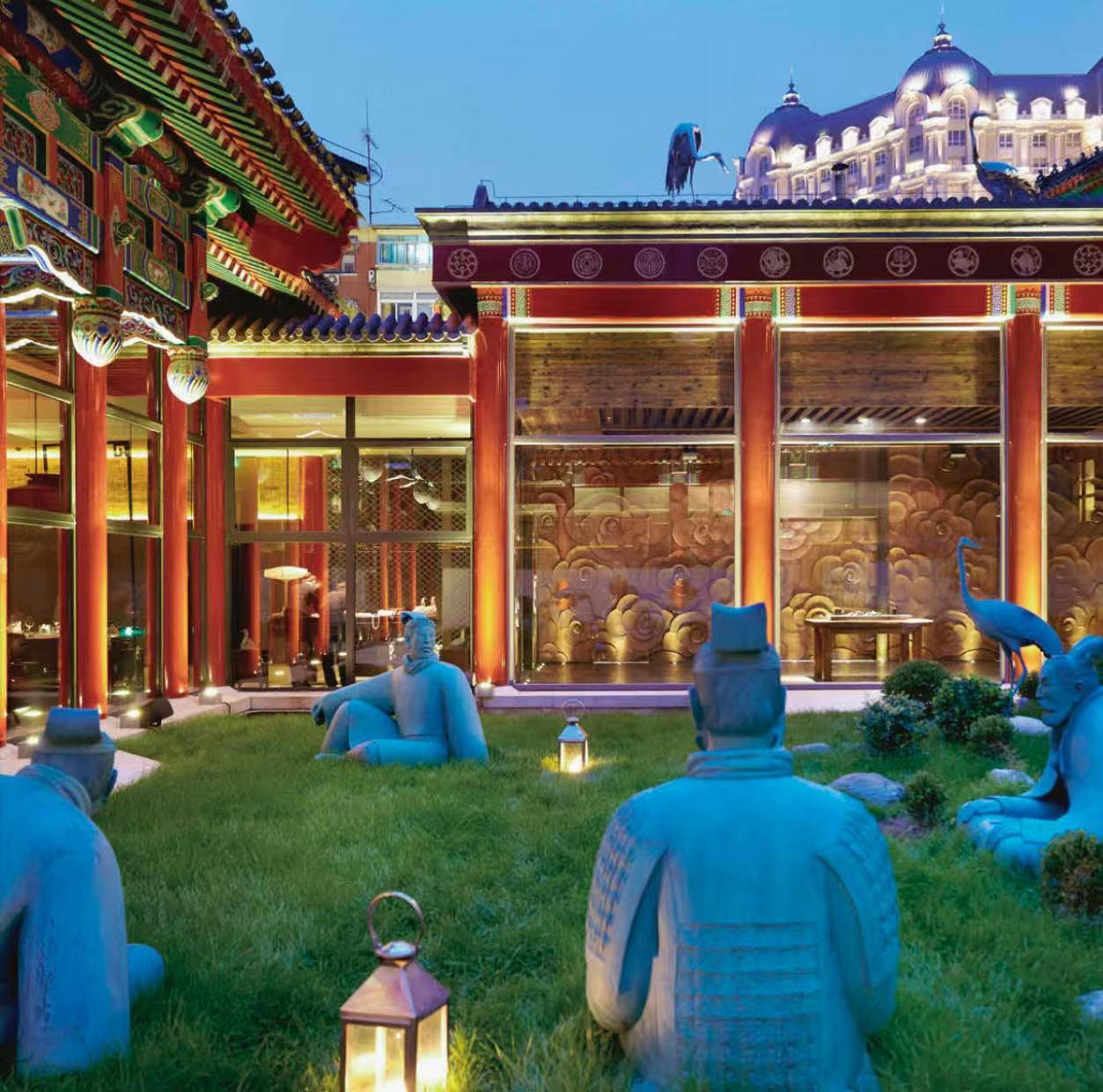
The theatrical format, including terracotta soldiers, painted beams, red pillars, and a gong announcement when the duck is served, tends to hold children's attention. The setting at 98 Jinbao Street is a converted courtyard house, so the space is open and less pressured than a formal dining room. Starter dishes like deep-fried king oyster mushrooms give younger diners something to eat while the duck finishes roasting.
What's the overall feel of 1949 - Duck de Chine?
The restaurant occupies a courtyard house in Dongcheng decorated with life-size terracotta soldiers, painted beams, and red pillars, all framing Peking duck as a ceremonial event rather than a casual meal. Service is punctuated by a gong when the duck arrives, which sets the tone: this is a production as much as a dinner. The imperial visual language is deliberate and dense, referencing Beijing's ceremonial past throughout.
Does 1949 - Duck de Chine have a Michelin star or similar recognition?
1949 - Duck de Chine has received recognition including: As you set foot in this courtyard house-turned-restaurant, it’s hard to miss the life-size terracotta soldiers, painted beams and red pillars. All of these decorative elements impart a majestic feel befitting its imperial speciality – Peki….
What should I order at 1949 - Duck de Chine?
The Peking duck is the centrepiece, roasted over date wood using a crossbreed of Cherry Valley and local white duck. While the duck roasts, the kitchen sends out starting dishes: deep-fried king oyster mushrooms and mustard duck web are among the documented options. Ordering the duck is non-negotiable; the starters exist to occupy the waiting time productively.
What's 1949 - Duck de Chine's location?
1949 - Duck de Chine is located at 98 Jinbao Street, Dongcheng, Beijing.
How far ahead should I plan for 1949 - Duck de Chine?
1949 - Duck de Chine at 98 Jinbao Street is one of Dongcheng's most visited addresses for Peking duck, drawing both Beijing residents and international visitors. Reservations in advance are advisable, particularly for weekend evenings or larger groups. Check current availability directly, as booking windows shift with season and demand.
At-a-Glance Comparison
Comparable venues nearby, for context on price, style, and recognition.
| Venue | Cuisine | Price | Awards | Notes |
|---|---|---|---|---|
| 1949 - Duck de ChineThis venue (the venue you are viewing) | Modern Peking Duck | $50–100 | Michelin Plate | Not listed |
| Top Feast (East Chang'an Street) | Imperial Beijing Fine Dining | Not listed | Michelin Plate | Zhengyilu |
| Vege Wonder | Modern Chinese Vegetarian | $100–150 | We're Smart World 5 Radishes | Dongcheng |
| Qiao Dong Bei (Dongcheng) | Modern Dongbei | Not listed | Michelin Plate | Chungshu |
| Jia (Chaoyang) | Cantonese | Not listed | Michelin Plate | Dongzhimen |
| Huaiyang Fu (Dongcheng) | Huaiyang Cuisine | $20–30 | La Liste Top Restaurants | Anwaidajie |
Recognition history
Dated appearances from independent guides and award organizations, with the underlying list record or original source where available.
Michelin Plate
Michelin · 2026 Michelin Plate
Continue exploring
More in Beijing
Restaurants in Beijing
All restaurants in Beijing →
Bars in Beijing
All bars in Beijing →
Details
- Elegant
- Sophisticated
- Cozy
- Classic
- Business Dinner
- Special Occasion
- Date Night
- Private Dining
- Open Kitchen
- Extensive Wine List
- A La Carte
- Vegetarian Friendly
- Gluten Free Options
Classical and elegant new Chinese style with warm red color scheme, painted beams, red pillars, spacious and low-key luxurious atmosphere.