


Michelin Guide New Hotels New Hotel · Michelin Selected · Star Wine List
The Ritz-Carlton, Harbin sits on West Youyi Road in the Daoli District, its angular glass facade drawing directly from the fractured ice sheets of the Songhua River below. The property holds a Star Wine List recognition for 2026, placing it among a small tier of hotels in northeastern China where the wine program carries independent credibility. For visitors arriving during ice season, the architecture and the setting are inseparable.

Pearl is the En Primeur Club membership app, where members save venues, book tables and use the concierge.
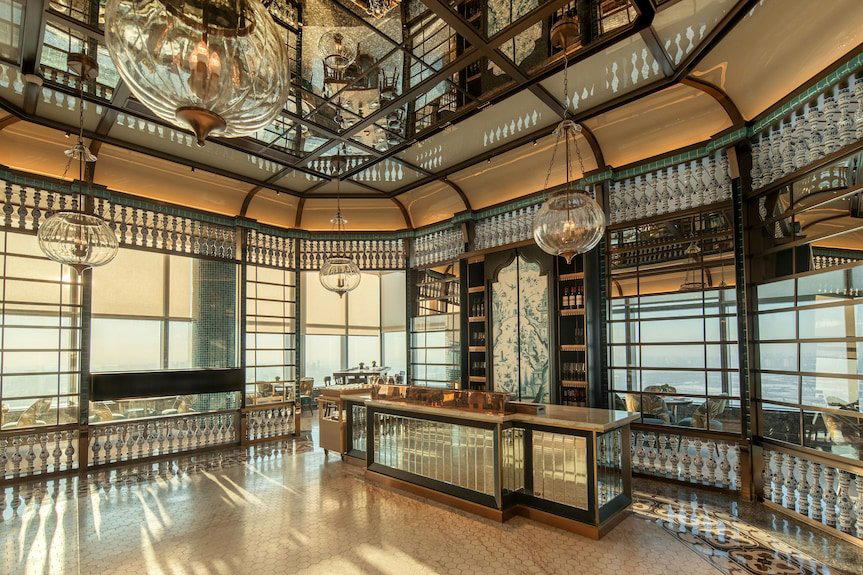
A Building That Answers Its River
Harbin has always had an unusual relationship with cold. The city built an international reputation not by sheltering from its Manchurian winters but by turning them into spectacle: the annual Ice and Snow World festival draws millions to a range of carved towers and illuminated corridors assembled from blocks cut directly from the Songhua River. The Ritz-Carlton, Harbin sits at Tower 1, No. 660 West Youyi Road in the Daoli District, positioned above that same river, and its architecture participates in that cultural logic rather than standing apart from it. The angular glass facade fragments light in the manner of splintering river ice, a design reference that becomes literal when winter sets in and the Songhua freezes below. Few hotels in China make their structural concept this legible from the outside, and fewer still have the geographical context to make it meaningful.
That approach, where the building responds to its specific physical environment rather than importing a generic luxury vernacular, places the Ritz-Carlton Harbin in a different conversation from properties that treat their facades as branding exercises. Chinese luxury hospitality has split in recent years between large-footprint international flagships and a smaller set of location-responsive designs. This property sits closer to the latter sensibility, even within a global chain context. For reference points across the country, Amanfayun in Hangzhou and Amandayan in Lijiang represent the smaller, more site-specific tier; the Ritz-Carlton Harbin operates at a different scale but shares that instinct to let geography drive form.
The Ice City Context
Harbin's positioning within Chinese travel has shifted considerably. A decade ago it functioned primarily as a domestic winter destination anchored by the ice festival. That identity remains, but the city has drawn growing international interest as travelers extend northeast China itineraries beyond Beijing and Shanghai. The Daoli District, where the hotel sits, is the historic commercial core: Russian-influenced architecture from the early twentieth century lines its central streets, and the Central Street pedestrian boulevard runs a short distance away. For visitors using the hotel as a base for the broader city, that location provides walkable access to Harbin's most photographed neighborhoods without requiring daily transport.
Winter arrival is the default assumption for most visitors, and the hotel's architectural concept fully justifies that timing. But the Songhua River has a distinct character across seasons, a wide, flat body of water that hosts boat traffic in summer and becomes a frozen platform for ice-sculpting crews and festival infrastructure in December and January. A stay at any point in the year reads differently against that view, and the glass facade means the river is a constant visual presence from the building's upper floors.
For travelers building a broader northeastern China itinerary, the region offers additional reference points: Vanke Lake Songhua Yunlu Hotel in Jilin sits along the same river system further upstream, and Beidahu Asian Games Village in Jilin province serves the ski market that overlaps with Harbin's winter visitor base. Mohe Youran Mountain Residence in Da Hinggan Ling represents the far northern extreme of that circuit, near China's aurora-viewing corridor.
The Wine Program as a Signal
The Star Wine List recognition for 2026 is worth reading carefully. Star Wine List operates as an independent wine publication that audits hotel and restaurant programs across a global set, awarding recognition based on list depth, sourcing breadth, and selection integrity rather than on commercial relationships. A hotel in Harbin holding that credential in 2026 indicates a wine program that has been assessed against international peers, not simply praised in local context. In northeastern China, that tier of independent wine recognition is rare, most luxury hotel wine programs in second- and third-tier Chinese cities operate without external audit or international credentialing.
For travelers who weight the wine program as a meaningful part of a hotel stay, that recognition shifts the Ritz-Carlton Harbin from a geographically interesting choice to one with documented program credibility. It also implies a food and beverage operation with enough seriousness to seek and sustain that kind of external validation. For comparison, Mandarin Oriental Qianmen in Beijing and JW Marriott Hotel Shanghai at Tomorrow Square operate in cities with denser competitive wine markets; the Harbin property earning that credential from a smaller, less concentrated scene is a different kind of signal.
Placing the Property in Its Tier
Within China's luxury hotel market, the Ritz-Carlton brand occupies a consistent upper-midrange position: above the standard international business hotel tier, below the allocation-only ultra-luxury segment represented by properties like the Aman group. That positioning is largely stable across the brand's Chinese properties, from coastal cities to inland destinations. What differentiates individual Ritz-Carlton properties within China is typically location specificity and F&B; program quality, two areas where the Harbin property makes claims worth examining.
The architecture, as noted, is location-specific in a way that goes beyond decorative gesture. The Star Wine List recognition addresses F&B; program quality with an independent data point. Together, those two factors suggest a property that has invested in distinguishing itself within the brand's own tier rather than relying solely on brand equity. For travelers comparing options across China, that distinction matters. Other strong regional alternatives at different price and style points include Andaz Shenzhen Bay, Conrad Tianjin, and Altira Macau, each operating in a different geographic and competitive context.
For those extending travel beyond China, the same editorial lens applies: Aman New York and Aman Venice sit at the ultra-luxury end of the international spectrum, while The Fifth Avenue Hotel in New York City occupies a boutique-adjacent tier with its own distinct credentialing.
Planning a Stay
The hotel sits in the Daoli District, which places it within the historic and commercial core of Harbin. Peak demand concentrates in December and January, when the Ice and Snow World festival operates and temperatures drop to ranges that make the ice architecture possible, typically between minus 15 and minus 30 Celsius. Booking well ahead of that window is standard practice; the festival draws domestic and international visitors in significant volume, and the upper-tier hotel inventory in Harbin is limited relative to Beijing or Shanghai. Spring and summer represent a quieter alternative with a different reading of the riverside setting.
Reservations through the Ritz-Carlton's global booking platform or through a travel specialist with China expertise are the practical paths. For further context on the broader Harbin dining and hospitality scene, see our full Harbin restaurants guide.
Side-by-Side Snapshot
Comparable venues nearby, for context on price, style, and recognition.
| Venue | Cuisine | Price | Awards | Notes |
|---|---|---|---|---|
| The Ritz-Carlton, HarbinThis venue (the venue you are viewing) | Contemporary luxury with Art Deco influences | Not listed | Michelin Guide New Hotels New Hotel · Michelin Selected | Not listed |
| Artyzen NEW BUND 31 Shanghai | modern lifestyle hotel | $200–300 | Michelin Selected · Preferred Hotels Member | Qiantan |
| Deqin Meri Poodom | Modernist architecture inspired by local Tnkhar houses and whitewash textures, perched at high altitude. | $300–500 | 1 Michelin Key | Shengping Town |
| Hebei Grand Hotel | Modern interpretation of classic Chinese courtyards | $1–100 | Not listed | Zhengding |
| W Changsha | Futuristic luxury hotel inspired by stars and galaxy | Not listed | Michelin Selected | Yuhua District |
| W Shanghai | Futuristic luxury towers fusing Shanghai's past, present, and future. | $200–300 | Michelin Selected | North Bund |
Recognition history
Dated appearances from independent guides and award organizations, with the underlying list record or original source where available.
Michelin Guide New Hotels New Hotel
Michelin Guide New Hotels
Michelin Selected
Michelin
Star Wine List
Star Wine List
Forbes Recommended
Forbes
Continue exploring
More in Harbin
Restaurants in Harbin
All restaurants in Harbin →
Details
- Elegant
- Sophisticated
- Ornate
- Romantic Getaway
- Business Trip
- Anniversary
- Panoramic View
- Butler Service
- Wi Fi
- Pool
- Spa
- Fitness Center
- Room Service
- Concierge
- Business Center
- Valet Parking
- Garden
- Wheelchair Accessible
- Elevator
- Accessible Restroom
- Step Free Entrance
- Accessible Parking
Elegant and serene atmosphere with soundproofed rooms, premium bedding, and relaxing spa facilities.