Green Lake Hotel Kunming occupies a address on South Cuihu Road, positioned directly alongside the city's most celebrated urban park. The property sits within a neighbourhood defined by colonial-era architecture, lakeside promenades, and proximity to Kunming's political and cultural institutions, placing it among the city's most historically grounded hotel addresses.
 Discover on Pearl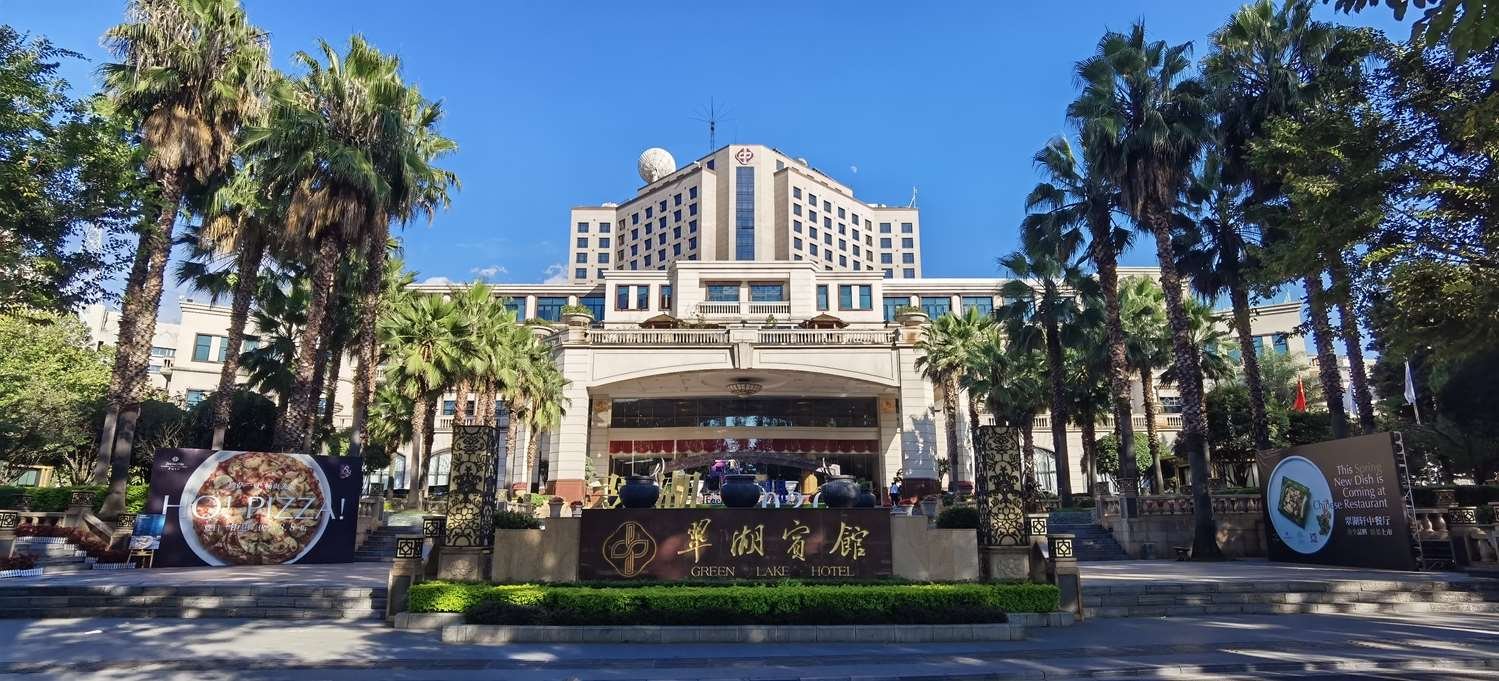
A Lakeside Address in Kunming's Most Storied Quarter
Cuihu Park, the green lung at the centre of Kunming's older residential and governmental districts, sets the terms for everything around it. The lake draws early-morning tai chi practitioners, retired calligraphers who brush characters in water on stone pavements, and migratory black-headed gulls from Siberia that arrive each winter in numbers large enough to become a civic event. Hotels that sit directly on South Cuihu Road inherit this context whether they choose it or not. Green Lake Hotel Kunming, at number 6, occupies one of the most historically weighted positions on that address, where the distinction between the property and its park setting is less a boundary than a gradient.
Yunnan's capital has long occupied an unusual position in Chinese urban geography: high-altitude, temperate, ethnically layered, and administratively significant as the gateway to Southeast Asia. The neighbourhood around Cuihu reflects that complexity in its built environment. Republican-era structures sit alongside Soviet-influenced institutional buildings from the 1950s and more recent additions, producing a streetscape that reads as a compressed record of the city's twentieth century. Positioning a hotel at this address is less a real estate decision than a statement about which version of Kunming the property intends to represent.
The shortlist, unlocked.
Hard-to-book tables, cellar releases, and concierge-planned trips.
Get Exclusive Access →The Architecture of Place
Hotels built into historically dense neighbourhoods in Chinese cities fall into two broad types: those that replace existing fabric with contemporary towers and those that work within or alongside the inherited scale and material palette of the area. The Cuihu district, with its mature plane trees, two-storey shophouses, and low institutional buildings set back from broad pavements, rewards the second approach. A property that reads as continuous with the lakeside setting, rather than imposed upon it, earns a different relationship with its guest than a glass-and-steel tower that happens to face water.
The architectural conversation between large heritage-adjacent hotels and their neighbourhoods is one that plays out differently across China's interior cities than on the coast. Compare the approach seen at Amanfayun in Hangzhou, where an entire lane of tea-farmer houses was preserved and adapted into rooms, or at Amandayan in Lijiang, which works within the Naxi old-town grain. Properties in Kunming's Cuihu district operate within a different constraint set — the surrounding fabric is mixed rather than uniformly historic — but the underlying editorial question is the same: does the building belong to its place, or merely occupy it?
For travellers arriving from properties like Mandarin Oriental Qianmen in Beijing or Andaz Shenzhen Bay, where design identity is established through controlled interior environments largely independent of what lies outside, Kunming's lakeside hotels offer a different proposition: the outdoor setting does significant work that interior design cannot replicate.
Kunming as a Destination Context
Yunnan Province has been drawing international and domestic travellers at an accelerating pace over the past decade, driven by its biodiversity, its ethnic minority cultures, and its position as a staging point for travel toward Lijiang,, and the Tibetan plateau. Kunming itself functions primarily as an entry and exit point, which means most visitors spend one or two nights in the city rather than treating it as a destination in its own right. Hotels that offer a reason to stay longer, rather than simply providing a clean transit stop, serve a different market segment.
The Cuihu neighbourhood is one of the strongest arguments for slowing down. A morning circuit of the lake on foot takes under an hour and passes the Yunnan Provincial Museum, the former French Consulate building, and several of the campuses that make this part of the city academically dense. The Bird and Flower Market, a few minutes' walk south, has operated in various forms for decades and remains one of the more honest retail environments in the city, largely unchanged by the tourism infrastructure that has transformed parts of Lijiang and Dali. For travellers comparing notes with peers who have stayed at Banyan Tree Ringha in or Xiamen Yunding Resort, a Cuihu-adjacent base in Kunming offers urban density rather than resort remove.
Yunnan cuisine, one of China's most internally diverse regional traditions, is well represented in the streets around Cuihu. The province's cooking draws on Dai, Bai, Yi, and Han traditions simultaneously, with rice noodles, wild mushrooms, goat cheese, and air-cured meats appearing in combinations that have no parallel in eastern Chinese cooking. Restaurants within walking distance of South Cuihu Road span the range from roadside crossing-the-bridge noodle shops to more considered Yunnan fine dining formats. Our full 昆明市 restaurants guide maps the eating options with more granularity than a hotel recommendation list can accommodate.
Placing the Property in Its Competitive Set
Kunming's hotel market has fragmented over the past decade in ways that mirror broader Chinese urban patterns. International chain hotels, mostly in the five-star category, cluster around the high-speed rail station and the financial district to the east. Boutique and design-led properties are still emerging as a category in the city, without the critical mass seen in Chengdu or Xiamen. A third tier, comprising older established hotels in historically significant locations, holds its position through address and institutional familiarity rather than through programme innovation or design renovation.
Green Lake Hotel's position on South Cuihu Road places it in this third category, where the primary credential is locational rather than operational. For travellers who prioritise address over amenity mix, this is a coherent choice. For those whose decision framework weights design, restaurant programme, or international brand consistency more heavily, the comparison set extends to JW Marriott Hotel Shanghai at Tomorrow Square or Conrad Guangzhou, both of which deliver on those metrics in their respective cities. The Cuihu address does something those properties cannot, which is to put the guest directly at the edge of Kunming's most characterful public space from the first step outside.
Planning a Stay
Kunming operates on standard Chinese hotel booking channels, and South Cuihu Road is accessible from Kunming Changshui International Airport in approximately forty minutes by taxi or shuttle. The city's spring and autumn months, roughly March through May and September through November, offer the most consistently mild conditions; Kunming's altitude of approximately 1,900 metres keeps summer temperatures moderate even when the rest of southwestern China is at peak heat. The winter months bring the Siberian gull migration to Cuihu, which peaks between December and February and draws considerable domestic visitor traffic to the park immediately adjacent to the hotel. Travellers continuing north or west into Yunnan should confirm onward transport from Kunming North Station, now the primary high-speed rail terminus for provincial connections.
Frequently Asked Questions
- What should I expect atmosphere-wise at Green Lake Hotel Kunming?
- The atmosphere is shaped more by the surrounding neighbourhood than by the hotel's interior programme. South Cuihu Road fronts directly onto one of Kunming's most active public parks, meaning mornings bring park-goers, street vendors, and the sounds of the lake's bird life. The area is calm rather than commercial, and the general character is that of an older, residentially established city quarter rather than a hotel district.
- What is the signature room type or position at Green Lake Hotel Kunming?
- Rooms with direct park or lake orientation are the logistical priority when booking. The hotel's position on South Cuihu Road means that park-facing rooms receive the visual and acoustic benefit of the green space rather than street-facing urban noise. This is the clearest differentiator within the property's own room tier, independent of category or price.
- What is Green Lake Hotel Kunming known for?
- The property is primarily associated with its address: South Cuihu Road is among the most historically and scenically weighted hotel positions in Kunming. The hotel has served as accommodation for visiting officials and cultural figures over several decades, which gives it a form of institutional recognition in the city that newer properties have not yet accumulated. Its proximity to Cuihu Park, the Yunnan Provincial Museum, and the university quarter defines its reputation more than any single interior feature.
- Is Green Lake Hotel Kunming a good base for exploring Yunnan Province beyond Kunming?
- For travellers using Kunming as a staging point for Yunnan itineraries that extend toward Lijiang, Dali, or the Tibetan plateau, the Cuihu address offers a more characterful overnight than the airport-adjacent or financial-district options. High-speed rail connections from Kunming North Station reach Lijiang in under three hours, and the city's bus and domestic flight network covers the province's main tourism hubs. Comparable approaches to using a culturally grounded city base before moving into more remote Yunnan terrain are taken by travellers who stay at Amandayan in Lijiang or Banyan Tree Ringha further along the route.
A Quick Peer Check
These are the closest comparables we have in our database for quick context.
| Venue | Cuisine | Price | Awards | Notes |
|---|---|---|---|---|
| Green Lake Hotel Kunming | This venue | |||
| Aman Summer Palace | ||||
| Amanfayun | ||||
| Amanyangyun | ||||
| Andaz Xintiandi, Shanghai | ||||
| Banyan Tree Hangzhou |
Preferential Rates?
Our members enjoy concierge-led booking support and priority upgrades at the world's finest hotels.
Get Exclusive AccessThe shortlist, unlocked.
Hard-to-book tables, cellar releases, and concierge-planned trips.
Get Exclusive Access →