
Selected by the Michelin Guide Hotels 2025, Hotel Boutique Adolfo occupies one of Toledo's most historically layered addresses on Plaza Zocodover. The property sits where the city's medieval, Moorish, and Christian architectural traditions converge, making its physical context as weighted as anything inside. For travellers treating Toledo as a serious destination rather than a day trip from Madrid, it operates as a credible base.
Pearl is the En Primeur Club membership app — saves, bookings, and concierge access live there. Same editors, same standards.
- Address
- Pl. de Zocodover, 14, 45001 Toledo, Spain
- Phone
- +34 925 25 29 19
- Website
- hotelboutiqueadolfo.com
- Directions
- Get directions
 Saves & bookings on Pearl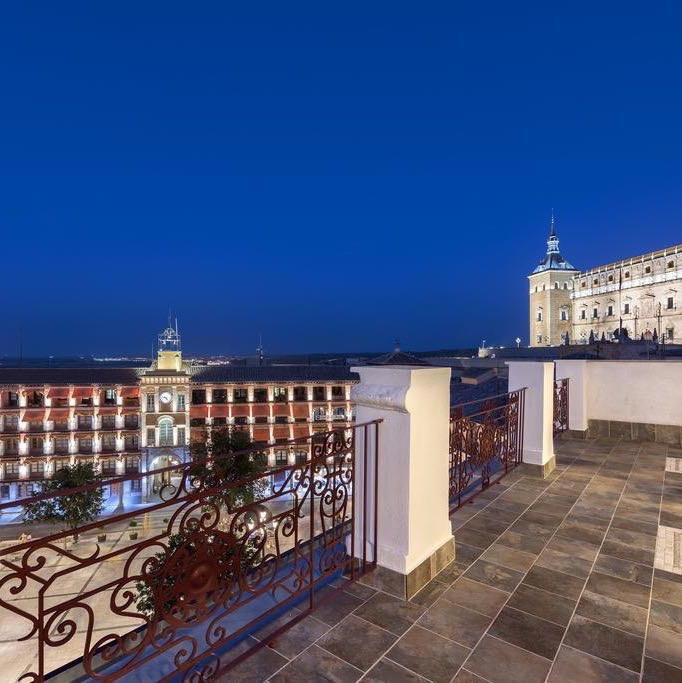
Where Toledo's Layers Come Into Focus
Toledo is a city that rewards attention paid to surfaces. The stonework on a single block can shift from Visigothic foundation to Moorish arch to Castilian Baroque overhang within a few metres, and the ideal way to read that density is from somewhere inside it rather than arriving by coach from Madrid. Plaza Zocodover sits at the centre of that compressed history: the square that served as the city's commercial hub under Moorish rule, later as the site of the Inquisition's public ceremonies, and today as the clearest entry point into Toledo's medieval core. Hotel Boutique Adolfo addresses this plaza directly, which means its physical relationship to the city is not incidental but structural.
The Michelin Guide's selection of Hotel Boutique Adolfo for its 2025 Hotels list places it in a category defined less by room count or amenity breadth and more by character, specificity, and a clear sense of place. The hotel has 12 rooms and a 4-star rating, with rates from about $190 per night. Michelin's hotel selection criteria have consistently favoured properties where the building itself carries editorial weight, and in Toledo, that bar is high given the competition from the city's historic fabric.
The Architecture as Argument
Toledo's historic centre is a UNESCO World Heritage Site, which imposes both constraints and advantages on any property operating within it. Constraints come from strict preservation requirements that govern what can be altered, extended, or modernised. The advantage is that a building in this zone arrives pre-loaded with centuries of physical character that no new-build can replicate through design alone.
Boutique hotels operating inside UNESCO-protected medieval cores across Spain have developed a recognisable approach: work with exposed stone and timber rather than against it, allow the original structure to set the spatial logic, and introduce contemporary comfort as a layer that reads as distinct from rather than mimicking the historic shell. This is the same approach evident at comparable Spanish properties such as Caro Hotel in València and Hotel Mercer Sevilla in Seville, both of which anchor their identity in archaeological and architectural depth rather than decorative programming.
At Plaza Zocodover 14, the building's position on one of Spain's most historically charged public squares means that the architectural conversation extends outward. The square's geometry, the sight lines to the Alcázar above, and the narrow streets radiating into the Judería and the old mosque quarter all form part of what a guest experiences from any window or terrace facing the city. This is a specific kind of architectural argument that larger, purpose-built hotels in Toledo's periphery cannot replicate regardless of their amenity list.
Toledo's Boutique Hotel Tier
Toledo's accommodation market splits clearly into two zones: large historic paradors and modern chain hotels positioned near the train station and the outer ring, and a smaller tier of boutique properties embedded in the old city. The latter group operates at closer quarters with the city's actual fabric and typically commands attention from travellers who consider the walk from their room to a Romanesque church or a Toledan damascene workshop as part of the value proposition.
Within Spain's broader boutique hotel category, the Michelin selection signals peer alignment with properties like Atrio Restaurante Hotel in Cáceres, another heritage-city property where the building's relationship to its historic environment is the primary editorial fact, or Terra Dominicata in Escaladei, where landscape and structure operate together as the guest experience. These are not properties competing on pool size or spa square footage. Their competitive currency is depth of place.
That comparable set sits some distance below the urban luxury tier anchored by properties like the Mandarin Oriental Ritz in Madrid or Mandarin Oriental Barcelona, where full-service luxury programming and brand infrastructure drive the proposition. Hotel Boutique Adolfo has 12 rooms, so its scale is far more intimate. Toledo's scale and character make that model less relevant here, and Hotel Boutique Adolfo is correctly positioned in the specialist boutique tier where specificity of place matters more than breadth of facilities. Travellers accustomed to those larger properties and looking for something calibrated differently will find the contrast sharpening rather than diminishing the experience.
The Case for Staying Rather Than Day-Tripping
Toledo sits roughly 75 kilometres south of Madrid, and the high-speed AVE train covers the distance in under 30 minutes from Atocha, which makes it technically viable as a day trip. Most travellers who treat it that way report spending their time in the obvious circuits: the Cathedral, El Greco's house, the Alcázar, lunch on the plaza, train home. That is a version of Toledo, but a compressed one that misses what the city actually holds in its quieter hours.
The old city empties of coach-tour traffic by late afternoon, and the streets that were impenetrable at midday become navigable by early evening. The light on Toledan stone in the hour before sunset has a quality that travel writers have been describing for centuries, and it is only accessible to people who are still there. Staying inside the historic core rather than commuting from a peripheral hotel means those hours are part of the itinerary rather than missed. Plaza Zocodover's position at the hinge between the main tourist circuit and the quieter residential quarters of the old city makes the hotel a useful base for that kind of visit.
For practical planning, Toledo's old city is dense and largely pedestrianised, so arriving by train and transferring to the plaza area on foot or by taxi is standard. The Michelin selection, while not a reservation system, does signal that the property has passed scrutiny for quality and character, which is a useful calibration point when booking independently. Travellers planning a stay during Toledo's Corpus Christi celebrations in late spring or during the summer high season should account for heavier demand across all city-centre properties. See our full Toledo restaurants guide for context on the dining options within walking distance.
How It Fits a Wider Spain Itinerary
Toledo pairs naturally with a Madrid base or as a standalone stop on a Castilla-La Mancha circuit. Travellers building a longer Spain itinerary that moves between heritage cities and design-led rural properties might consider how the hotel connects thematically with Abadía Retuerta LeDomaine in Teruel or the wine-estate approach of Torre del Marqués Hotel Spa & Winery in Sardoncillo, both of which share the character-over-amenity logic that defines the Michelin boutique selection in Spain.
Those extending to coastal or island properties can trace a coherent thread through Cap Rocat in Cala Blava, Hotel Can Ferrereta in Santanyí, or La Residencia, A Belmond Hotel, Mallorca, all of which operate in the same register of architecture-led hospitality. For Galicia, Pepe Vieira Restaurant & Hotel in Poio and Casa Beatnik Hotel in A Coruña represent the Atlantic end of the same spectrum. Further afield, Akelarre in San Sebastián, Mas de Torrent Hotel & Spa in Torrent, Hotel Mas Lazuli in Girona, Predi Son Jaumell in Capdepera, Finca Serena Mallorca in Montuïri, Marbella Club Hotel in Marbella, and Royal Hideaway Corales Resort in Adeje each represent distinct nodes in Spain's premium accommodation map. Beyond Spain, the Hotel Can Cera in Palma and international reference points like The Fifth Avenue Hotel in New York City, Badrutt's Palace Hotel in St. Moritz, and Hôtel de Paris Monte-Carlo in Monte Carlo illustrate the broader range of what Michelin's hotel recognition spans globally.
How It Stacks Up
Comparable venues nearby, for context on price, style, and recognition.
| Venue | Cuisine | Price | Awards | Notes |
|---|---|---|---|---|
| Hotel Boutique AdolfoThis venue — the venue you are viewing | Contemporary boutique hotel blending heritage charm with modern minimalist design in a restored historic building. | $$$ | 4-Star | Not listed |
| NH Collection Madrid Gran Vía | Contemporary luxury boutique hotel blending modern elegance with historic architecture on Madrid's most well-known avenue. | $$$ | 4-Star | Sol |
| Vincci Molviedro | Contemporary Andalusian fusion in historic buildings | $$$ | 4-Star | Centro |
| Parador de Baiona | Historic fortress-palace hybrid combining medieval fortification with 19th-century Neo-Gothic architecture, operated by Spain's prestigious Paradores chain. | $$$ | 4-Star | Monterreal Peninsula |
| Madrid Marriott Auditorium Hotel & Congress Center | Contemporary business conference hotel with extensive event facilities | $$$ | 4-Star | Iveco Pegaso |
| Hotel Boutique Can Sastre | rustic-meets-luxury historic boutique | $$$ | 4-Star | Ciutadella old town |
Recognition history
Dated appearances from independent guides and award organizations, with the underlying list record or original source where available.
Michelin Selected
Michelin
Continue exploring
More in Toledo
Bars in Toledo
Browse all →
Restaurants in Toledo
Browse all →
Wineries in Toledo
Browse all →
At a Glance
- Romantic
- Elegant
- Quiet
- Classic
- Romantic Getaway
- Weekend Escape
- Anniversary
- Historic Building
- Terrace
- Panoramic View
- Design Destination
- Wi Fi
- Concierge
- Room Service
- Bar
- Restaurant
- Airport Shuttle
- Air Conditioning
- Street Scene
- Wi Fi
- Concierge
- Room Service
- Bar
- Restaurant
- Airport Shuttle
- Air Conditioning
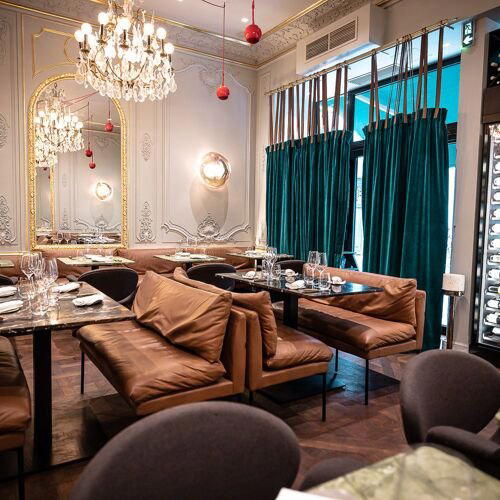
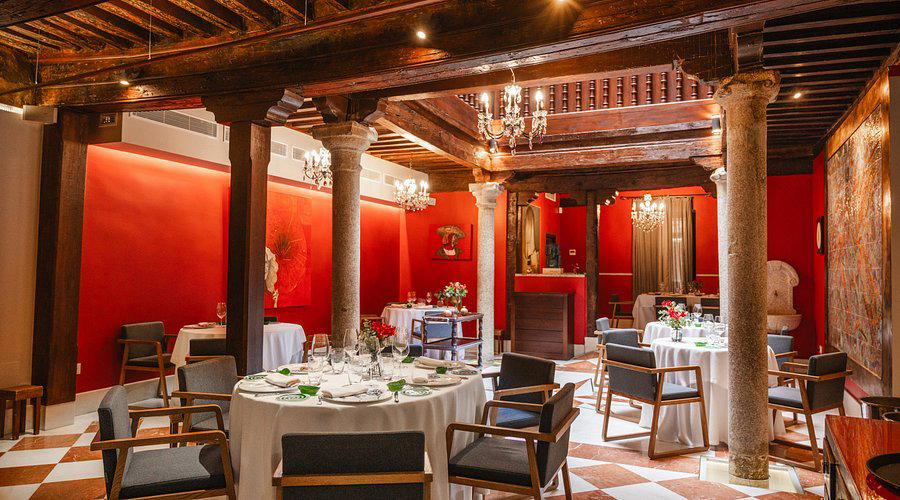
Stylish and serene with contemporary design elements, warm lighting from the terrace overlooking the square, and carefully curated traditional touches like exposed wooden beams.