Hotel Arena Amsterdam

Hotel Arena Amsterdam occupies a converted 19th-century orphanage in Amsterdam's Oosterpark district, placing 141 rooms inside a building whose chapel, courtyard, and listed interiors define the guest experience as much as any service standard. A member of Great Hotels of the World, it addresses a specific question in the city's accommodation market: what happens when the architecture is the offering.
Pearl is the En Primeur Club membership app — saves, bookings, and concierge access live there. Same editors, same standards.
- Address
- 's-Gravesandestraat 55, 1092 AA Amsterdam, Netherlands
- Directions
- Get directions
 Saves & bookings on Pearl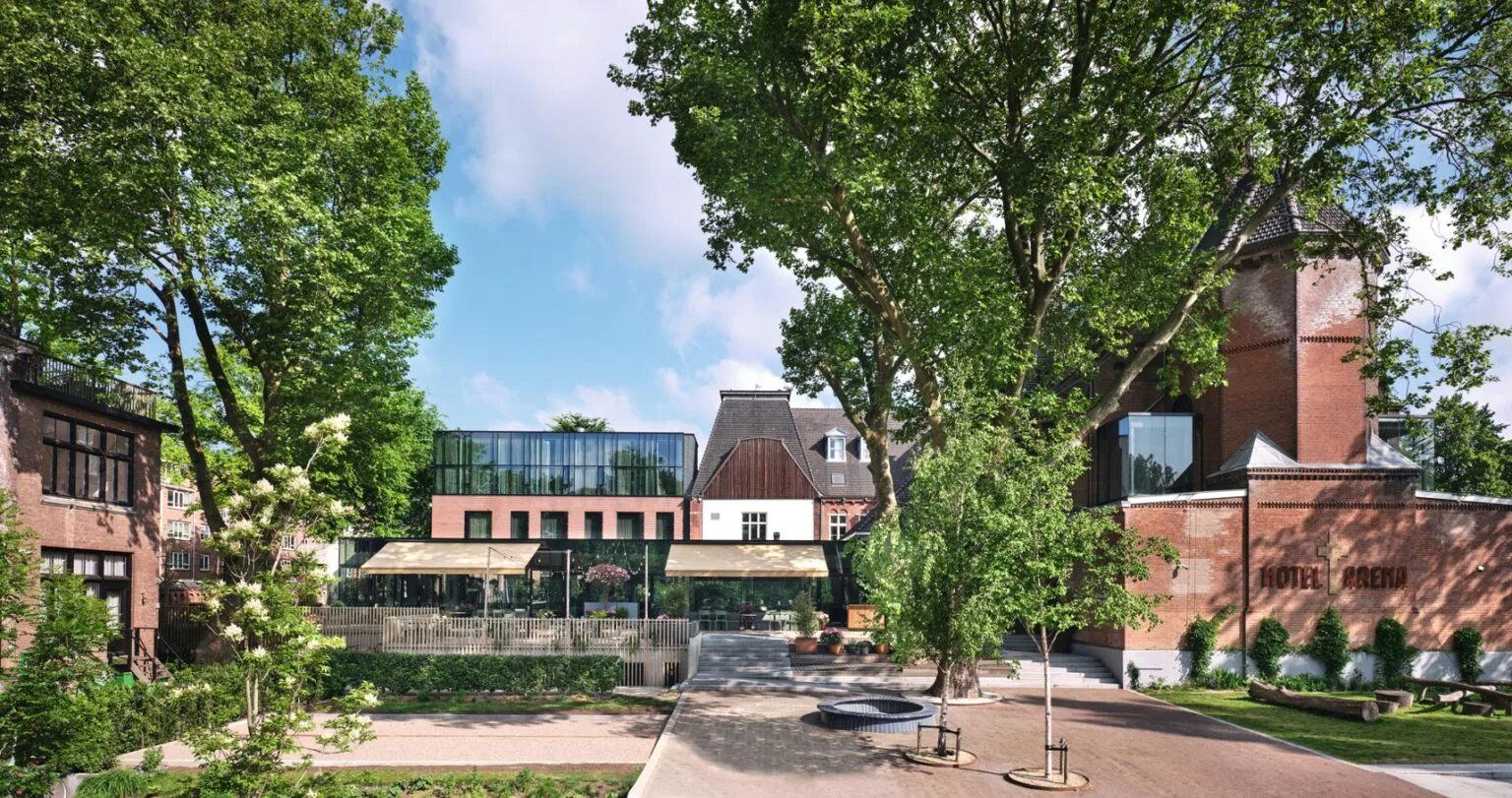
A Building That Precedes Its Brief
Amsterdam's hotel market divides more cleanly than most European capitals. Along the canal belt, properties like De L'Europe Amsterdam and Conservatorium trade on institutional grandeur and five-star positioning. Further out, design-led independents and converted structures occupy a different register entirely, one where the building's prior life is the editorial argument rather than a footnote in the marketing copy. Hotel Arena Amsterdam is a four-star hotel in Amsterdam's Oosterpark neighbourhood, with 141 rooms and a chapel venue for events. The address, 's-Gravesandestraat 55, places it in the Oosterpark neighbourhood, east of the Amstel river and removed from the canal-house density that defines the city's tourist core. That distance is a positioning decision as much as a geographical one.
The building itself is a former Roman Catholic orphanage, constructed in the late 19th century. Its conversion into a hotel preserved the chapel, now an events and performance space with a theatre capacity of up to 180, along with the arcaded courtyard and the heavy masonry volumes that characterise Dutch institutional architecture of that period. This is not adaptive reuse in the sense of scraping a space clean and installing contemporary furniture. The spatial logic of the original structure remains legible. Corridors follow institutional proportions. Ceiling heights in the public areas reflect a building designed for collective use rather than private comfort. That tension between original function and present purpose is what gives Hotel Arena its particular atmosphere: you are always aware of what the building once was.
What the Great Hotels of the World Designation Signals
Membership in the Great Hotels of the World collection is a trade-facing credential as much as a consumer one. The collection groups independent four- and five-star properties that meet specific standards around service delivery and physical plant, and it functions as a distribution and quality signal for travel buyers. Hotel Arena's inclusion at the four-star level places it in a comparable set that includes design-forward independents across Europe, properties that typically compete on character and specificity rather than amenity depth. For a converted heritage building with 141 rooms, that positioning is coherent. The room count is large enough to support event infrastructure, seven meeting rooms, the chapel venue, without tipping into the anonymous scale of a convention hotel.
Within Amsterdam specifically, that four-star independent bracket is more contested than it appears. Properties like Canal House, Breitner House, and Décor Canal House compete on canal-belt location and boutique scale. Hotel Arena's counter-argument is spatial: few properties in the city offer a 19th-century chapel as an event space or a monastic courtyard as a common area. The architecture does work that a standard hotel room count simply cannot.
The Spatial Logic of a Converted Institution
Adaptive reuse projects in hospitality tend to fall into two failure modes. The first is overcorrection toward the historic, where preservation anxiety produces rooms that feel more like museum installations than places to sleep. The second is the opposite: stripping the original character so thoroughly that the conversion rationale disappears entirely. Hotel Arena holds a more considered position. The chapel's conversion into a live music and events venue is architecturally honest, the space was always designed for assembly, for acoustics, for an audience facing a focal point. Repurposing it for performance rather than liturgy respects the spatial logic without pretending the building's history is decorative.
The courtyard functions as the property's social centre in a way that interior-facing lobbies rarely achieve. In a city where outdoor space is limited by canal-belt density, a genuine courtyard represents a spatial advantage that newer-build hotels in the centre cannot replicate. Amsterdam's hotel development in the canal district, including properties such as Andaz Amsterdam Prinsengracht, works within the constraints of listed canal houses, which means vertical circulation challenges and rooms built around 17th-century plot widths. Hotel Arena's orphanage footprint operates on different dimensions entirely.
Neighbourhood Context: Oosterpark and Its Logic
The Oosterpark district has tracked a trajectory common to inner-urban neighbourhoods in mid-sized European capitals: post-industrial decline followed by incremental gentrification anchored by cultural institutions. The Tropenmuseum, one of the more serious ethnographic collections in the Netherlands, sits nearby. The park itself, Oosterpark, is one of Amsterdam's older public green spaces. For a hotel oriented toward events, performances, and meetings alongside leisure stays, the neighbourhood's cultural density is a practical asset rather than a consolation for not being on the Herengracht.
Travellers accustomed to staying within the canal ring will find Oosterpark quieter and less immediately legible as a tourist zone, which is either a drawback or an advantage depending on what they're optimising for. Access to the centre is direct by tram, and the neighbourhood's own restaurant and bar scene has deepened considerably in recent years.
Events Infrastructure and the 141-Room Format
The combination of 141 rooms, seven dedicated meeting spaces, and a chapel venue with 180-person theatre capacity positions Hotel Arena in a specific operational category: the independent events hotel. This is a segment that sits between boutique leisure properties and full-scale conference centres, and it serves a guest mix that includes corporate groups, cultural events, and individual stays drawn by the architectural character. Properties in this format, like Conscious Hotel Amsterdam City (The Tire Station) in the design-adaptive tier, demonstrate that Amsterdam's market has appetite for hotels that define themselves through a specific spatial or conceptual argument rather than amenity breadth.
Inntel Hotels Amsterdam Zaandam takes a different approach to architectural identity, while Château Neercanne in Maastricht and Château St. Gerlach in Valkenburg aan de Geul represent the heritage-property category in the southern provinces. De Librije in Zwolle, Posthoorn in Monnickendam, and Bij Jef in Den Hoorn round out the independent end of the Dutch regional spectrum.
Planning a Stay
Hotel Arena Amsterdam is located at 's-Gravesandestraat 55, 1092 AA Amsterdam, in the Oosterpark neighbourhood on the east side of the city. With 141 rooms and a four-star classification, it operates in a mid-to-upper independent tier rather than the five-star bracket occupied by canal-belt properties. Booking is recommended in advance.
Frequently Asked Questions
What is the leading suite at Hotel Arena Amsterdam?
What the property does offer, at the four-star level with 141 rooms, is a range that includes accommodation in the converted orphanage building itself, where particularly sought-after rooms typically occupy spaces with the highest ceilings and one direct relationship to the original architecture. For current suite availability and pricing, contact the hotel directly or consult the Great Hotels of the World reservation platform.
What is Hotel Arena Amsterdam known for?
Hotel Arena's clearest differentiator is its event and performance infrastructure inside a listed heritage building. The chapel venue, with capacity for 180 in theatre configuration, and the seven meeting rooms give it a functional depth that most boutique properties in the city cannot match. For stays oriented around cultural programming or group events, that combination is the property's strongest argument.
Is Hotel Arena Amsterdam reservation-only?
Reservations are recommended for rooms and event spaces. Booking in advance through the hotel's channels or the Great Hotels of the World network is the practical approach.
Does Hotel Arena Amsterdam accommodate large group events alongside regular hotel guests?
Yes. The property's format is specifically designed for this dual function. With 141 guest rooms, seven meeting rooms, and a chapel venue holding up to 180 in theatre configuration, it operates as both a leisure and events hotel. That means individual guests and group bookings share the property, which is worth factoring into timing, stays during major in-house events will have a different atmosphere than quieter periods.
In Context: Similar Options
Comparable venues nearby, for context on price, style, and recognition.
| Venue | Cuisine | Price | Awards | Notes |
|---|---|---|---|---|
| Hotel Arena AmsterdamThis venue — the venue you are viewing | Monumental boutique hotel in park setting | $$$ | 4-Star | Not listed |
| The Hoxton, Amsterdam | Boutique hotel in restored canal houses blending history with contemporary flair. | $$$ | 4-Star | Felix Meritisbuurt |
| Hotel De Hallen | Urban-vintage industrial conversion in a monumental tram depot. | $$$ | 4-Star | Bellamybuurt Zuid |
| Leonardo Eden Hotel Amsterdam City Center | Modern hotel in historic industrial building | $$$ | 4-Star | Rembrandtpleinbuurt |
| citizenM Amsterdam South | affordable luxury pod hotel | $$ | 4-Star | Zuideramstel |
| Hotel V Nesplein | Contemporary design hotel in a converted office building with quirky mid-century industrial aesthetic and Dutch character. | $$$ | 4-Star | Nes e.o. |
Recognition history
Dated appearances from independent guides and award organizations, with the underlying list record or original source where available.
Great Hotels of the World GHOTW Collection Member
Great Hotels of the World
Continue exploring
More in Amsterdam
Hotels in Amsterdam
Browse all →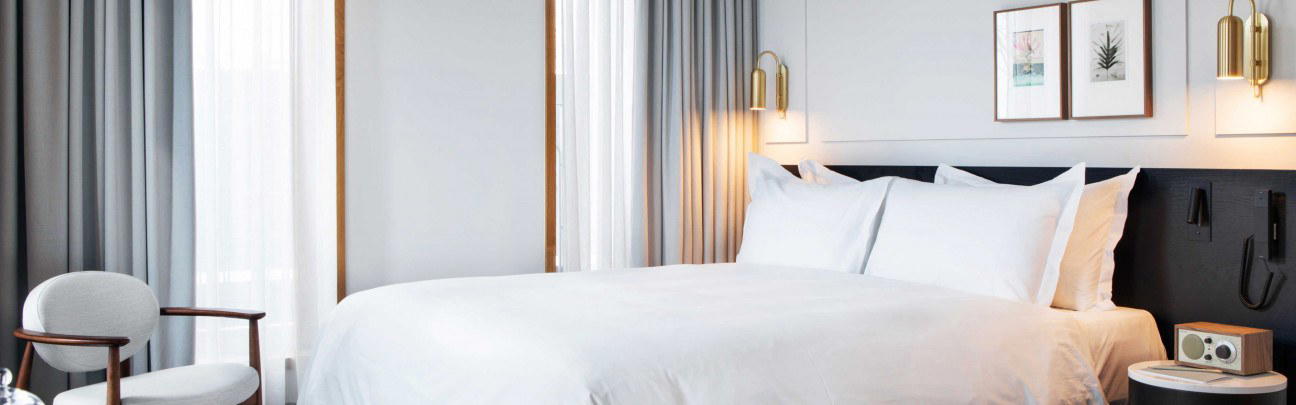
Bars in Amsterdam
Browse all →
Restaurants in Amsterdam
Browse all →
Wineries in Amsterdam
Browse all →
At a Glance
- Modern
- Trendy
- Lively
- Weekend Escape
- Business Trip
- Garden
- Terrace
- Historic Building
- Wi Fi
- Restaurant
- Room Service
- Concierge
- Laundry Service
- Bicycle Rental
- Meeting Rooms
- Garden
- Garden
- Wi Fi
- Restaurant
- Room Service
- Concierge
- Laundry Service
- Bicycle Rental
- Meeting Rooms
- Garden
Stylish and tranquil with high ceilings, large windows, lobby fireplace, and park views