Glou Glou

Star Wine List
Glou Glou opened in Amsterdam's De Pijp neighbourhood in April 2015, modelling itself on Parisian bars à vins naturelles such as Aux Des Amis and Café de la Nouvelle Mairie. The bar is credited with kickstarting Amsterdam's natural wine movement, bringing a Loire-and-Jura-inflected sensibility to a city that had been slow to embrace low-intervention wine culture.

Pearl is the En Primeur Club membership app, where members save venues, book tables and use the concierge.
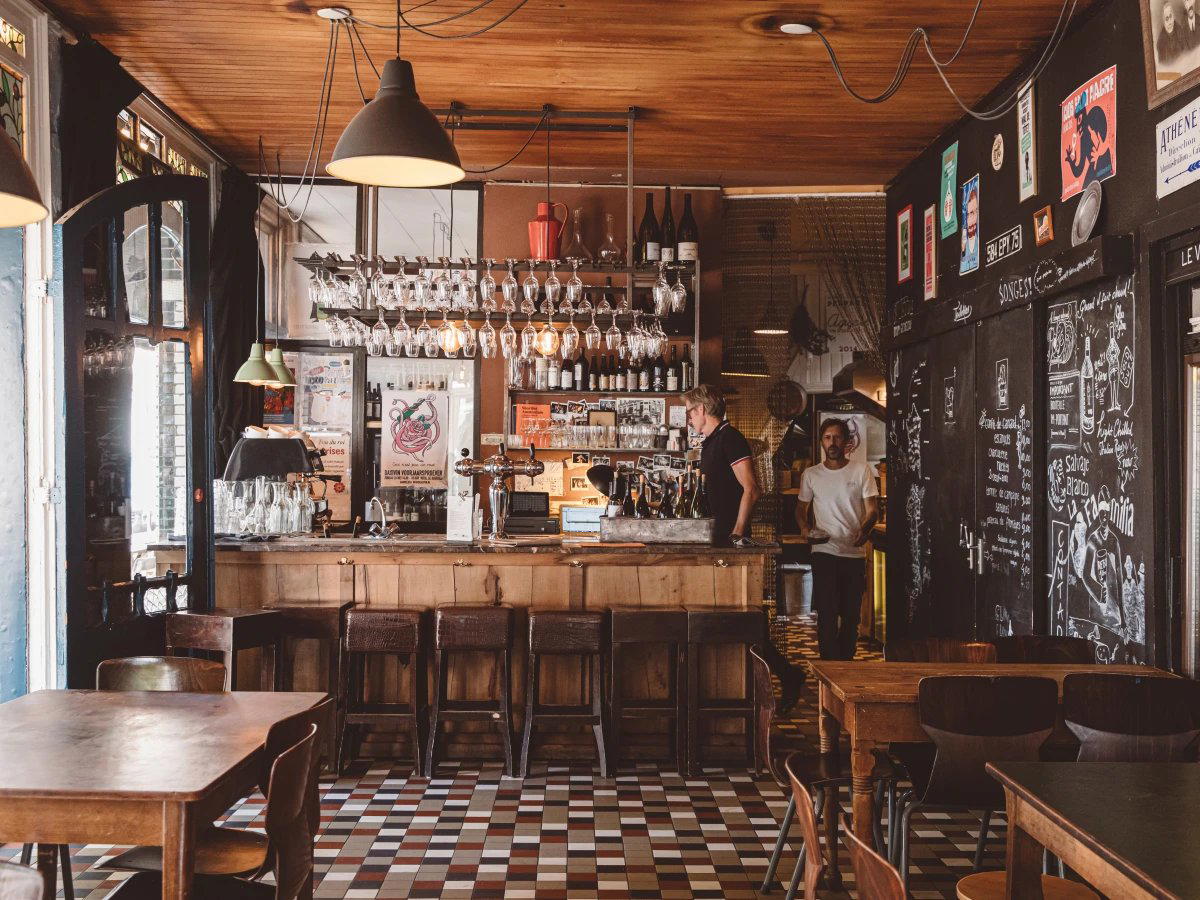
Where Paris Sent Its Wine Culture, and Amsterdam Kept It
There is a particular quality of light in De Pijp on a weekday evening: the neighbourhood exhales after dark in a way that the canal belt rarely does, and the streets around the Albert Cuypmarkt fill with the kind of foot traffic that belongs to residents rather than tourists. It is into this context that Glou Glou arrived in April 2015, on Tweede van der Helststraat, a side street calibrated precisely for the sort of bar that does not need a sign to be found by the right people.
The template was explicitly Parisian. Bars à vins naturelles like Aux Des Amis and Café de la Nouvelle Mairie had by the early 2010s established a format in Paris that was distinct from both the formal wine bar and the casual café: natural wine, small plates, chalked lists, the deliberate absence of ceremony. Glou Glou transported that format to Amsterdam at a moment when the Dutch capital had no comparable venue, no place where a glass of skin-contact Alsatian or a carbonic Beaujolais could be ordered without explanation or apology.
What the Paris Model Did to Amsterdam's Wine Scene
The bar à vins naturelles as a format is structurally different from a wine bar in the conventional sense. The selection is not organised by region or varietal for the ease of the uninitiated; it is organised around producer philosophy, with the implicit assumption that the person behind the bar can bridge any gap in the drinker's knowledge. This is a model that depends heavily on the quality of conversation at the counter, and it is also a model that, when executed consistently, functions as a kind of ongoing education for a city's wine culture.
In Amsterdam's case, the education took. The years following Glou Glou's 2015 opening saw a measurable shift in the city's drinking habits at the independent end of the market. Natural wine moved from a subcultural signal to a broadly understood category, appearing on lists across De Pijp, the Jordaan, and Oud-West. The bar did not invent this trajectory on its own, producer importers, sympathetic restaurateurs, and a broader European drift toward low-intervention wine all contributed, but it provided a fixed address for a scene that had previously been scattered and provisional.
This is the dynamic that makes Glou Glou worth locating within its competitive set rather than in isolation. Compared to Amsterdam's cocktail-forward bars, where technical programs drive the offer, venues like Door 74 and Tales & Spirits operate at the precision end of spirits culture, Glou Glou occupies a different register entirely: informal, producer-led, and explicitly anti-theatrical. The cultural reference point is the French bistrot cave, not the cocktail laboratory.
The Intersection of Imported Method and Local Appetite
What the Paris bar à vins model introduced to Amsterdam was not merely a list of wines but a set of values about how wine should be served and discussed. Low intervention in the cellar, transparency about producers, a preference for small growers over négociant houses: these are positions, not just stylistic preferences, and they carry an implicit argument about how agriculture and consumption are related. Glou Glou brought that argument to a Dutch audience that proved receptive to it, partly because the Netherlands has its own strong tradition of engagement with food provenance and sustainability.
The result is a venue that functions at the intersection of an imported French format and a local appetite for provenance-conscious drinking. The Loire, the Jura, and the Languedoc are the spiritual territories of the natural wine movement, but in Amsterdam they have been received through a Dutch lens: direct, curious, and unusually willing to engage with the unfamiliar. A glass of pétillant naturel or an oxidative white from an obscure Savoie producer lands differently here than it might in a more conservative wine culture.
This also places Glou Glou in an interesting position relative to the wider Dutch hospitality scene. Venues like Amsterdam Roest and Bakers & Roasters speak to De Pijp's appetite for independent, character-led spaces. Beyond Amsterdam, the same sensibility appears in different forms at places like Florin Utrecht in Utrecht, Brasserie Lalou in Delft, and Café Barolo in Eindhoven, each operating at the serious-but-unstuffy end of Dutch wine and food culture. Bowie in The Hague and Boode Foodbar in Bathmen represent the same appetite reaching into smaller cities and towns. For something further afield in terms of format, Espressobar Kopi Soesoe in Rotterdam and Bar Leather Apron in Honolulu demonstrate how a commitment to craft and producer relationships translates across very different contexts.
Finding It and Knowing When to Go
Glou Glou sits at Tweede van der Helststraat 3, a short walk from the Albert Cuypmarkt, which means it is well-positioned for an early evening visit following an afternoon in De Pijp. The neighbourhood is navigable on foot from Heineken Plein or by tram from the city centre, and the address is compact enough that arriving without a reservation is the natural mode, though the bar's reputation, built over nearly a decade, means that weekend evenings will test that assumption. Midweek visits, particularly before 20:00, are the more reliable entry point for a seat at the counter without a wait.
For those building a broader Amsterdam itinerary, our full Amsterdam guide maps the city's drinking and dining offer across neighbourhoods and price tiers. De Pijp specifically rewards the kind of unhurried evening that moves between venues, a format that suits Glou Glou's own unhurried pace.
Side-by-Side Snapshot
Comparable venues nearby, for context on price, style, and recognition.
| Venue | Cuisine | Price | Awards | Notes |
|---|---|---|---|---|
| Glou GlouThis venue (the venue you are viewing) | wine_bar | $20–30 | Star Wine List | Not listed |
| Wynand Fockink Proeflokaal and Spirits | pub | $20–30 | Not listed | Oude Kerk e.o. |
| Flying Dutchmen Cocktails | cocktail_bar | $20–30 | Top 500 Bars Best Bars #76 | Leidsegracht Zuid |
| De Sluyswacht | pub | $10–20 | Not listed | Uilenburg |
| Café Old Sailor | pub | $10–20 | Not listed | Burgwallen Oost |
| Cafe Belgique | beer_bar | $20–30 | Not listed | Nieuwe Kerk e.o. |
Recognition history
Dated appearances from independent guides and award organizations, with the underlying list record or original source where available.
Star Wine List
Star Wine List
Continue exploring
More in Amsterdam
Bars in Amsterdam
All bars in Amsterdam →
Restaurants in Amsterdam
All restaurants in Amsterdam →
Hotels in Amsterdam
All hotels in Amsterdam →
Wineries in Amsterdam
All wineries in Amsterdam →
Details
- Cozy
- Intimate
- Trendy
- Lively
- Date Night
- Casual Hangout
- After Work
- Standalone
- Seated Bar
- Lounge Seating
- Outdoor Terrace
- Natural Wine
Current opening hours
- Monday
- 3 PM–12 AM
- Tuesday
- 3 PM–12 AM
- Wednesday
- 3 PM–12 AM
- Thursday
- 3 PM–12 AM
- Friday
- 3 PM–12 AM
- Saturday
- 2 PM–12 AM
- Sunday
- 2 PM–12 AM
Hours can change for holidays and private events. Hours as of .
Cozy and intimate interior with warm wood and small tables, lively and relaxed atmosphere enhanced by friendly staff and great music, especially lively on the terrace during sunny days.