Our verdict
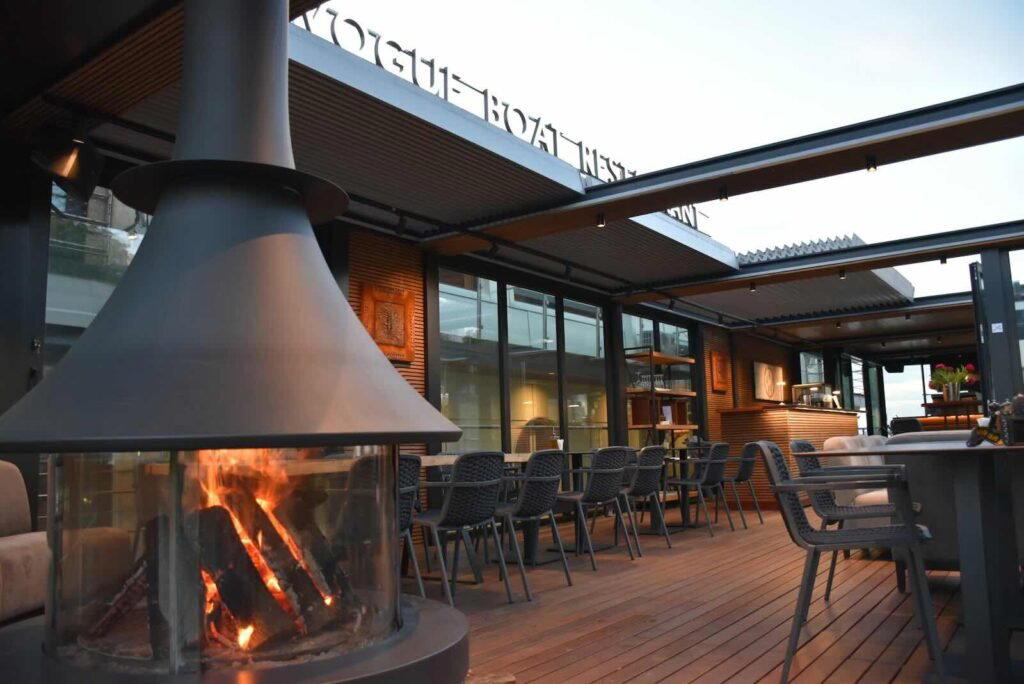
Moored at Carl Lutz rakpart 1 along Budapest's Danube embankment, Vogue Boat Restaurant brings dining onto the water in a city whose riverbank has seen a steady rise in floating hospitality. The setting places guests at river level, with the Pest skyline framing the experience from a vantage point few land-based addresses can replicate. Booking ahead is advisable, particularly through the warmer months when terrace demand along this stretch of the Danube runs high.

Pearl is the En Primeur Club membership app, where members save venues, book tables and use the concierge.
The menu
What to order
- Duck Leg
- Grilled Salmon Fillet with Dill Shrimp Sauce
- Pork Tenderloin
- Chicken Paprikash
Dining at River Level: Budapest's Floating Restaurant Scene
Budapest's relationship with the Danube has always been complicated. The river divides Buda from Pest, defines the city's skyline, and shapes its self-image, yet for much of the year it operates more as a backdrop than as a venue in its own right. That has changed incrementally over the past decade, with a cluster of boat restaurants and floating bars establishing themselves along the embankment, most concentrated between the Chain Bridge and Margaret Island. Vogue Boat Restaurant, moored at Carl Lutz rakpart 1 in the 13th district, sits within this emerging waterfront dining tier, placing guests at river level rather than above it.
The 13th district address is a specific positioning choice. This stretch of the Danube north of the Pest city centre sits away from the more heavily trafficked tourist corridor near the Chain Bridge and the Parliament building. Dining here means a slightly quieter embankment, with the river's width more apparent and the city's illuminated bridges visible downstream. It is a setting where the physical environment does real work, and where the gap between a well-executed meal and a mediocre one is more visible: the backdrop amplifies everything.
What the Waterfront Format Demands
Boat restaurants operate under constraints that land-based kitchens do not face. Galley-scale preparation areas, the logistics of provisioning on a moored vessel, and the structural demands of a floating hull all shape what a kitchen can realistically produce. The leading operators in this format across European cities, Budapest, Prague, Amsterdam, Hamburg, have historically resolved this tension in one of two ways: by narrowing the menu to a short list of well-sourced dishes the kitchen can execute consistently, or by leaning into the theatre of the setting and accepting that some diners are paying primarily for the view.
The sourcing question matters more here than in a conventional restaurant. When kitchen space is constrained and supply logistics are tighter, ingredient quality becomes the clearest lever a kitchen has. The most credible floating restaurants in central Europe have leaned toward Hungarian regional produce, freshwater fish from the Tisza and Danube catchments, game from the Great Plain, and seasonal vegetables from the market gardens of the Pest hinterland, precisely because the supply chains are shorter and the quality argument is easier to sustain. Hungary's agricultural regions produce raw material of genuine quality: Mangalica pork, grey cattle beef, and paprika-grown in Kalocsa and Szeged carry appellation-level provenance that serious kitchens treat as a point of differentiation.
Where a boat restaurant sources its fish is particularly telling. The Danube itself once supported significant fishing traditions along its Hungarian stretch, and while commercial fishing has contracted sharply, regional suppliers still bring catfish, carp, and pike-perch to Budapest's better kitchens. Pike-perch (fogas in Hungarian) from Lake Balaton remains a benchmark ingredient in Hungarian fine dining, appearing on menus at Michelin-recognised addresses like Borkonyha Winekitchen and Costes as a marker of seasonal seriousness. A waterfront restaurant with access to the same supply chain has an obvious narrative advantage.
Placing Vogue Boat Restaurant in Budapest's Dining Tiers
Budapest's restaurant market has stratified considerably since the mid-2010s. At the upper end, a cluster of Michelin-starred and Michelin-recognised addresses including Stand, Babel, and essência have established a credible fine dining tier that positions Budapest alongside Warsaw and Prague rather than simply behind Vienna and Berlin. Below that, a mid-market of wine-forward bistros and modern Hungarian kitchens has grown substantially. Boat restaurants occupy a separate band, where setting and format are part of the value proposition alongside food quality.
This is not a criticism. Diners who book a riverfront table in Budapest are making a deliberate choice about how they want to spend an evening, and the leading boat venues understand and deliver on that contract. The question worth asking about any floating restaurant is whether the kitchen is doing enough to justify the full ticket, or whether the setting is carrying more weight than it should. At city level, that assessment drives the difference between a one-visit novelty and an address that earns repeat bookings from residents who know the alternatives. The comparison set for Vogue Boat Restaurant is not Stand or Costes; it is the broader category of experiential dining where atmosphere and cuisine are jointly evaluated.
For readers planning a broader Hungarian itinerary, the regional dining scene beyond Budapest has its own strong entries: Platán Gourmet in Tata, Pajta in Őriszentpéter, and Aranysárkány Vendéglő in Szentendre each represent the sourcing-led, regionally rooted approach that Hungary's most interesting kitchens have adopted outside the capital. Further afield, BoriMami in Gyöngyös, Halasi Pince Panzió in Villány, and Forst-Ház Étterem és Kávézó in Eger reflect the wine-region dining culture that has developed around Hungary's appellations. For something further from the mainstream, Classic Grill Serbian Restaurant Underground in Szeged and Astro Tea & Kávéház in Gyor show how the country's culinary range extends well beyond Budapest's obvious orbit. Our full Budapest restaurants guide maps the city's dining scene by neighbourhood and tier.
Seasonal Timing and Practical Considerations
The Danube embankment between May and September draws significant foot traffic, and boat restaurants along this stretch of Carl Lutz rakpart fill quickly on warm evenings. The riverfront setting earns its strongest argument during this window: long dusk light over the water, the city's illuminated bridges visible downstream, and the particular quiet that comes from being on the river rather than beside it. Winter visits are a different proposition; the Danube's embankments are colder and less hospitable than Budapest's inner-district restaurants, and heated indoor seating on a moored vessel has practical limits.
For comparable waterfront dining experiences internationally, the gap between a Budapest boat restaurant and a top-tier address like Le Bernardin in New York City or a technically focused tasting menu at Atomix is substantial. The Budapest waterfront format is better understood alongside the city's own mid-tier experiential dining, where the river itself is part of the proposition. Reservations for summer evenings at well-regarded Danube-side venues are advisable weeks in advance; Carl Lutz rakpart 1 is accessible from the Jászai Mari tér area, with tram connections along the Pest embankment providing direct access from the city centre. Additional regional context is available through venues like Almalomb in Hosszúhetény and La Pizza Del Lupo in Onga, which illustrate the range of Hungary's broader culinary geography.
Frequently asked questions
What part of town is Vogue Boat Restaurant in?
Vogue Boat Restaurant is located at Budapest, Carl Lutz rkp. 1, 1137 Hungary, Budapest.
Is Vogue Boat Restaurant in Budapest good for a special occasion dinner on the Danube?
The venue's position at Carl Lutz rakpart 1 in Budapest's 13th district places it directly on the Danube, which makes it a functional choice for an occasion where the river setting does significant atmospheric work. Boat restaurants in this format offer a fixed sense of place that rooftop terraces or embankment-adjacent rooms cannot replicate, you are at water level on the river itself.
What do people recommend at Vogue Boat Restaurant?
What draws repeat visitors to this address on Carl Lutz rakpart is the combination of a working river setting and proximity to the Danube embankment, which defines the experience as much as the menu. For the most current food recommendations, checking recent visitor reviews before your visit will give you the clearest picture of what the kitchen is doing well.
How hard is it to get a table at Vogue Boat Restaurant?
Boat restaurants along the Carl Lutz rakpart stretch of Budapest's Danube embankment fill quickly between May and September, when foot traffic on the riverfront peaks and outdoor riverside seating is in high demand across the city. Vogue Boat Restaurant operates within this same seasonal pressure, so advance booking during summer months is advisable. Outside peak season, availability is generally less constrained.
Peers in This Market
Comparable venues nearby, for context on price, style, and recognition.
| Venue | Cuisine | Price | Notes |
|---|---|---|---|
| Vogue Boat RestaurantThis venue (the venue you are viewing) | Hungarian-Mediterranean Fusion with South Slavic Influences | $30–50 | Not listed |
| Robinson | Mediterranean Steakhouse with Hungarian Influences | $30–50 | Városliget |
| Atrium Bistro | Hungarian Brasserie | $50–100 | Terézváros |
| Százéves Étterem | Traditional Hungarian | Not listed | Belvaros |
| Türkiz Budapest | Authentic Turkish | $30–50 | Varhegy |
| Pavillon de Paris | Classic French Bistro | $50–100 | Varhegy |