Our verdict
Tokyo Restaurant Bus operates a moving dining experience from Marunouchi Building, running routes through central Tokyo while guests eat aboard a double-decker bus converted for table service. The format sits in a growing category of mobile hospitality that treats the city itself as the dining room backdrop. Reservations and seasonal menus make it a time-specific proposition rather than a drop-in affair.

Pearl is the En Primeur Club membership app, where members save venues, book tables and use the concierge.
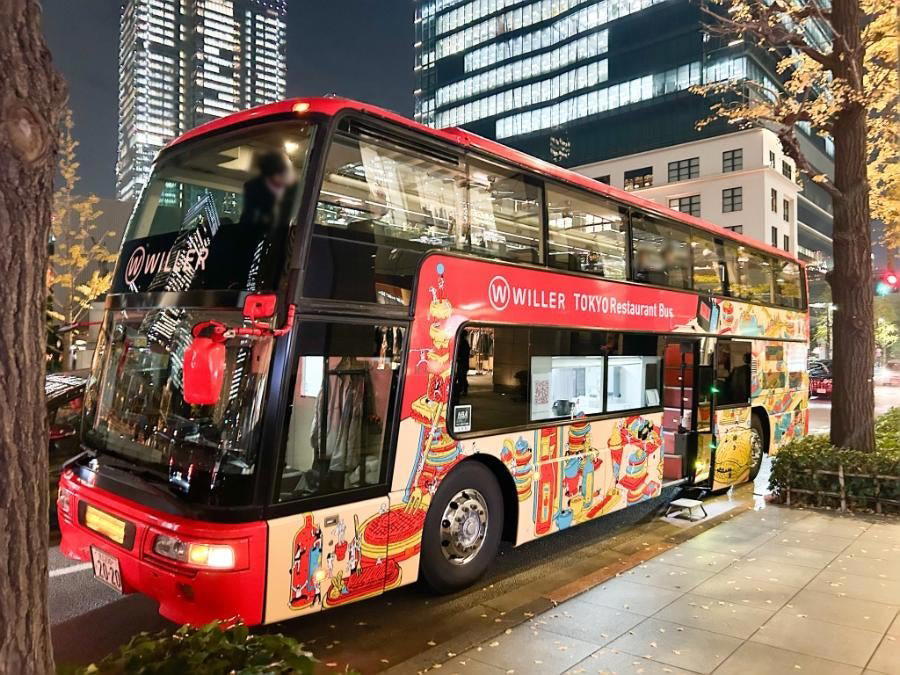
Dining in Motion: Tokyo's Bus-Format Restaurant in Context
Mobile dining as a format has a longer international history than its recent Tokyo iteration might suggest. From barge restaurants working European canals to tram dinners in Melbourne and Hong Kong, the proposition is consistent: the city becomes the setting, and the journey does work that a fixed dining room cannot. Tokyo Restaurant Bus, operating from the ground floor of the Marunouchi Building in Chiyoda City, belongs to that lineage. It launched into a Tokyo dining scene that already offered extraordinary density at fixed addresses, from the kaiseki precision of RyuGin to the French rigour of L'Effervescence, and positioned itself as something categorically different: a route-based experience where the view is part of the menu.
The Marunouchi district was a deliberate starting point. As Tokyo's financial and corporate centre, it frames the bus's departures with a particular urban grammar: the Imperial Palace moat on one side, the glass towers of the business quarter on the other. Routes through central Tokyo place guests above street level on the upper deck of a converted double-decker, a vantage point that shifts the relationship between diner and city in ways that ground-floor restaurants cannot replicate. For visitors trying to read Tokyo's spatial logic while also eating, that elevation offers something genuinely useful.
Sustainability Framing in Mobile Hospitality
The sustainability argument for a bus-based dining format is not obvious at first pass, but it has structural logic. Moving a single vehicle through existing road infrastructure to serve a dining function consolidates journeys that might otherwise involve multiple separate trips by individual diners. More directly relevant to the editorial conversation around ethical hospitality in Japan is the question of food sourcing and waste management in a constrained kitchen environment.
Japanese dining culture has long operated with a version of mottainai, the principle of minimising waste and honouring the full use of ingredients, embedded in everything from kaiseki portion philosophy to the disciplined mise en place of omakase counters like Harutaka. A bus kitchen has strict volume limits by necessity, which imposes a discipline on ordering and preparation that larger restaurant operations often struggle to maintain voluntarily. The constraint becomes a structural sustainability mechanism: over-ordering raw ingredients for a fixed capacity vehicle is a more visible and immediate problem than over-ordering for a restaurant with walk-in flexibility.
Across Japan, this conversation about responsible sourcing and waste reduction is gaining institutional weight. HAJIME in Osaka has made ecological sourcing a stated pillar of its culinary programme. akordu in Nara works within Yamato Cuisine frameworks that emphasise local and seasonal produce. The Tokyo Restaurant Bus format, operating at smaller scale and with tighter logistics, participates in a similar discipline by necessity rather than manifesto.
Where It Sits in Tokyo's Dining Geography
Tokyo's dining options in 2025 organise themselves along several axes: price tier, format, cuisine tradition, and booking difficulty. The ¥¥¥¥ counters, including the French precision of Sézanne and the innovative work at Crony, operate in a different register entirely. Tokyo Restaurant Bus does not compete with that tier on culinary ambition; it competes on experience category, offering a moving tableau of the city as a dining proposition in its own right.
Within Japan's broader restaurant map, the contrast is instructive. The meditative, place-rooted dining of Gion Sasaki in Kyoto or the regional specificity of Goh in Fukuoka depend entirely on their fixed location for meaning. The bus format inverts that dependency, making mobility the defining characteristic. Neither approach is more serious than the other; they serve different reader decisions. Our full Tokyo restaurants guide maps the fixed-address options across price tiers and cuisine traditions for readers building a wider itinerary.
For regional comparison beyond the capital, options like the Nanao restaurant on the Noto Peninsula or the Sapporo option in Hokkaido anchor themselves to specific local food cultures in ways a mobile Tokyo experience cannot. The bus format trades that rootedness for urban spectacle, a trade that suits a particular type of visitor: those who have the fixed-address options covered and want a different entry point into the city's texture.
Practical Considerations for Planning
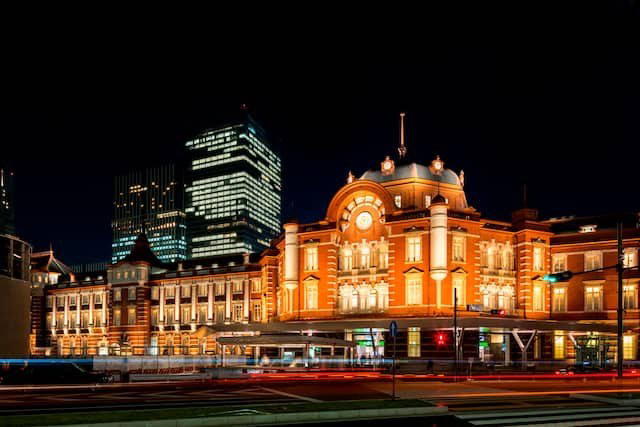
The Marunouchi Building departure point places Tokyo Restaurant Bus at one of the best-connected addresses in the city. Marunouchi station on the Tokyo Metro Marunouchi Line, along with Tokyo Station's multiple JR connections, puts the boarding location within easy reach from most central Tokyo accommodation. The Marunouchi Building's ground floor entrance is a recognisable landmark for anyone arriving from Tokyo Station's Marunouchi South Exit, roughly a five-minute walk.
Seasonal timing matters for this format more than for most fixed-address restaurants. Spring cherry blossom routes through Chidorigafuchi and the Palace East Gardens refine the visual component significantly; autumn foliage along routes touching outer garden areas of the Imperial Palace does the same. Summer evening departures after dark trade seasonal colour for illuminated skyline and neon, a different but equally coherent proposition. Winter lunch slots, where the low angle of afternoon light hits the Palace moat, have their own logic. The format rewards planning around Tokyo's seasonal calendar rather than treating the experience as season-neutral.
Booking operates on a reservation basis rather than walk-in access. Given the fixed capacity of a converted bus, advance planning is the operative assumption. Diners considering comparable international formats, such as the fine dining supper clubs attached to urban rail experiences in cities like New York, where Le Bernardin and Atomix set the benchmark for fixed-address ambition, will find the Tokyo bus format a different but complementary proposition in how cities use hospitality to frame civic space.
Regional Japanese dining that similarly rewards pre-trip logistics includes the Takashima restaurant on Lake Biwa's shore and the Nishikawa Machi option in Yamagata, both of which require planning for reasons of geography rather than format. Birdland in Sakai and Bistro Ange in Toyohashi represent the regional city tier where planning effort pays off in specificity of experience.
Quick reference: departs from Marunouchi Building 1F, Chiyoda City, Tokyo; reservation-based booking; seasonal routes recommended; Tokyo Station Marunouchi South Exit is the nearest major transit hub.
Frequently asked questions
What's the address for 東京レストランバス "Tokyo Restaurant Bus"?
東京レストランバス "Tokyo Restaurant Bus" is located at Japan, 〒100-6390 Tokyo, Chiyoda City, Marunouchi, 2 Chome−4−1 Marunouchi Building, 1F正面, Tokyo.
Where does Tokyo Restaurant Bus depart from, and how central is the location?
Departures operate from the ground floor of the Marunouchi Building at 2-4-1 Marunouchi, Chiyoda City, one of the most transit-accessible addresses in Japan, directly adjacent to Tokyo Station. The location means guests arriving by Shinkansen or the Tokyo Metro's Marunouchi Line can reach the departure point without a taxi. No separate transfer to an out-of-centre boarding point is required.
What should I eat at 東京レストランバス "Tokyo Restaurant Bus"?
The menu at Tokyo Restaurant Bus is served on board as the vehicle moves through central Tokyo, departing from the Marunouchi Building in Chiyoda City. Specific dishes change by season and sitting, so checking the official booking channel at time of reservation is the most reliable way to confirm current offerings. The format is structured around a set course served during the route, not à la carte selection.
Do they take walk-ins at 東京レストランバス "Tokyo Restaurant Bus"?
Walk-ins are not a practical option for a bus-format restaurant with fixed departure times and a set number of seats per journey. Departures from the Marunouchi Building, Chiyoda City operate to a schedule, meaning capacity is fixed before the bus rolls. Advance reservation through the official booking channel is the standard approach.
What has 東京レストランバス "Tokyo Restaurant Bus" built its reputation on?
Tokyo Restaurant Bus occupies a distinct position in Tokyo's dining geography by combining a moving vehicle with a seated, served meal, a format that turns the city's central streets into the dining room backdrop. Departing from the Marunouchi Building in one of Tokyo's best-connected transport hubs, it draws guests looking for a format that differs structurally from fixed-address restaurants. The appeal is the route as much as the plate.
Peers You’d Cross-Shop
Comparable venues nearby, for context on price, style, and recognition.
| Venue | Cuisine | Price | Awards | Notes |
|---|---|---|---|---|
| 東京レストランバス "Tokyo Restaurant Bus"This venue (the venue you are viewing) | Modern Japanese Kaiseki | $100–150 | Not listed | Not listed |
| Sushi Sugita (日本橋 蛎殻町 すぎた) | Edomae Sushi Omakase | $300–500 | Not listed | Nihonbashi |
| 寿司 健 | High-End Edo-Mae Sushi Omakase | $300–500 | Black Pearl 1 Diamond | Ginza |
| Sushi Mitani (鮨 三谷) | Edomae Omakase | $200–300 | La Liste Top Restaurants · Tabelog Gold #16 | Yotsuya |
| Namba | Modern Japanese Omakase | $300–500 | La Liste Top Restaurants · Tabelog Silver #86 | Chiyoda |
| Toku Uchiyama | Traditional Japanese Kaiseki | $200–300 | Tabelog 100 #77 | Chūō |