The Door
The Door sits on Baisley Boulevard in Jamaica, Queens, at a remove from Manhattan's concentrated fine-dining corridor.
Pearl is the En Primeur Club membership app — saves, bookings, and concierge access live there. Same editors, same standards.
- Address
- 163-07 Baisley Blvd, Jamaica, NY 11434
- Phone
- +17185251083
- Website
- thedoorrestaurant.nyc
- Directions
- Get directions
 Saves & bookings on Pearl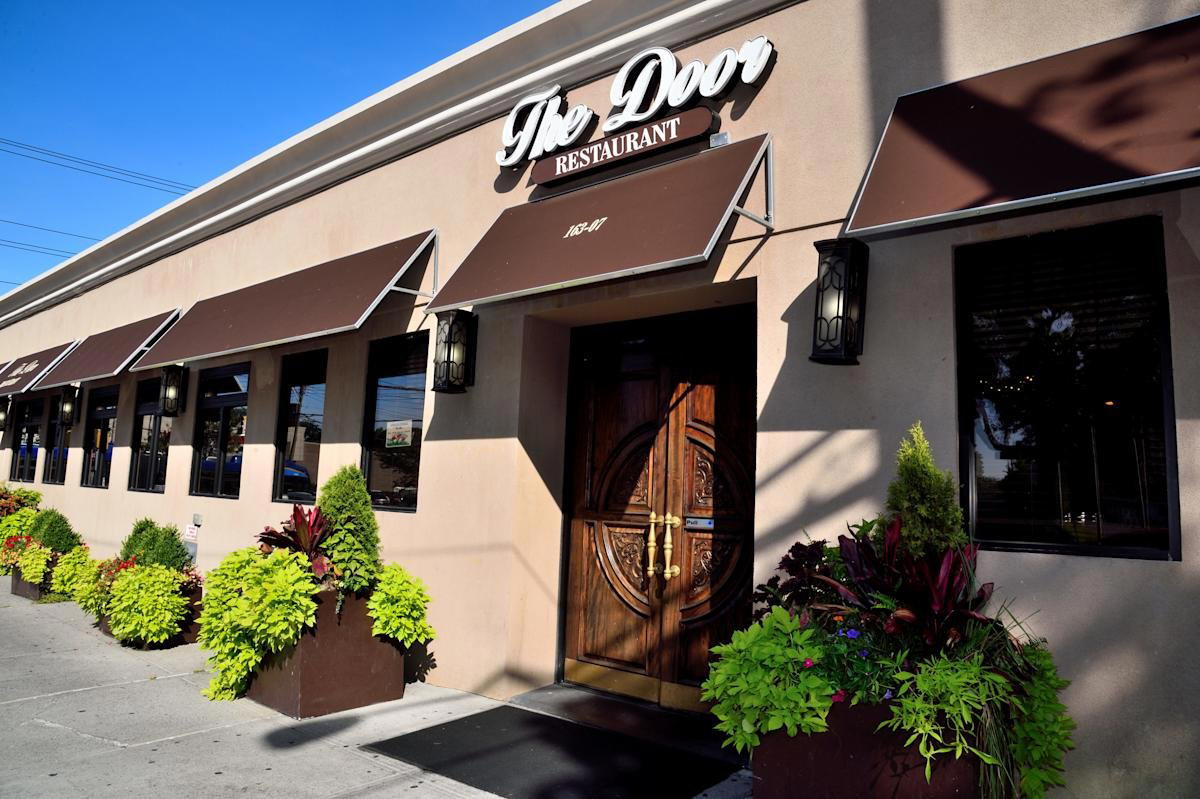
Outer-Borough Dining and the Technique Question
New York's fine-dining conversation has long been anchored to a Manhattan grid: the midtown seafood authority of Le Bernardin, the Columbus Circle formalism of Per Se, the spare omakase precision of Masa. But the more interesting pressure on that model has come from the outer boroughs, where lower overheads, denser immigrant food cultures, and a different kind of neighbourhood loyalty have produced kitchens operating with far less institutional support and, in some cases, far more technical ambition than their Manhattan counterparts might expect. Jamaica, Queens, a neighbourhood with deep Caribbean, South Asian, and West African demographic roots, a functioning commercial strip, and direct access to JFK, sits at the edge of that outer-borough shift. The Door, at 163-07 Baisley Boulevard, is an Authentic Jamaican restaurant in Jamaica, Queens.
What makes the Jamaica dining context worth paying attention to is the raw-material question. Outer-borough neighbourhoods with strong immigrant communities tend to sit closer to the actual supply chains for their cuisines: the distributors, the ethnic grocery wholesalers, the halal butchers, the Caribbean produce markets. That proximity matters technically. Kitchens in these neighbourhoods often source ingredients that Manhattan restaurants either cannot access, pay a significant premium for, or receive in diminished condition after additional transit. The editorial argument for a venue like The Door is less about individual accolades and more about what that positioning makes possible, technique applied to ingredients that arrive fresher and more specific than anything routed through a Midtown receiving dock.
The Local-Global Tension in Queens Kitchens
The intersection of imported culinary method and hyperlocal product is not a New York-specific phenomenon. Single Thread Farm in Healdsburg built its entire model around closing the distance between farm and kitchen. Blue Hill at Stone Barns in Tarrytown made that loop its central editorial identity. In both cases, the technique is global, French, Japanese, Nordic influences filtered through American fine-dining grammar, while the ingredients are aggressively local. The same logic operates in outer-borough New York, but without the institutional infrastructure or the pastoral branding. A kitchen in Jamaica is not selling a farm-to-table narrative. It is simply operating closer to the sources that its community has always relied on.
Across the country, the venues that have most effectively handled this tension are the ones that resist the pull toward either pure nostalgia or imported technique as a performance. Lazy Bear in San Francisco threads that needle through format; Alinea in Chicago prioritizes the technical over the territorial. The more sustainable model, as venues like Providence in Los Angeles and Addison in San Diego have demonstrated, treats local specificity as a starting point for technical elaboration rather than a destination in itself. Whether The Door operates within that framework or against it remains unclear, but the neighbourhood context places it in a conversation where that question matters.
Jamaica as a Dining Address
Jamaica's position in New York's dining geography is underappreciated partly because of how the borough's restaurant press coverage is distributed. Most editorial attention in Queens flows toward Long Island City, Astoria, and Flushing, neighbourhoods that either border Manhattan or carry a specific cuisine-tourism draw. Jamaica gets coverage primarily through its transit function: it is the AirTrain terminus, the last subway stop, the place you pass through on the way to JFK. That transit identity obscures a neighbourhood with a genuinely layered food culture, one that spans Jamaican patty shops, Guyanese roti vendors, West African suya counters, and a growing number of restaurants operating with more formal ambition.
For the reader oriented toward the kind of Korean-American progressive cooking found at Atomix or the French-Korean architecture of Jungsik New York, Jamaica represents a different register entirely. The neighbourhood's food identity is Caribbean and West African in its dominant notes, with South Asian inflections throughout. Any kitchen choosing to operate with serious technical intent in that context is working with raw materials and a customer base that demand a different kind of fluency than the one required on the Upper West Side or in Tribeca.
The broader American fine-dining circuit has begun to reckon with this geography. Bacchanalia in Atlanta, Emeril's in New Orleans, and The Inn at Little Washington each occupy regional food cultures that resist reduction to a single technical tradition. Particularly credible restaurants in those contexts earn their authority by working with the specific ingredients and techniques native to their place rather than importing a generic fine-dining template. See also our full New York City restaurants guide for a broader map of how that argument plays out across the five boroughs.
What the Record Supports
The restaurant's public data footprint is limited. That absence is itself a data point. In New York's restaurant ecosystem, venues with significant critical profiles tend to accumulate a traceable digital record quickly: Michelin visits, press mentions, aggregator scores, booking platform entries. The absence of that trail suggests either a early-stage operation, a venue primarily serving a local rather than destination audience, or a business that has not yet sought that kind of external validation. All three scenarios are common in outer-borough New York, and none of them preclude genuine quality.
Internationally, particularly technically sophisticated kitchens operate well outside the award-circuit infrastructure. 8½ Otto e Mezzo Bombana in Hong Kong and Alain Ducasse's Louis XV in Monte Carlo represent the opposite extreme: maximum institutional recognition, maximum data density. The restaurant sits at a different point on that spectrum.
Planning a Visit
The restaurant is located at 163-07 Baisley Boulevard, Jamaica, NY 11434. Getting there: Jamaica is served by the A, E, J, and Z subway lines, with the Jamaica station approximately a mile from Baisley Boulevard; the AirTrain connects directly to Jamaica from JFK. Reservations: Recommended. Budget: About $25 per person. Hours: Mon to Thu and Sun, 8 AM to 10 PM; Fri and Sat, 8 AM to 12 AM. Dress: Casual.
Comparison Snapshot
Comparable venues nearby, for context on price, style, and recognition.
| Venue | Cuisine | Price | Notes |
|---|---|---|---|
| The DoorThis venue — the venue you are viewing | Authentic Jamaican | $$ | Not listed |
| Madera | Cuban Steakhouse & Grill | $$ | Long Island City-Hunters Point |
| Pat'e Palo Bar & Grill | Dominican Caribbean Grill | $$ | Inwood |
| Paladar | Authentic Hispanic Latin Cuisine | $$ | Lower East Side |
| Mamajuana Cafe Inwood | Nuevo Latino & Dominican | $$ | Inwood |
| Kingston Tropical | Jamaican bakery and patty shop | $ | Wakefield |
Continue exploring
More in New York City
Restaurants in New York City
Browse all →
Bars in New York City
Browse all →
Hotels in New York City
Browse all →




At a Glance
- Elegant
- Classic
- Cozy
- Family
- Group Dining
- Casual Hangout
- Brunch
- Late Night
- Standalone
Current opening hours
- Monday
- 8 AM–10 PM
- Tuesday
- 8 AM–10 PM
- Wednesday
- 8 AM–10 PM
- Thursday
- 8 AM–10 PM
- Friday
- 8 AM–12 AM
- Saturday
- 8 AM–12 AM
- Sunday
- 8 AM–10 PM
Hours can change for holidays and private events. Last verified .
Elegant atmosphere with polished service, designed to reflect the stronger aspects of Jamaica.