Kingston Tropical

Our verdict
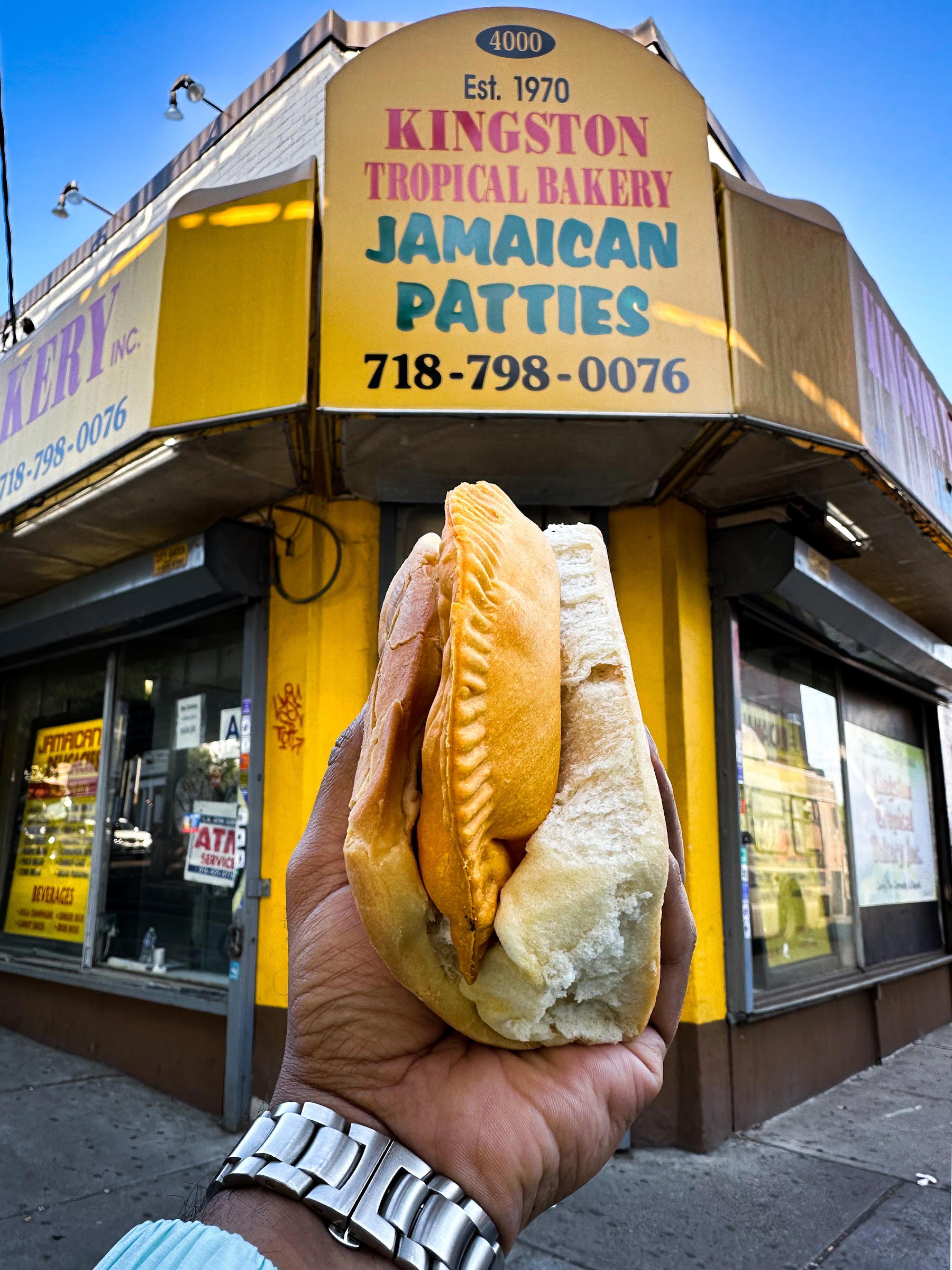
Kingston Tropical is a Wakefield takeout counter with a long local memory and a narrow, disciplined reason to go: Jamaican patties made in the old bakery style. The appeal is not polish; it is the link between Bronx transit life, Caribbean provision shops, and a $-tier format that has served the neighborhood since 1970.

Pearl is the En Primeur Club membership app, where members save venues, book tables and use the concierge.
The menu
What to order
- Jamaican beef patties
- Beef patty in coco bread
- Coco bread
- Cinnamon buns
- Carrot cake
New York City has the soundscape of daily eating: buses braking, storefront gates rattling, commuters moving between errands. In that setting, Jamaican and Caribbean food is not a themed night out. It can be commuter food, school-run food, church-errand food, and late-afternoon fuel carried back into the day. Kingston Tropical belongs to that tradition, where the counter matters more than the dining room and the measure of quality is whether a simple stop feels rooted in regular use.
The useful way to read this New York City address is through continuity rather than through restaurant glamour. Jamaican and Caribbean cooking in New York has long depended on repeat customers, recognizable rhythms, and food that works for people moving through ordinary schedules. New York City has long supported that kind of food economy, with takeout shops functioning as both neighborhood infrastructure and cultural memory. Kingston Tropical has that kind of authority, distinct from newer dining rooms built around cocktails, design, or broad survey-style menus.
New York City's patty culture is built on bakery discipline, not dining-room theater
The casual food of a city is often treated too casually by outsiders because it is inexpensive and portable. That is a mistake. The form still has rules. The food needs structure, seasoning, and enough consistency to hold up through transit, a folded bag, and the first bite taken after an errand or commute. At Kingston Tropical, the appeal sits in that classic register: Jamaican and Caribbean food served with the directness of a counter rather than the ceremony of a dining room.
Ingredient sourcing, in this context, is less about farm names than about the supply logic of diaspora food. Jamaican and Caribbean takeout in New York relies on consistency: staples that behave the same way at scale, seasonings that keep their identity through repeated batches, fillings and preparations that stay satisfying after holding, and a format that rewards dependability over spectacle. That steadiness is why a $ spot can matter. It feeds a daily public rather than a tasting-menu audience, and the $ price tier keeps the experience closer to neighborhood habit than destination dining.
The history matters only because it explains the category: this is not chef-led Caribbean reinterpretation. It is everyday food infrastructure, the kind that turns a kitchen's work into a civic service by repeating it for a regular public. In New York City, that distinction is essential. The same city can support high-design counters, cafés, wine-bar grazing, and Caribbean takeout, but they operate on different clocks. For a broader city scan, Our full New York City restaurants guide maps those formats without forcing them into the same template.
The order is small, specific, and tied to the street outside
The experience here is a takeout rhythm. The strongest image is not a table setting but food carried outside, with the city moving around it. That physical setting is part of the appeal: food designed for movement, not ceremony. The format also explains why Kingston Tropical should not be judged by the expectations attached to full-service Caribbean restaurants. The point is the counter scale, the quick-stop confidence, and the sense of a place that does not need to broaden itself into a survey course.
New York's dining culture often rewards novelty, but the city's deeper food intelligence sits in repetition. A $ counter that continues to draw attention says something about procurement, technique, and local demand. It also says something about New York City, where Caribbean foodways are not imported atmosphere but everyday commerce. That makes Kingston Tropical more valuable as a reading of place than as a conventional restaurant outing.
Readers building a wider New York itinerary can place this stop alongside different formats without pretending they are rivals: other Caribbean-American addresses, cured-meat counters, Italian small-plate rooms, Japanese restaurants, and café-format cooking all occupy different lanes. The city's hospitality frame extends beyond restaurants as well: Our full New York City hotels guide, Our full New York City bars guide, Our full New York City wineries guide, and Our full New York City experiences guide help separate eating, drinking, sleeping, and cultural planning.
Why a $ patty counter deserves serious attention
Price can distort critical judgment. A $ counter is often treated as a convenience stop, while expensive rooms receive the language of craft. Kingston Tropical reverses that bias. The craft is visible in constraint: a compact format, repeated for a public that can tell when a familiar stop has lost its focus. That repetition creates a kind of proof that no décor budget can imitate.
The larger American food map has many places where narrow formats carry serious cultural weight. For readers tracing that idea beyond New York, consider the role of specialization across other dining rooms and counters without making the comparison too literal. The shared lesson is not sameness. It is that format discipline, when the food has a clear job, can carry as much meaning as a longer menu.
Frequently asked questions
Can I bring kids to Kingston Tropical?
Yes. Kingston Tropical is a $ takeout spot in New York City, so it suits a quick family stop rather than a long sit-down meal at the counter.
What's the overall feel of Kingston Tropical?
It reads as a straight counter operation, not a dining room: Jamaican and Caribbean food served in New York City, with the street-level rhythm part of the backdrop.
Is Kingston Tropical Michelin-listed?
Kingston Tropical is recognized by the New York Times, which lists it at No. 72 on its 2026 Best Restaurants in New York City list.
What's the cuisine at Kingston Tropical?
Kingston Tropical serves Jamaican, Caribbean cuisine.
Is Kingston Tropical more mid-range or high-end?
Pricing at Kingston Tropical is listed as $.
Where is Kingston Tropical located?
Kingston Tropical is located in New York City.
Should I book Kingston Tropical in advance?
No. The format is a $ takeout spot, and Kingston Tropical runs on counter service in New York City rather than advance reservations.
How It Compares
Comparable venues nearby, for context on price, style, and recognition.
| Venue | Cuisine | Price | Notes |
|---|---|---|---|
| Kingston TropicalThis venue (the venue you are viewing) | Jamaican bakery and patty shop | $10–20 | Not listed |
| Arepa Lady | Authentic Colombian Arepas | $10–20 | Jackson Heights |
| Paladar | Authentic Hispanic Latin Cuisine | Not listed | Lower East Side |
| Lammy's Restaurant | Jamaican | $10–20 | Eastchester-Edenwald-Baychester |
| Lhasa Fast Food | Tibetan Momos | $10–20 | Jackson Heights |
| Lanzhou Handmade Noodle | Lanzhou Hand-Pulled Noodles | $10–20 | Flushing-Willets Point |
Recognition history
Dated appearances from independent guides and award organizations, with the underlying list record or original source where available.
New York Times Best Restaurants in New York City #72
New York Times
Continue exploring
More in New York City
Restaurants in New York City
All restaurants in New York City →
Bars in New York City
All bars in New York City →




Details
- Lively
- Classic
- Well Known
- Solo
- Casual Hangout
- Family
- Late Night
- Standalone
- Historic Building
- Street Scene
- A La Carte
- Counter Dining
Busy, no-frills storefront bakery with a constant flow of customers, bright display cases of patties and pastries, and an old-school neighborhood feel that reflects its decades-long history in Wakefield.