We're Smart World 4 Radishes
Our verdict
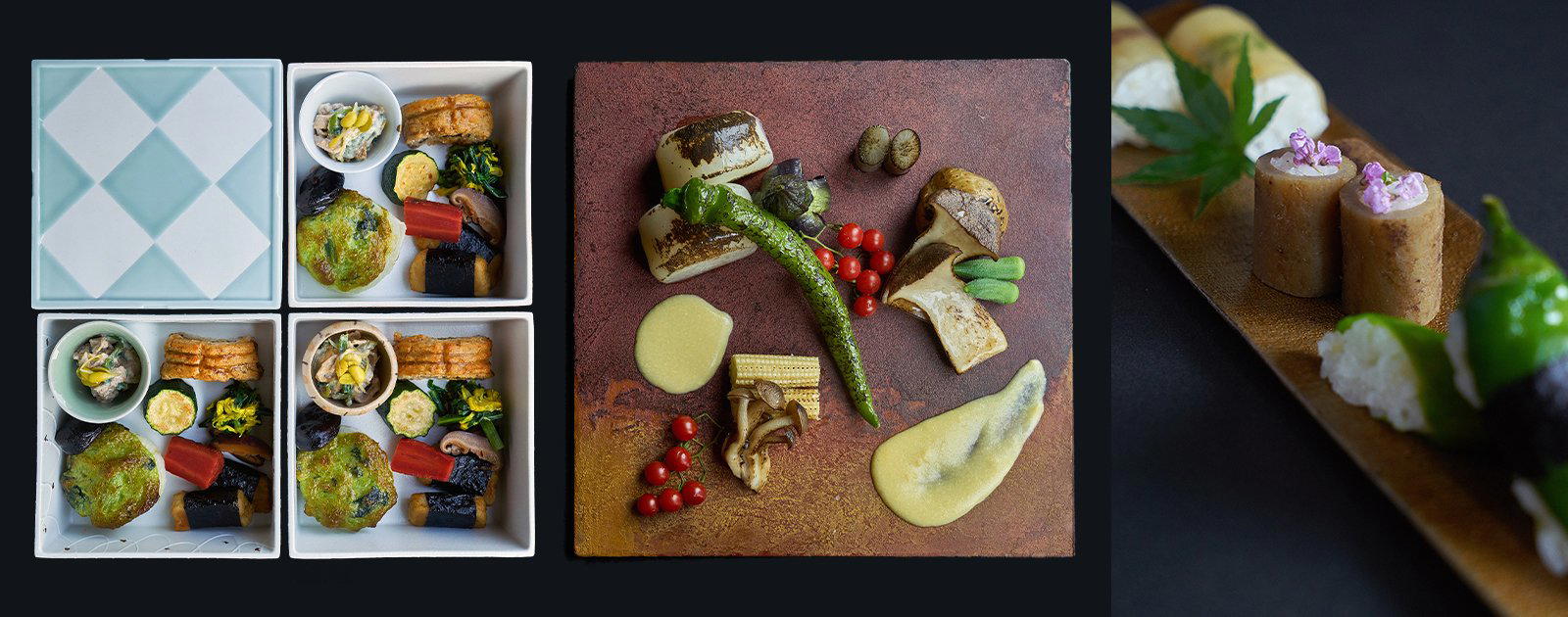
In Roppongi's crowded dining scene, Shojin Sougo occupies a quieter register: a third-floor address where Chef Nomura builds each course around vegetables, herbs, edible flowers, and fruit rather than protein. Pumpkin spaghetti, chrysanthemum leaves, and broth with fried mini eggplants signal a kitchen that treats plant ingredients with the same technical seriousness Tokyo usually reserves for fish and aged beef.

Pearl is the En Primeur Club membership app, where members save venues, book tables and use the concierge.
Plant-Forward Cooking in a City That Defaults to Protein
Tokyo's fine dining conversation is dominated by fish counters and kaiseki houses where premium animal protein sets the price and the hierarchy. Vegetable-led restaurants occupy a smaller, less visible tier, not because the city lacks the produce, but because the cultural grammar of prestige dining here has always been written around tuna, wagyu, and aged dashi. Shojin Sougo, on the third floor of a building in Roppongi's 6-chome, sits in that quieter bracket and operates by a different logic: the assumption that restraint with simple ingredients, handled with genuine technique, can deliver as much interest as any luxury protein counter. Chef Nomura's stated position, that it should not always be expensive to make something satisfying, is less a philosophy statement than a practical bet on the produce itself.
That bet places Shojin Sougo in an unusual competitive position. Roppongi houses some of Tokyo's most lavish tables, including kaiseki rooms and French kitchens where four-figure bills are unremarkable. Against that backdrop, a restaurant whose identity is built around pumpkin, daikon, chrysanthemum leaves, and fried eggplant reads as a deliberate counter-programme. It is not shojin ryori in the strict Buddhist temple sense, nor is it the kind of vegetable-forward tasting menu that European fine dining has developed over the past decade. It is something more specific: a kitchen treating plants as primary subjects rather than supporting cast.
The Kitchen's Approach to Collaboration
Vegetable-focused kitchens place particular demands on team coordination. When the menu does not anchor on a single prestige ingredient, no otoro, no A5 wagyu, no lobster bisque to fall back on, every element of service has to carry more narrative weight. At Shojin Sougo, that means the relationship between kitchen and floor is less about choreographing a luxury reveal and more about communicating what the produce actually is, where the technique is doing the work, and why a broth built around fried mini eggplant and grated daikon deserves the same attention a guest might give to a red-vinegar shari at one of Tokyo's sushi counters.
In kitchens that build menus around vegetables, herbs, and edible flowers, the front-of-house role shifts from order-taker to translator. Diners arriving with expectations calibrated to a conventional tasting format, protein progression, luxury interlude, rich finish, need to be reoriented fairly quickly. The detail of pumpkin prepared as spaghetti, or yellow chrysanthemum leaves used structurally rather than decoratively, only lands if the service team can explain the logic without over-explaining it. That calibration, between enough context and too much, is one of the harder things to get right in a small, specialist room.
What the Menu Signals About the Produce
The dishes reported at Shojin Sougo indicate a kitchen interested in texture and form as much as in flavour. Spaghetti cut from pumpkin reframes a familiar vegetable inside a format the diner already knows, which creates a specific kind of surprise: not shock, but recognition followed by adjustment. The use of edible flowers, yellow chrysanthemum leaves in particular, suggests an attention to visual composition that operates alongside, rather than in place of, flavour logic. A broth with fried mini eggplants and grated daikon is more structurally classical: a clear liquid base, a textural contrast from the frying, a sharpness from the daikon. These are not arbitrary combinations. They read as a kitchen that has worked out what each element contributes before committing it to a dish.
Tokyo has a long tradition of vegetable precision in the context of kaiseki, where seasonal produce appears at specific moments in a carefully sequenced meal. Shojin Sougo operates in a different register, but the underlying respect for the ingredient is familiar. Restaurants like RyuGin demonstrate how seriously Tokyo's leading kitchens treat seasonal produce within a kaiseki framework; Shojin Sougo approaches the same raw material from a different angle, without the formality of multi-course kaiseki structure. Meanwhile, the vegetable-led contemporary French approach practised at L'Effervescence shows how international techniques have been absorbed into Tokyo's broader plant-focused cooking conversation. Shojin Sougo seems to sit outside both traditions while drawing on both.
Roppongi as Context
The neighbourhood matters. Roppongi is not the obvious home for a modest, vegetable-led restaurant. Its dining identity is shaped by high-end hotel restaurants, international fine dining rooms, and late-night bar culture rather than by quiet, specialist kitchens. That Shojin Sougo operates here, on a third floor, without apparent fanfare, places it in the category of rooms that local regulars and focused visitors find rather than stumble across. The address, 6 Chome-1-8, third floor, is not the kind of frontage that generates walk-in traffic. It functions, practically, as a destination for people who have already decided to go.
For reference within the broader Tokyo scene, the city's other destination restaurants cover a wide range: Harutaka operates at the premium end of Tokyo's sushi tier, Sézanne brings a French perspective to the city's luxury dining canon, and Crony demonstrates what an innovative French kitchen looks like in Tokyo's contemporary frame. Shojin Sougo is not in competition with any of these rooms. It occupies a different tier and a different category, which is part of what makes it worth tracking within Tokyo's full dining picture. Our full Tokyo restaurants guide maps those distinctions across price point and cuisine type. For the wider Japan picture, vegetable-led and produce-focused cooking appears at kitchens like HAJIME in Osaka and Gion Sasaki in Kyoto, which approach seasonal produce from their own regional perspectives. Further afield, akordu in Nara and Bleston Court Yukawatan in Nagano show how Japan's regional kitchens are handling the same conversation about ingredients and restraint. Goh in Fukuoka and giueme in Akita extend that regional picture further. Internationally, the contrast in ingredient-first thinking is visible at kitchens like Le Bernardin in New York City or Emeril's in New Orleans, where the relationship between produce and technique takes on a very different cultural shape.
Planning a Visit
Shojin Sougo is located at 6 Chome-1-8 Roppongi, Minato City, Tokyo, on the third floor. The Roppongi address puts it within walking distance of Roppongi Station on both the Tokyo Metro Hibiya Line and the Toei Oedo Line. Given the specialist nature of the kitchen and the room's likely small capacity, typical for this type of focused, produce-driven Tokyo restaurant, reservations are advisable well in advance, particularly for weekend visits. Specific booking contact details and current hours are best confirmed directly through the venue or a current listings source, as these are subject to change. For broader planning across Tokyo's hotel and bar options, EP Club's Tokyo hotels guide, Tokyo bars guide, Tokyo wineries guide, and Tokyo experiences guide cover the broader itinerary picture.
Frequently asked questions
How do I find Shojin Sougo?
Shojin Sougo is located at Japan, 〒106-0032 Tokyo, Minato City, Roppongi, 6 Chome−1−8 3F, Tokyo.
Is Shojin Sougo award-winning?
Shojin Sougo has received recognition including: Vegetable chef Nomura tries to pamper people with simple ingredients. It should not always be expensive to make it tasty. Totally agree as far as we are concerned. Vegetables, herbs, edible flowers and fruit are therefore given a major role….
What dish is Shojin Sougo famous for?
The kitchen has drawn attention for pumpkin spaghetti, strips of pumpkin shaped into pasta, and a broth featuring fried mini eggplants with grated daikon. Both dishes reflect chef Nomura's interest in texture and form: familiar formats rebuilt entirely from vegetables, herbs, and edible flowers sourced for the season.
How far ahead should I plan for Shojin Sougo?
Contacting the restaurant directly through local concierge channels is advisable before making travel arrangements around a visit.
What makes Shojin Sougo worth seeking out?
In a city where fine dining hierarchies are largely built around premium fish and meat, chef Nomura's premise is deliberately counter-programmed: that simple ingredients, handled creatively, do not require expensive sourcing to produce compelling food.
Can Shojin Sougo adjust for dietary needs?
The menu is built on vegetables, herbs, edible flowers, and fruit as primary ingredients rather than as accompaniments, which positions it naturally for guests avoiding meat and fish.
Is Shojin Sougo a good option for vegetarians visiting Tokyo who want something beyond standard temple cuisine?
Yes. Where traditional shojin ryori follows strict Buddhist conventions, chef Nomura's approach at Shojin Sougo in Roppongi is more openly creative, pumpkin spaghetti and chrysanthemum leaf preparations signal a kitchen working with produce outside any fixed doctrinal format. For vegetarian visitors who find temple cooking too austere or repetitive across a Tokyo itinerary, the Minato City address offers a different register of vegetable cooking within the same city.
What It’s Closest To
Comparable venues nearby, for context on price, style, and recognition.
| Venue | Cuisine | Price | Awards | Notes |
|---|---|---|---|---|
| Shojin SougoThis venue (the venue you are viewing) | Modern Shojin Ryori | $100–150 | We're Smart World 4 Radishes | Not listed |
| Gaigai | Charcoal-Grilled Yakitori & Izakaya | $50–100 | Not listed | Minato |
| Kintan | Yakiniku Japanese BBQ | $50–100 | Not listed | Minato |
| 麺尊RAGE | Modern Shamo Shoyu Ramen | $20–30 | Not listed | Suginami |
| Honmura-An | Handmade Soba Noodles | Not listed | Not listed | Minato |
| Zakuro TBS ten | Traditional Japanese Shabu-shabu & Sukiyaki | $50–100 | Tabelog 100 #47 | Minato |
Recognition history
Dated appearances from independent guides and award organizations, with the underlying list record or original source where available.
We're Smart World 4 Radishes
We're Smart World