
A 10-seat counter in Chofu that puts Tokyo ramen’s low-waste discipline into sharp relief: small room, tight format, and repeated Tabelog Ramen TOKYO “Tabelog 100” selections from 2017 through 2025. Shibasaki Tei Tsutsujigaoka honten belongs to the suburban ramen tier where craft is measured less by ceremony than by consistency, turnover, and restraint.
Pearl is the En Primeur Club membership app — saves, bookings, and concierge access live there. Same editors, same standards.
- Address
- 東京都調布市西つつじケ丘3-25-52
- Website
- shibasakitei.com
 Saves & bookings on Pearl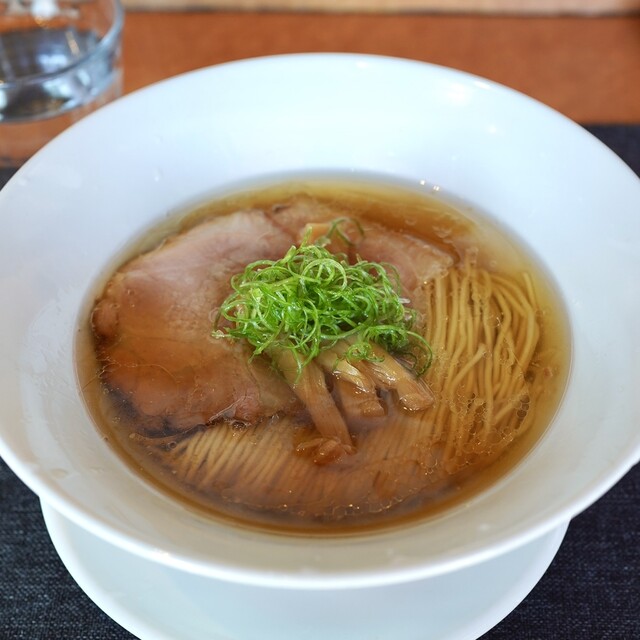
Approach Tsutsujigaoka and Tokyo’s ramen map changes register. The city’s central ramen districts trade on velocity, queues, and late-night density; out here in Chofu, the rhythm is more residential, with the counter doing the work that a larger room would dilute. Shibasaki Tei Tsutsujigaoka honten operates in that smaller, more exacting format: 10 counter seats, no private rooms, no smoking, and a service model built around bowls that have to justify their place in a tightly run room.
That counter scale matters for more than atmosphere. Ramen is often discussed through broth style or noodle texture, but the operational discipline is just as revealing. Small ramen shops in Tokyo have long been laboratories for portion control, ingredient efficiency, and short service cycles. A compact counter reduces waste by keeping production close to demand; it also exposes inconsistency quickly. In that sense, the format is part of the food culture, not a decorative detail.
A suburban ramen counter shaped by restraint, not spectacle
Tokyo ramen has splintered into many micro-scenes: station-adjacent quick bowls, destination counters, chef-led tasting-adjacent formats, and neighbourhood shops that maintain serious followings without adopting luxury-restaurant signals. This address sits in the latter camp. Its recognition on Tabelog Ramen TOKYO “Tabelog 100” in 2017, 2018, 2019, 2022, 2023, 2024, and 2025 places it inside a competitive field where consistency over years carries more weight than novelty.
The price tier also says something about Tokyo ramen’s democratic tension. A bowl can remain financially accessible while the shop earns repeat critical attention, a combination that is increasingly rare in other parts of the city’s dining culture. Compared with nearby and western-Tokyo peers such as AOSAN Sengawa ten and Teuchi Mensai Kamei, the appeal is not built around luxury cues. It is built around a narrow category executed with enough reliability to survive repeated public ranking cycles.
The sustainability angle in ramen is rarely advertised in the language of environmental policy, but it often appears in practice: counter-only seating, brief menus, quick turnover, and a culture that treats finishing a portion as part of the social contract. Here, the extra-large portion policy is unusually explicit, with a fine for leaving it uneaten. Read less as a gimmick than as a blunt expression of ramen-shop economics: order what can be finished, and do not make the kitchen absorb waste as theatre.
Why the recognition matters in Tokyo's ramen economy
Tabelog’s Hyakumeiten lists are not Michelin-style fine-dining awards; they are more useful for understanding where serious local attention clusters. For ramen, that distinction is valuable. Tokyo has thousands of bowls competing across style, price, and geography, and a Chofu counter appearing repeatedly on the city list signals durable relevance beyond its immediate neighbourhood.
That is especially important because suburban ramen does not get the same casual tourist traffic as Shinjuku, Ginza, or Akihabara. Diners make the trip with intent, and the shop has to function for regulars as well as destination eaters. This is where Tokyo’s ramen culture becomes more interesting than the simplified hunt for famous names: the better lesson is how much quality exists along commuter lines, where craft is folded into routine rather than staged as an event.
The comparison with higher-spend Tokyo restaurants is useful only up to a point. Tezukuri Gyoza no Mise Yoshiharu, Tio Danjo, and Don Bravo operate in different price and category bands, so they frame the broader western-Tokyo dining spread rather than direct competition. Ramen’s advantage is compression. The room is smaller, the decision cycle is shorter, and the assessment is immediate. A counter like this either earns repeat custom through the bowl or it does not.
How to place it inside a Tokyo food day
Shibasaki Tei Tsutsujigaoka honten is better treated as a purposeful ramen stop than a centrepiece evening. The logic is simple: a small counter rewards diners who arrive with flexible timing and a willingness to eat in the rhythm of the room. It also suits travellers who want to understand Tokyo beyond central wards, especially the way serious food culture follows railway lines into residential districts.
Families are not excluded from the equation; children are welcomed and children’s tableware is available. That detail matters in a category sometimes misread as adult-only because of cramped counters and fast pacing. The better framing is practical rather than sentimental: this is a compact ramen room where small groups and efficient meals fit the format more naturally than lingering.
For a broader Tokyo plan, pair the Chofu ramen thread with other category-specific stops rather than forcing direct comparison. Akihabara offers a different register at . 鮪と炭火焼き うお炭 秋葉原店, Shinjuku has its own late-district cadence at 12/10 Shinjuku ten, and Kagurazaka’s skewered-grill culture reads differently at 124. KAGURAZAKA (Yakitori). For casual visual dining, 2D Cafe sits in another lane entirely, while curry specialists such as 3 Chome no Curry Ya San show how Tokyo’s low-to-mid price food culture stays intensely segmented.
Use the wider city guides to build around the meal rather than stretching the stop beyond its natural scale: Our full Tokyo restaurants guide, Our full Tokyo hotels guide, Our full Tokyo bars guide, Our full Tokyo wineries guide, and Our full Tokyo experiences guide. For readers mapping Japanese food culture beyond Tokyo, the same practical lens applies to -Grilled beef Sukiyaki- KAMAKURA TANUKIAN 鎌倉 たぬき庵 in Kamakura.cafe in Osaka.know in Kumamoto, (Shoku) Vietnam in Kawasaki, [Curry Senmon Ten] Maruyama Kyoju. in Sapporo, and [ki:] in Kyoto. The Japanese casual-food diaspora provides a useful counterpoint too, from Jōdo Saké Bar in Los Angeles to Onigiri Time in Pasadena.
The editorial case is not that every traveller should cross Tokyo for one bowl. It is that a repeat-recognized, counter-only ramen shop in Chofu tells a sharper story about Tokyo dining than another tour of premium omakase rooms. It shows how craft, affordability, and waste awareness can coexist without turning sustainability into a slogan.
Budget and Context
Comparable venues in the metro at similar price points.
| Venue | Cuisine | Price | Notes |
|---|---|---|---|
| Shibasaki Tei Tsutsujigaoka hontenThis venue — the venue you are viewing | Tsutsujigaoka, Ramen | $$ | Not listed |
| らぁめん家 69'N' ROLL ONE 赤坂本店 | Akasaka, Chicken Clear Soy Ramen | $$ | Not listed |
| Coffee Tengoku | Asakusa, Retro Japanese Pancake Cafe | $$ | Not listed |
| COFFEE HALL Kugutsusou | Not listed | $$ | Kichijoji, Traditional Japanese kissaten with coffee and curry |
| LITTLE SPICE | Kichijoji, Japanese curry house | $$ | Not listed |
| FRENCH CURRY SPOON | Suginami, French-style Japanese curry | $$ | Not listed |
Recognition history
Dated appearances from independent guides and award organizations, with the underlying list record or original source where available.
Tabelog 100 #14 · No. 14
Tabelog · Tabelog 100 - Ramen - TOKYO - 2025
Continue exploring
More in Tokyo
Restaurants in Tokyo
Browse all →



Bars in Tokyo
Browse all →



Hotels in Tokyo
Browse all →




Wineries in Tokyo
Browse all →
At a Glance
- Quiet
- Cozy
- Classic
- Solo
- Casual Hangout
- Family
- Standalone
Clean, simple, and relaxing, with a small counter-only layout and a quiet neighborhood ramen-shop feel.