Sette Osteria
On 14th Street NW, where Washington's dining scene shifted decisively toward neighborhood-driven ambition over the past decade, Sette Osteria occupies a stretch that rewards walking. The kitchen works within Italian osteria tradition, offering a counterpoint to D.C.'s concentration of high-concept tasting menus and modern American formats. It reads as a place built for return visits rather than debut occasions.
Pearl is the En Primeur Club membership app — saves, bookings, and concierge access live there. Same editors, same standards.
- Address
- 1634 14th St NW, Washington, DC 20009
- Phone
- +12022901178
- Website
- setteosteria.com
- Directions
- Get directions
 Saves & bookings on Pearl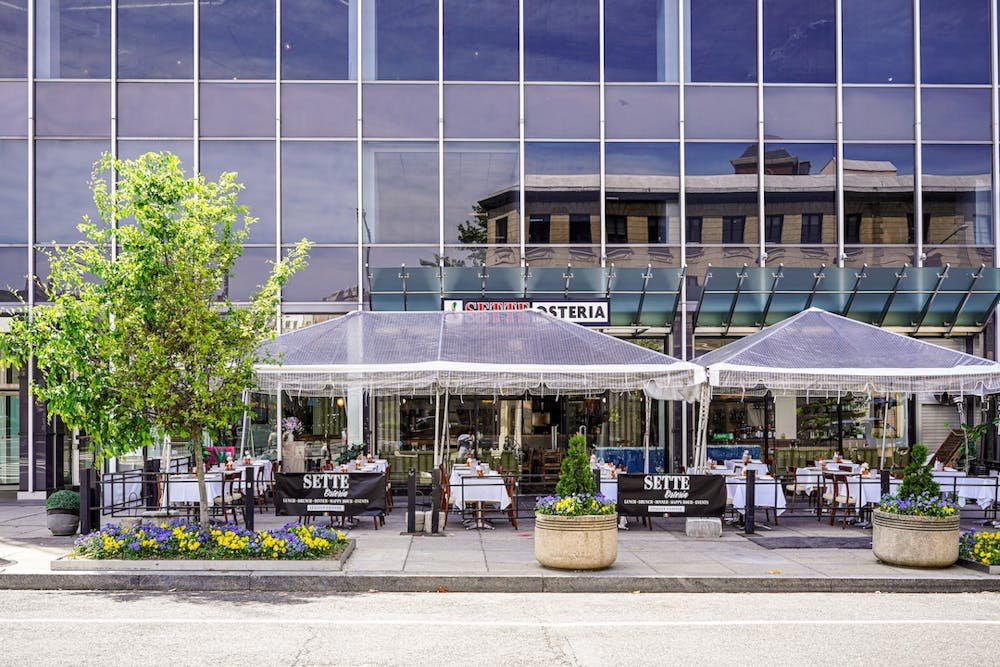
14th Street and the Case for the Neighborhood Osteria
Washington's 14th Street NW corridor has become one of the more instructive stretches of American urban dining to watch. Over roughly fifteen years, the strip between Thomas Circle and Columbia Heights transformed from a marginal commercial block into one of the city's densest concentrations of independent restaurants, bars, and wine-focused spots. The logic of that shift is worth understanding: 14th Street attracted operators who were priced out of Penn Quarter or Georgetown, who wanted foot traffic without tourist dependency, and who bet on a residential audience willing to eat and drink seriously several nights a week. That bet paid off, and the corridor now functions as a proving ground where format and culinary identity matter more than location prestige.
Sette Osteria is an authentic Italian osteria at 1634 14th St NW in Washington, D.C. priced around $30 per person. It sits inside that arc. The osteria format it draws from has specific Italian origins worth noting: osterie were working-class eating houses, defined by simplicity of preparation, regional loyalty, and the assumption that the wine and the food were inseparable. The format migrated to American cities in waves, filtered through different regional interpretations, and landed somewhere between casual trattoria and mid-tier ristorante in most U.S. markets. What distinguishes the better versions is a commitment to doing a narrow set of things consistently rather than chasing the breadth of a full Italian-American menu.
Italian Tradition on a Street Built for Regulars
The cultural logic of the osteria maps well onto 14th Street's residential character. Unlike the tasting-menu format, which asks for a committed evening and a specific kind of attention, the osteria invites repetition. You return for the same pasta, the same glass poured without ceremony, the same room you already know how to inhabit. That rhythm suits a neighborhood where people walk rather than drive, and where the restaurant functions as a social anchor rather than a destination event.
Italian-American dining in Washington has historically concentrated in older enclaves and tourist-adjacent corridors, with a handful of white-tablecloth Italian rooms downtown that served the expense-account circuit for decades. The shift toward more casual, ingredient-focused Italian formats on streets like 14th represents a broader national recalibration: less emphasis on red-sauce tradition and more attention to regional specificity, shorter menus, and natural or Italian-leaning wine programs. That shift has been playing out in cities from New York to San Francisco, and Washington's version of it is increasingly coherent.
Within D.C.'s current dining map, Sette Osteria occupies a different register than the high-investment contemporary rooms that have drawn critical attention in recent years. Venues like Jônt and minibar operate at the tasting-menu tier, where the format itself is the proposition. Sette Osteria's value sits in a different direction: accessibility of format, repetition, and a room calibrated for conversation rather than performance dining.
Where It Sits in the Competitive Field
The 14th Street corridor now supports a range of serious independent operators, which means Sette Osteria competes in a genuinely crowded field. Nearby, Oyster Oyster has drawn sustained recognition for its sustainable New American format at the $$$ tier. Albi and Causa both operate at the $$$$ tier with focused, culturally specific menus that have built loyal followings. The comparison is useful: in a neighborhood where format discipline and culinary identity are rewarded, the osteria proposition requires clarity about what it is and what it is not.
The broader D.C. dining field has also grown more competitive at every price point. The city that once lagged behind New York, Chicago, and San Francisco in serious restaurant culture now generates its own critical conversation, with venues like The Inn at Little Washington holding long-established prestige and newer entrants reshaping expectations at the neighborhood level. For readers tracking the full picture of what D.C. does well, our full Washington, D.C. restaurants guide maps the current field across price tiers and cuisine types.
Italian Osterie in the American Context
It is worth situating the osteria format within the wider arc of Italian dining in the United States. The past two decades have seen a sustained critical interest in regional Italian cooking that moved well beyond Tuscan and Roman benchmarks toward the specificity of Venetian cicchetti, Ligurian preparations, Sicilian sourness and sweet-sour agrodolce traditions, and the pasta cultures of Emilia-Romagna. That specificity has raised the baseline expectation for what Italian restaurants in American cities are supposed to deliver.
The reference points now span globally recognized Italian rooms like 8 1/2 Otto e Mezzo Bombana in Hong Kong, which carries three Michelin stars and operates at the formal end of Italian fine dining, and domestically, the conversation about what casual Italian can achieve has been shaped by the same forces that refined places like Le Bernardin in New York and Lazy Bear in San Francisco: a general upward pressure on ingredient sourcing, technique, and wine program seriousness, even at informal price points. That pressure reaches the osteria format too.
For readers whose frame of reference includes tasting-menu formats at venues like Alinea in Chicago, The French Laundry in Napa, or Providence in Los Angeles, the osteria proposition will read as a deliberate step down in ceremony and price, and that is precisely the point. The osteria does not try to be those rooms. It exists to provide something those rooms cannot: the ease of a Tuesday dinner without a reservation three months out.
Planning a Visit
The restaurant's address on 14th Street NW puts it in walkable range of the U Street and Columbia Heights neighborhoods.
How Sette Osteria Compares at a Glance
| Venue | Cuisine | Price Tier | Format |
|---|---|---|---|
| The restaurant | Italian | Not confirmed | Osteria / neighborhood dining |
| Oyster Oyster | New American, Vegetarian | $$$ | Ingredient-focused tasting |
| Causa | Peruvian | $$$$ | Modern Peruvian, tasting |
| Albi | Middle Eastern | $$$$ | Regional focused, à la carte |
| Blue Hill at Stone Barns | New American | $$$$ | Farm-to-table tasting |
| Addison | Contemporary | $$$$ | Fine dining tasting |
| Single Thread Farm | Japanese-California | $$$$ | Inn and tasting menu |
| Atomix | Korean | $$$$ | Counter tasting |
| Emeril's | Contemporary Louisiana | $$$ | Full-service à la carte |
In Context: Similar Options
Comparable venues nearby, for context on price, style, and recognition.
| Venue | Cuisine | Price | Notes |
|---|---|---|---|
| Sette OsteriaThis venue — the venue you are viewing | Authentic Italian Osteria | $$ | Not listed |
| Ulivo | Neighborhood Italian Trattoria | $$ | Pleasant Plains |
| Gordon Ramsay Street Pizza - Washington DC | Modern Italian Street Pizza | $$ | Penn Quarter |
| Etto | Neapolitan Pizza & Italian Antipasti | $$ | Logan Circle |
| All-Purpose & AP Pizza Shop | Italian-American pizzeria and AP Pizza Shop counter | $$ | Shaw |
| DuPont Italian Kitchen | Classic Italian Trattoria | $$ | Dupont Circle |
Continue exploring
More in Washington DC
Restaurants in Washington DC
Browse all →
Bars in Washington DC
Browse all →
Hotels in Washington DC
Browse all →
At a Glance
- Cozy
- Rustic
- Sophisticated
- Casual Hangout
- Date Night
- Brunch
- Open Kitchen
- Extensive Wine List
- Street Scene
Current opening hours
- Monday
- 12–9 PM
- Tuesday
- 12–9 PM
- Wednesday
- 12–9 PM
- Thursday
- 12–9 PM
- Friday
- 12–10 PM
- Saturday
- 10 AM–10 PM
- Sunday
- 10 AM–9 PM
Hours can change for holidays and private events. Last verified .
Cozy yet sophisticated atmosphere with exposed bricks, warm lighting from wood-fired oven, and busy international energy.