Sea Maru Abalone Porridge
Our verdict
Abalone porridge occupies a specific and serious place in Korean coastal cuisine, and Sea Maru Abalone Porridge represents Busan's version of that tradition: slow-cooked, seafood-forward, and rooted in the fishing culture of Korea's southern coast. For visitors working through the city's broader dining range, this is where the ingredient, not the technique, does the talking.

Pearl is the En Primeur Club membership app, where members save venues, book tables and use the concierge.
The menu
What to order
- Abalone porridge
Where the Porridge Comes From
Abalone porridge, known in Korean as jeonbokjuk, sits at the intersection of coastal geography and culinary restraint. Along Korea's southern and western coasts, abalone has historically been harvested by haenyeo, the free-diving women whose practice is now a UNESCO-listed tradition. The porridge built around that harvest is not a celebratory dish in the theatrical sense. It is restorative, precise, and defined almost entirely by the quality of its central ingredient. In Busan, where the East Sea and Korea Strait meet and where the fish markets at Jagalchi set the daily tone, this style of cooking has found a natural home.
Sea Maru Abalone Porridge operates within that tradition. The name itself positions the restaurant clearly: this is not a multi-course seafood restaurant, not a fusion experiment, and not a contemporary Korean tasting menu. It is a specialist address for a single dish type, in a city that has developed a serious appetite for ingredient-led, low-intervention cooking at the accessible end of the price spectrum.
The Dish and Its Context
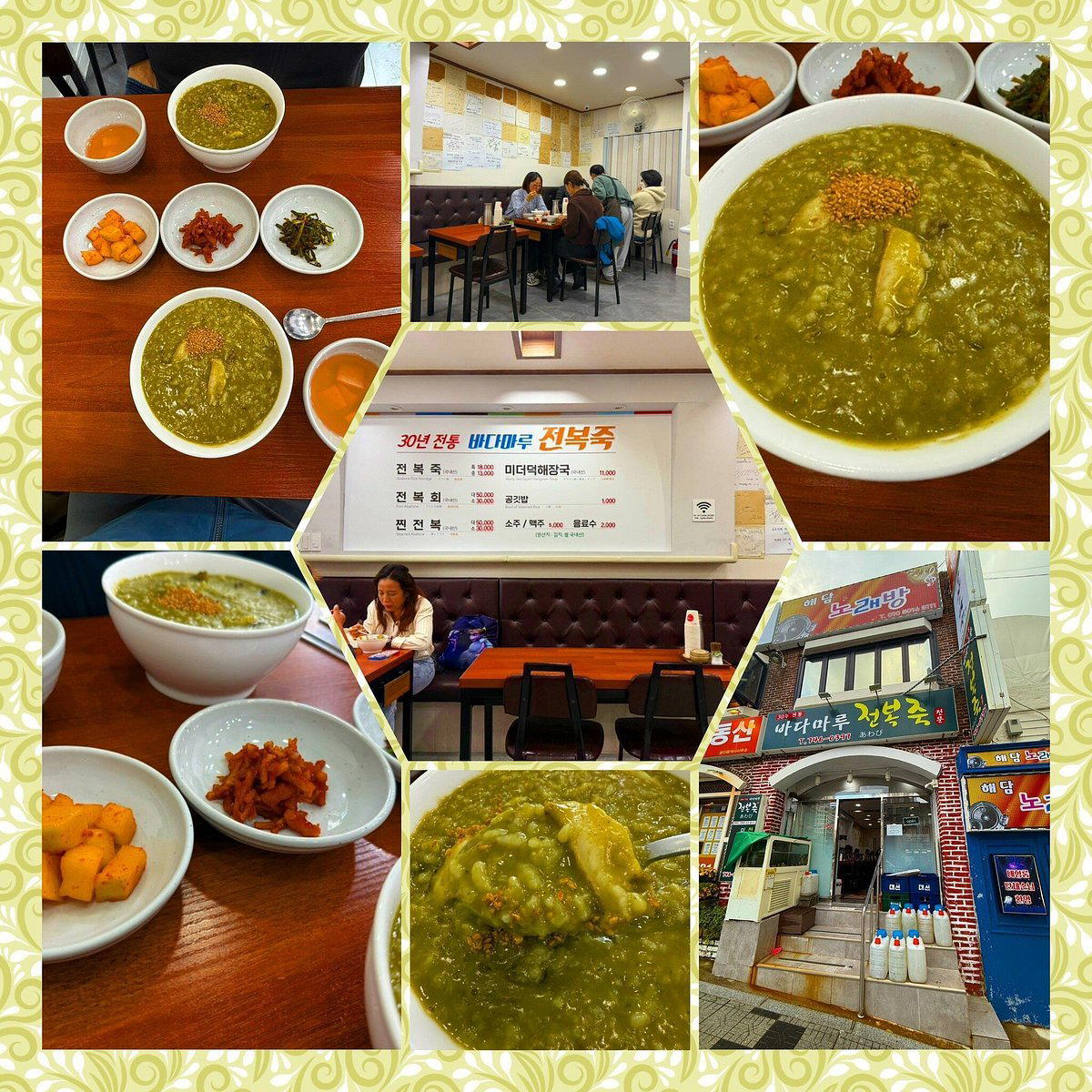
Jeonbokjuk is made by cooking whole or sliced abalone with rice, typically in an abalone-enriched stock or water, until the grains break down into a dense, silky porridge. The abalone liver is often included, which turns the porridge a distinct shade of green and adds a mineral depth that separates it from simpler rice porridges. It is a dish where temperature control, ratio, and the freshness of the abalone matter more than any chef's intervention. At specialist restaurants in Busan, this is understood implicitly: the kitchen's job is to stay out of the way of the ingredient.
That framing matters when placing Sea Maru Abalone Porridge within Busan's dining range. The city's restaurant scene runs from raw-at-the-counter seafood at Jagalchi to Korean contemporary at addresses like Palate and Japanese-influenced precision at Mori. At the other end of the price register, single-dish specialists like 100.1. Pyeongnaeng and 1969 Buwondong Kalguksu demonstrate that the city's food culture rewards focus. Sea Maru fits that latter category: a kitchen defined by what it does not do as much as what it does. For the full range of Busan's dining, see our full Busan restaurants guide.
Abalone in Korean Culinary Culture
Abalone carries a particular cultural weight in Korea. Historically, it appeared in royal court cuisine and in offerings made during ancestral rites, partly because of its rarity and partly because of its association with longevity. In contemporary Korea, it remains a premium ingredient, which means restaurants built around it occupy a specific position: accessible enough to be a lunch destination, but carrying ingredient costs that reflect the seafood's market value. The porridge format lowers the barrier to entry compared to, say, grilled or raw abalone preparations, which is one reason jeonbokjuk has become the format through which most visitors encounter the ingredient for the first time.
That dynamic extends beyond Busan. Along Jeju Island's coast, abalone preparation has its own distinct register, visible in restaurants like Hinode in Seogwipo and the grilling culture documented at Black Pork BBQ. In Seoul, the ingredient appears in more composed formats, including at Mingles, where Korean tradition is reframed through a fine-dining lens. At the highest level internationally, seafood-led minimalism finds its parallel in kitchens like Le Bernardin in New York City, where the ingredient-first philosophy shares a logic with jeonbokjuk even if the execution is entirely different. Korean cuisine's presence in international fine dining has also grown through restaurants like Atomix, which has introduced global audiences to the depth of Korean culinary tradition in a tasting-menu format.
Busan's Specialist Dining Tradition
One of Busan's consistent traits as a food city is the co-existence of premium destination restaurants and highly focused, low-cost specialists. Born and Bred occupies the best of the steakhouse tier at ₩₩₩₩. Porridge and noodle specialists operate at the opposite end. This is not a tension; it reflects a food culture in which format specialisation is respected across the entire price range. In Suwon, a similar pattern plays out at Doosoogobang, and in Gyeongju, deeply traditional formats survive and attract steady followings, as seen at Gyeongju Wonjo Kongguk and Hwangnam Bread and Busan Steamed Bun. Across Korean food culture, the single-dish specialist is not a compromise; it is often the point.
Sea Maru fits that tradition. Abalone porridge is not a secondary item on a broader seafood menu here. It is the reason to go, and the kitchen's credibility rests entirely on execution of that one format. Other Busan addresses like Dining Room and Badang Lounge in Jeju pursue a different model, one defined by range and atmosphere. Sea Maru's model is defined by depth and repetition: the same dish, prepared correctly, every service. Further afield, the Jeju barbecue tradition at 88돼지 and the Suwon galbi institution Gobojeong Galbi #1 follow similar logic in their respective formats.
Planning Your Visit
Abalone porridge restaurants in Busan tend to operate on lunch-forward schedules, with some closing once the day's stock is exhausted rather than at a fixed hour. For a single-dish specialist of this type, arriving early in the service window is the more reliable approach than arriving late.
Frequently asked questions
Is jeonbokjuk at Sea Maru Abalone Porridge made with whole abalone or sliced?
Sea Maru Abalone Porridge is located in Busan, a city with direct access to southern Korean coastal seafood supply. Jeonbokjuk is traditionally prepared with either whole or sliced abalone cooked down with rice in an abalone-enriched stock, and the preparation choice affects both texture and intensity of flavour.
What dish is Sea Maru Abalone Porridge famous for?
The restaurant is built around jeonbokjuk, the Korean abalone porridge in which rice is slow-cooked with abalone until it breaks down into a dense, savoury broth. In Busan, a port city where raw seafood and specialist restaurants operate side by side, this kind of single-focus cooking carries its own credibility. Abalone has deep roots in Korean culinary history, appearing in royal court cuisine and ancestral rite offerings long before it became a restaurant fixture.
Do I need a reservation for Sea Maru Abalone Porridge?
Busan's specialist porridge restaurants tend to operate on a walk-in basis, but queue times at well-regarded spots can extend significantly, particularly on weekends. Contacting the venue directly before visiting is the most reliable approach.
What's Sea Maru Abalone Porridge best at?
Sea Maru operates as a focused specialist in jeonbokjuk, the discipline that gives the restaurant its name and its reason for existing in Busan's crowded seafood scene. Busan has a consistent tradition of single-dish restaurants that compete on depth rather than breadth, and abalone porridge fits squarely in that category. The dish itself rewards restraint: the quality of the abalone and the patience of the cook are the only variables that matter.
Quick Comparison
| Venue | Cuisine | Price | Awards | Notes |
|---|---|---|---|---|
| Sea Maru Abalone PorridgeThis venue (the venue you are viewing) | Korean Abalone Porridge | Not listed | Not listed | Not listed |
| Palate | Contemporary French with Korean Fusion | $150–200 | 1 Michelin Star · La Liste Top Restaurants | Contemporary |
| Mori | Japanese Kaiseki | $200–300 | 1 Michelin Star | Japanese |
| Born and Bred | Modern Hanwoo Beef Omakase Steakhouse | $100–150 | Michelin Plate · World's 50 Best #51 | Steakhouse |
| 100.1. Pyeongnaeng | Pyongyang-style Naengmyeon | $10–20 | Michelin Bib Gourmand | Not listed |
| Anmok | Modern Korean Dwaeji-Gukbap | $10–20 | Michelin Bib Gourmand | Not listed |