The Logic of the Italian Progression
Italian restaurant dining, at its most structured, follows a sequencing logic that bears almost no resemblance to the abbreviated two-course habits that German city-centre dining has normalised. The antipasto establishes the kitchen's relationship with cured and preserved ingredients. The primo, usually pasta or risotto, carries the bulk of the kitchen's technical argument. The secondo, meat or fish, arrives as a resolution. Contorni come alongside but never overwhelm. Dolci close the arc. This is not arbitrary tradition: each stage operates at a different temperature, richness level, and pace, and the meal only coheres when the kitchen respects the transitions.
In Berlin, few osterie hold to this full progression without compressing it into a hybrid format. The city's dining culture, shaped in part by its late-night rhythms and its resistance to formality, has pushed most Italian kitchens toward a simplified card where pasta dominates and the remaining courses are optional add-ons. A kitchen that sequences properly, where the antipasto is not a courtesy plate and the secondo is not an afterthought, occupies a different position in the city's Italian dining tier from the majority of neighbourhood trattorias.
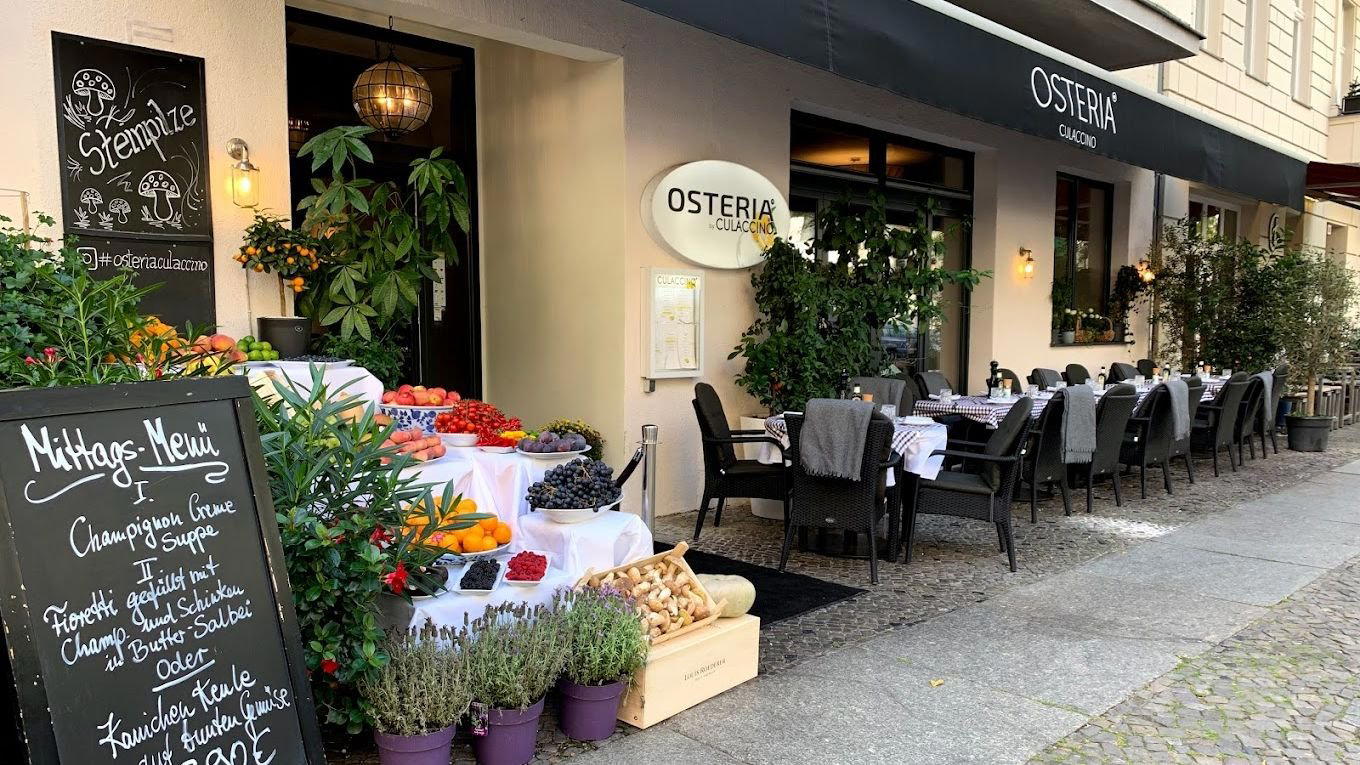
That structural commitment is one useful frame for reading what Osteria Culaccino is doing on Grolmanstraße. Berlin's broader fine-dining tier, represented by kitchens like Rutz, Nobelhart & Schmutzig, and FACIL, operates in a contemporary European idiom where Italian tradition is rarely the explicit reference. The osteria format, with its regional Italian grammar and its emphasis on the progression of a full meal, carves out a distinct position in a market that otherwise skews toward either high-end tasting menus or casual pizza-and-pasta operations with no structural ambition between them.
Where the Meal Arc Begins
In the Italian sequence, antipasti carry a specific function: they calibrate the diner's expectations and establish the kitchen's relationship with preserved, marinated, and cured ingredients. A well-assembled antipasto selection in an osteria setting communicates whether the kitchen imports its salumi and formaggi or selects them deliberately, whether acidity is understood as a structural tool rather than an afterthought, and whether portion logic is disciplined enough to leave appetite intact for the courses that follow. These signals matter more than any individual dish name.
The middle of the progression, the primo, is where Italian kitchens are most legible. Pasta in particular operates as a near-well-suited diagnostic: dough hydration, resting time, sauce-to-pasta ratio, and finishing technique are all visible in the result. In Berlin, where high-quality pasta has become more common as Italian imports and specialist suppliers have expanded their reach into the city, the distinction between competent and considered execution has sharpened. A kitchen that can hold a proper primo against that context is making a substantive claim.
Berlin's Italian Tier in Context
Germany's premium Italian dining exists largely outside Berlin. Kitchens like Vendôme in Bergisch Gladbach, Schwarzwaldstube in Baiersbronn, and Aqua in Wolfsburg represent Germany's highest Michelin tier, but they operate in a French-influenced fine-dining idiom rather than an Italian one. The Italian osteria tradition, with its emphasis on region-specific ingredients, full-meal sequencing, and a wine list that functions as a regional document rather than a prestige showcase, has found less institutional recognition in the German system than its French-coded equivalents. Comparable Italian-focused precision at the fine-dining end in Germany tends to appear in smaller cities rather than in Berlin's competitive central market.
The neighbourhood's dining public has the appetite and the spending habit for a properly sequenced Italian meal at a price point that reflects ingredient quality and kitchen effort. The comparison set for a serious osteria in this postcode is not Berlin's Michelin-starred tasting menus, represented in the city's broader portfolio by formats like CODA and Restaurant Tim Raue, but rather the mid-to-upper tier of the city's European restaurant market, where consistency and sourcing discipline matter more than format innovation.
For broader context on where Osteria Culaccino sits within the city's full dining picture, the the guide Berlin restaurants guide maps the competitive set across neighbourhoods and cuisine types. Germany-wide comparisons in the Italian register can also draw from JAN in Munich and ES:SENZ in Grassau, both of which operate in the southern German market where Italian culinary influence on fine dining is more pronounced than in the north. International reference points for precision sequencing and hospitality philosophy include Le Bernardin in New York and Atomix, alongside the German peers Victor's Fine Dining by Christian Bau in Perl, Waldhotel Sonnora in Dreis, Restaurant Haerlin in Hamburg, Schanz in Piesport, and Bagatelle in Trier.
Seasonal Positioning
Italian cooking is acutely seasonal in a way that its Berlin versions do not always reflect. Autumn is the period when the Italian pantry is at its most expressive: truffle, porcini, chestnut, and late-harvest vegetables give the primo and secondo stages of the progression a depth that summer menus built around lighter produce cannot replicate. A kitchen in the osteria tradition that sources with the Italian seasonal calendar rather than the German supermarket calendar will produce a meaningfully different meal between October and December than it does in June. For a restaurant whose name references the unhurried pace of a meal properly taken, the autumn and early winter window is the period most aligned with that promise.
Know Before You Go
- Address
- Grolmanstraße 21, 10623 Berlin, Germany
- Neighbourhood
- Charlottenburg
- Phone
- not listed, check current booking channels directly
- Website
- Not available at time of publication
- Reservations
- Price range
- Not confirmed; comparable Charlottenburg osterie in the mid-to-upper tier
- Leading season
- Autumn through early winter for peak Italian pantry ingredients