


1 Michelin Star · Star Wine List · Wine Spectator Award of Excellence
Our verdict
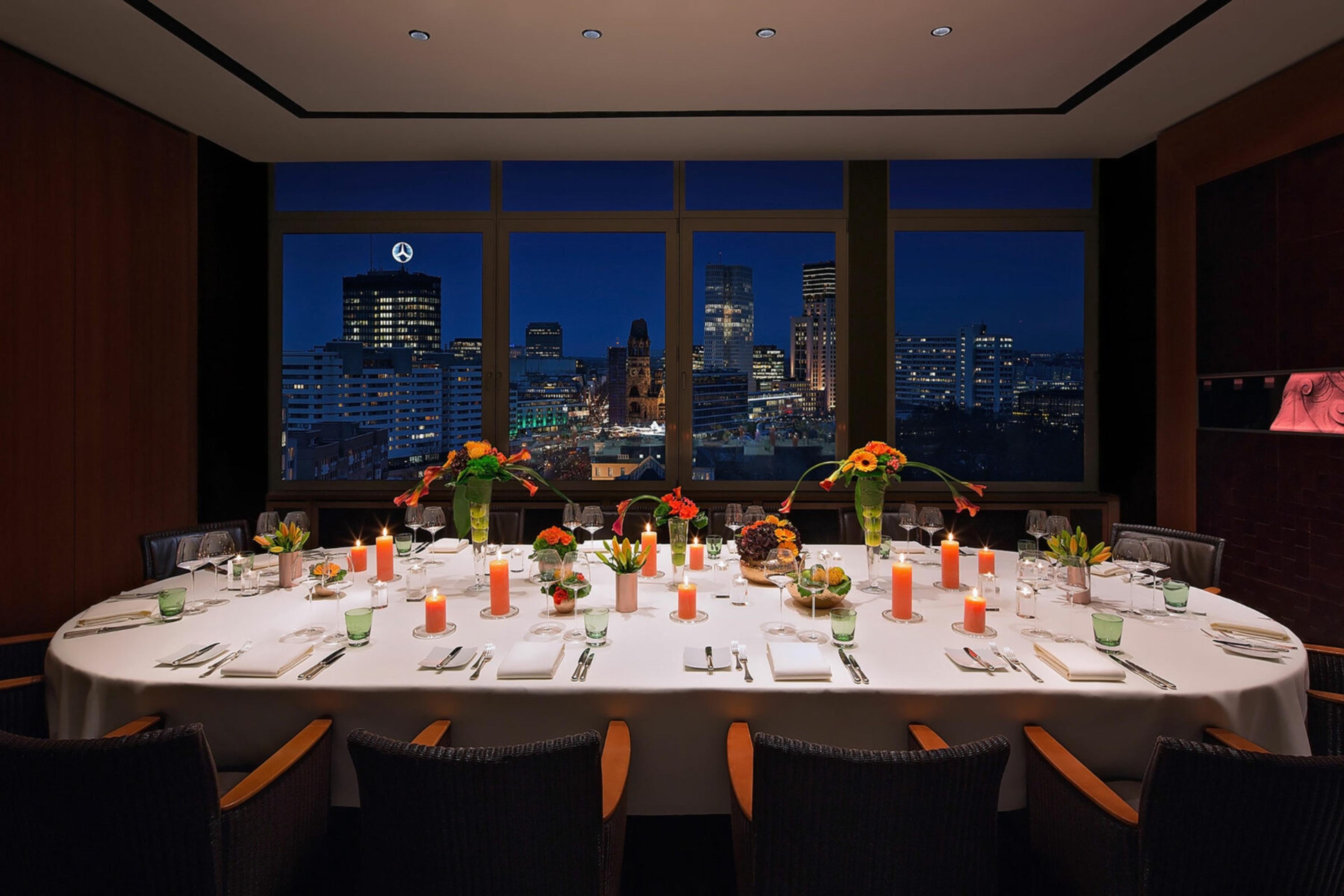
On the 14th floor of Berlin's InterContinental Hotel, Hugos holds a Michelin star for modern cuisine that draws on Mexican culinary roots and European fine-dining technique. Panoramic views sweep across the Tiergarten to the Victory Column. The wine list, with 1,500 labels across French, Champagne, Californian, and Mexican selections, matches the kitchen's cross-continental ambition.

Pearl is the En Primeur Club membership app, where members save venues, book tables and use the concierge.
Fourteen Floors Up, Where Berlin Meets Mexico City
Berlin's fine-dining scene has long operated on a tension between local identity and cosmopolitan ambition. The city's leading tables range from hyper-regional German minimalism, practised at places like hallmann & klee, to European creative cooking at FACIL (two Michelin stars) and Rutz (three stars), where the emphasis is on technique applied to European product. Hugos occupies a distinct position inside that range: it is the city's most visible address for cooking that imports Mexican culinary logic into a fine-dining European framework, then serves it from an eyrie above the Tiergarten.
The setting is not incidental. At 14 floors above Budapester Strasse, inside the InterContinental Hotel, the room commands sightlines across the Tiergarten to the Victory Column and, on clear evenings, the Fernsehturm beyond. Hotel fine-dining rooms in major cities often carry a slight stigma, associated with convenience over conviction, but Hugos has maintained a Michelin star through both 2024 and 2025 by treating the kitchen as the serious department and the view as a secondary dividend.
The Logic of Imported Technique
The editorial angle that defines Hugos within Berlin's Michelin tier is the intersection of indigenous Mexican product with European fine-dining method. This is a category that remains rare across Germany's starred restaurants. At JAN in Munich, Schwarzwaldstube in Baiersbronn, or Vendôme in Bergisch Gladbach, the prevailing grammar is Franco-German, drawing on French classical training applied to regional German or European ingredient sourcing. Hugo Ortega, who also co-owns the restaurant alongside Tracy Vaught, arrives from a different culinary lineage. His background is Mexican, and the cooking at Hugos translates that inheritance through the precision and presentation standards that the Michelin framework demands.
This matters for the guest's reading of the menu. What appears at the table is not a conventional European tasting menu with a Mexican ingredient dropped in for novelty. The structural logic, the layering of heat, acidity, and fat, the weight given to corn derivatives, dried chiles, and slow-cooked proteins, belongs to a Mexican culinary idiom. The execution, the plate control, the sourcing specificity, the wine pairing infrastructure, belongs to European fine dining. The two systems are genuinely integrated rather than decorative.
That integration places Hugos in a peer conversation that extends beyond Berlin. Modern cuisine houses that apply rigorous European method to non-European culinary traditions have found consistent Michelin traction in recent years, from Nordic-inflected addresses to Japanese-French hybrids. The starred recognition Hugos holds signals that the Michelin assessors, who have historically been more conservative in Germany than in France or Japan, now read cross-cultural culinary authority as a credible category.
Where Hugos Sits in Berlin's Michelin Map
Berlin's current Michelin geography runs from two and three-star addresses, CODA for creative dessert-focused work, FACIL for contemporary European, Horváth for modern Austrian, through to a cluster of single-star kitchens doing distinct national or regional work. Among the single-star tier, Hugos's cuisine type is singular. Bieberbau and pars Restaurant represent other individual voices within that bracket, each with their own culinary logics. The competitive set for Hugos, however, is less about geographic proximity and more about the cooking category: hotel fine-dining with cross-continental culinary identity, rated at the four-price-tier level in a city where that bracket demands sustained Michelin credibility.
For a broader view of what Berlin's fine dining addresses look like across neighbourhoods and price points, our full Berlin restaurants guide maps the city's current offer. Berlin's hotel category, which has grown significantly in the luxury segment over the last decade, is covered in our full Berlin hotels guide.
The Wine Program as a Structural Argument
A restaurant's wine list is one of the clearest signals of how seriously its operators take the dining room as a complete proposition. Hugos's list, directed by Israel Diaz, who also serves as General Manager, runs to approximately 1,500 bottles across roughly 150 selections. The geographic spread, France, Champagne, California, Mexico, is not decorative. Mexico appears on a fine-dining wine list in Europe as a deliberate statement rather than a curiosity. Mexican wine production, concentrated in Baja California's Valle de Guadalupe and Ensenada sub-regions, has built genuine quality credentials over the past two decades, and including it at Hugos is consistent with the kitchen's cross-continental identity.
The pricing structure uses a dollar-sign scale that places the list in a mid-to-upper bracket: a range of pricing with significant representation of bottles above the 100-euro threshold. For a four-price-tier restaurant holding a Michelin star, this is calibrated to the expected spend rather than padded for margin. France and Champagne selections anchor the classical pairing options; the California and Mexico sections offer the less conventional pairings that match the kitchen's own register.
Diaz's dual role, both wine director and general manager, is worth noting as a structural choice. It concentrates front-of-house authority in one person with deep wine knowledge, which tends to produce more coherent pairing recommendations than the more common split between a GM focused on operations and a sommelier focused purely on the list.
Charlottenburg as a Dining Address
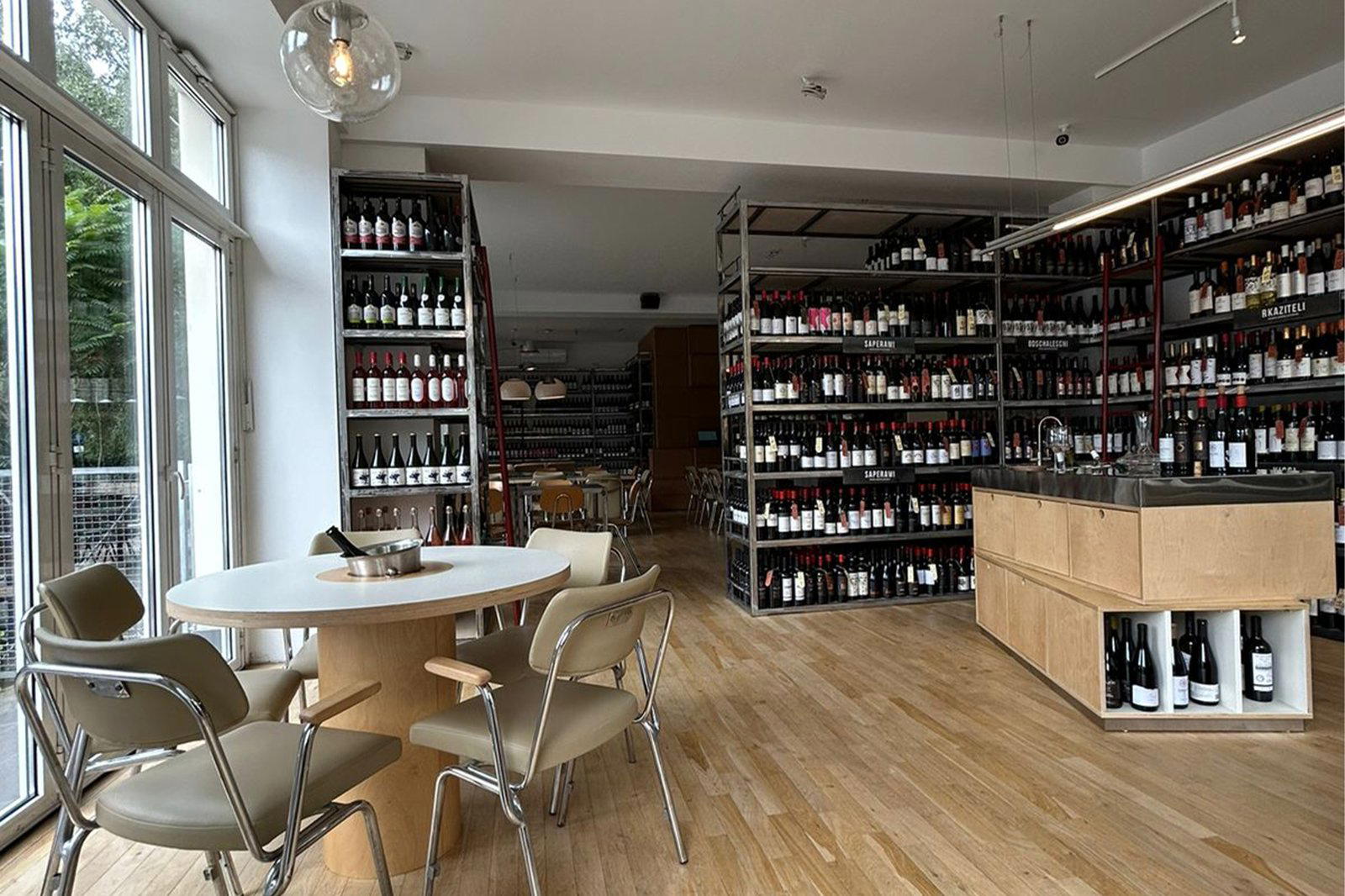
Charlottenburg carries a different character from the Mitte and Kreuzberg addresses where many of Berlin's newer fine-dining ventures have opened. It is an older, more established residential and hotel district, anchored by the Kurfürstendamm and bordered by the Tiergarten and the Berlin Zoo. The neighbourhood's dining identity is less experimental than the east-central cluster and more aligned with the kind of formal, hotel-adjacent fine dining that was the default model for serious restaurants before Berlin's post-reunification creative scene emerged. Hugos operates within that tradition but has not been defined by its conservatism. The Michelin star, maintained across multiple cycles, indicates that the kitchen has kept pace with the assessors' evolving benchmarks rather than coasting on location.
Other addresses at the higher end of Berlin's scene, including SKYKITCHEN and aerde, bring different formats and culinary priorities to the city's refined dining conversation. For visitors interested in how Berlin's bar culture has developed alongside its restaurant scene, our full Berlin bars guide and our full Berlin experiences guide offer companion reading.
Germany's Starred Tier in Context
Germany's Michelin-starred restaurants have historically clustered in Baden-Württemberg, Bavaria, and North Rhine-Westphalia, with Berlin punching below its population and reputation weight at the top tier. Addresses like Aqua in Wolfsburg, ES:SENZ in Grassau, and Restaurant Haerlin in Hamburg illustrate how the German starred map distributes across the country. Hugos belongs to the narrower subset of Berlin's current starred cohort and holds its position in a city whose fine-dining offer has grown more competitive over the last decade.
For comparison at the modern cuisine category across Scandinavia and the Gulf, Frantzén in Stockholm and FZN by Björn Frantzén in Dubai represent how ambitious modern cuisine formats have scaled internationally. Hugos's model, a single-property fine-dining room with a specific culinary identity and deep wine infrastructure, is a different proposition from those multi-city operations, but the Opinionated About Dining ranking at 571 in North America (2025) indicates that the restaurant's reputation carries weight beyond its immediate European context. The cross-listing speaks to the Mexican culinary lineage at the heart of the kitchen: the OAD assessor community reads Hugos partly in the context of where its cooking comes from.
Planning a Visit
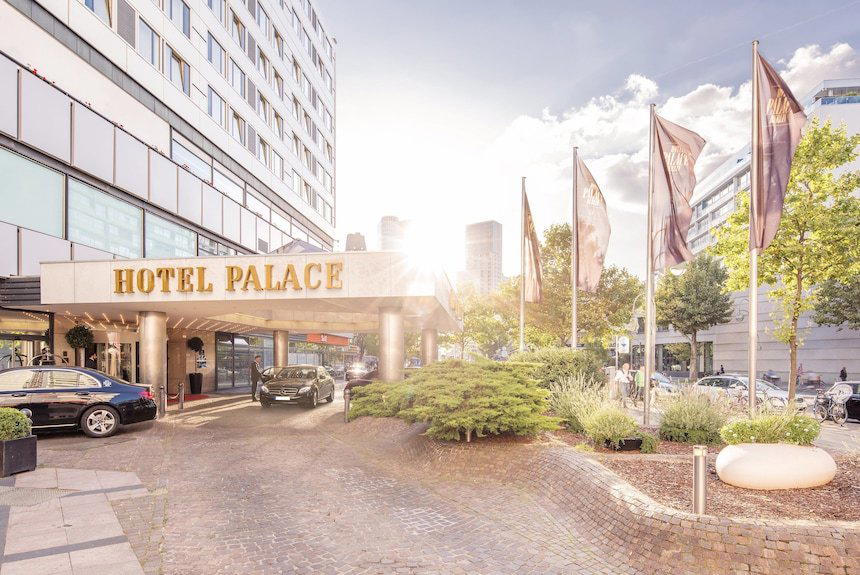
Hugos is at Budapester Strasse 2, 10787 Berlin, on the 14th floor of the InterContinental Hotel in Charlottenburg. The hotel sits directly at the edge of the Tiergarten, a short walk from Zoologischer Garten station, which is served by the S-Bahn and U-Bahn. At the four-price-tier level with a current Michelin star, reservations in advance are advisable, particularly for evening sittings when the panoramic views across the city are at their most considered. The wine list's breadth and the dual-role authority of Israel Diaz as both GM and wine director make pre-visit communication about pairing preferences a sensible step. For broader context on Berlin's wine scene, our full Berlin wineries guide covers what the city's growing natural wine and import culture looks like beyond the restaurant floor.
What to Order at Hugos
The menu at Hugos is grounded in modern cuisine with Mexican culinary architecture applied through fine-dining technique. Given chef Hugo Ortega's background and the kitchen's cross-continental identity, the dishes that leading express the restaurant's argument are those where the Mexican structural logic, the use of dried chiles, masa derivatives, and long-braised proteins, is most clearly in dialogue with European presentation standards. The wine list's Mexico section, selected by Israel Diaz, offers the most coherent pairing choice for dishes in that register, while the France and Champagne selections provide the classical counterpoint for guests who prefer to anchor the wine side conventionally. The Michelin one-star rating through 2024 and 2025, combined with the OAD North America ranking, confirms that the kitchen's output meets the sustained technical threshold expected at this price tier.
Frequently asked questions
Who runs the kitchen at Hugos?
The chef associated with Hugos is Hugo Ortega.
What should I expect cuisine-wise at Hugos?
What's the best thing to order at Hugos?
The menu is built around modern cuisine with Mexican culinary architecture applied through European fine-dining technique, chef Hugo Ortega's defining approach, recognised with a Michelin star in both 2024 and 2025. Dishes that reflect this intersection most directly are where the menu earns its reputation: preparations where indigenous Mexican product is treated with the precision typical of Berlin's starred tier. The wine program, which runs to 1,500 labels with particular depth in France, Champagne, California, and Mexico, is worth engaging seriously rather than treating as an afterthought.
What does dinner at Hugos typically cost?
Pricing at Hugos is listed as €€€€.
Where is Hugos in Berlin?
Hugos is located at Budapester Str. 2, 10787 Berlin, Germany, Berlin.
What's Hugos known for in terms of accolades?
Hugos has received recognition including: Located in the Charlottenburg district, on the 14th floor of the Intercontinental Hotel, bordering the famous Berlin Zoo, Hugos offers panoramic views of the city, including the Victory Column, Alexan...; Opinionated About Dining Top Restau….
Credentials Lens
| Venue | Cuisine | Price | Awards | Notes |
|---|---|---|---|---|
| HugosThis venue (the venue you are viewing) | Modern European Fine Dining | $200–300 | 1 Michelin Star · Star Wine List | Not listed |
| CODA Dessert Dining | Dessert-Inspired Fine Dining | $200–300 | 2 Michelin Stars · World's 50 Best #79 | Creative |
| Rutz | Modern German Fine Dining | $200–300 | 3 Michelin Stars · La Liste Top Restaurants | Modern European, Modern Cuisine |
| Nobelhart & Schmutzig | Hyper-Local Modern German Fine Dining | $100–150 | 1 Michelin Star · World's 50 Best #59 | Modern German, Creative |
| FACIL | Modern Fusion Fine Dining | $200–300 | 2 Michelin Stars · La Liste Top Restaurants | Contemporary European, Creative |
| Horváth | Modern Austrian Vegetable Cuisine | $200–300 | 2 Michelin Stars · La Liste Top Restaurants | Modern Austrian, Creative |
Recognition history
Dated appearances from independent guides and award organizations, with the underlying list record or original source where available.
Michelin 1 Star
Michelin
Star Wine List
Star Wine List
Opinionated About Dining Top Restaurants in North America Ranked #571
Opinionated About Dining
Wine Spectator Award of Excellence
Wine Spectator
Full recognition history (6 entries)
Michelin 1 Star
Michelin
Michelin 1 Star
Michelin