
Tabelog Bronze #331
Our verdict
Sushi Oga operates from an eight-seat counter in Sakai, Osaka, earning Tabelog Silver recognition from 2019 through 2022 before transitioning to Bronze, alongside repeated selection for the Tabelog Sushi WEST Top 100. Dinner runs JPY 50,000–59,999, with two evening sittings and reservation-only access. The counter draws serious sushi diners from across the Kansai region.

Pearl is the En Primeur Club membership app, where members save venues, book tables and use the concierge.
The menu
What to order
- Akami tuna
- Chutoro
- Otoro
- Jabara toro
- Sea urchin
- Ankimo
Sakai is not where most visitors to the Osaka metropolitan area expect to find serious omakase sushi. The city sits south of Osaka proper, better known historically for its blade-making traditions and merchant culture than for its restaurant scene. That positioning, a short walk from Nankai Electric Railway Sakai Station, outside the dense concentration of dining destinations in Namba or Minami, means the counters that have earned genuine recognition here operate on different terms: they attract guests who have done the research, not guests who have simply wandered in from a hotel lobby. Sushi Oga is among the clearest examples of this pattern.
A Counter South of the Spotlight
The broader Kansai sushi scene has developed in ways that make Sakai worth understanding on its own terms. Osaka-area sushi does not trace the same lineage as Tokyo's Edomae tradition, where the rice vinegar balance, the resting temperature of rice, and the sequence of the omakase follow conventions shaped over two centuries in the old capital. Kansai sushi has its own registers, including a historical relationship with pressed and marinated preparations, and the region's seafood supply networks, drawing from the Pacific coast and the inland sea, give western Japan counters access to fish that does not always reach the east in prime condition. The better counters in the Sakai and Osaka area position themselves within that supply geography rather than in imitation of Tokyo.
Sushi Oga opened in June 2018, which places it in its seventh year of operation. The Tabelog award record across that period is instructive: Silver recognition from 2019 through 2022, then Bronze from 2023 onward, alongside selection for the Tabelog Sushi WEST Top 100 in 2021, 2022, and again in 2025. The score sits at 4.32–4.33 across recent cycles. That trajectory, Silver in the early years and sustained recognition since, reflects a counter that established its footing quickly after opening and has held a consistent position in western Japan's competitive sushi tier.
The Eight-Seat Counter
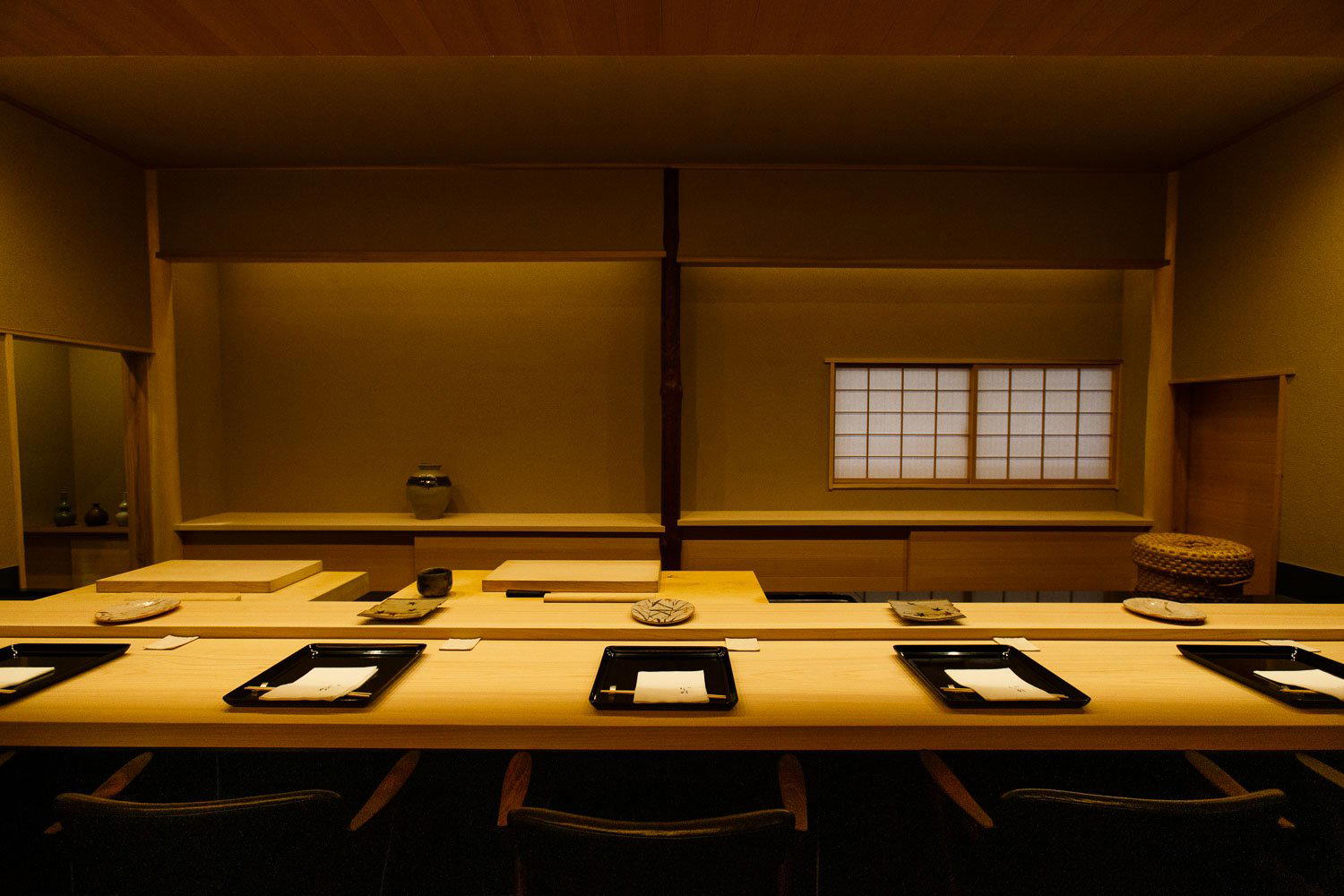
The format is the eight-seat omakase counter, the configuration that now defines serious sushi dining across Japan regardless of geography. At that scale, the counter functions more like a private dining room than a restaurant: every seat faces the same preparation surface, the sequencing of courses is identical for all guests, and the interaction between chef and guest is close enough to be conversational if the guest invites it. Counters of this size in the JPY 50,000–59,999 dinner range, which is where Sushi Oga sits, compete not with neighbourhood sushi restaurants but with a specific tier of omakase operations that require advance reservation and deliver a full evening's progression of courses. Harutaka in Tokyo operates within a comparable omakase framework, and counters at this price point across Japan share certain structural commitments: reservation-only access, no à la carte, and a format that places the chef's sequencing at the centre of the experience.
Two sittings run each evening, the first from 17:30 and the second from 20:30, seven days a week including public holidays and the days immediately before and after them. That consistency is notable: many counters at this tier close on Sundays or restrict hours around public holidays, so the full-week schedule here reflects either high demand or a deliberate operational choice to remain accessible. Closure dates are described as not fixed rather than following a regular weekly pattern.
Tuna, Lineage, and the Fourth Generation
The Tabelog listing describes the counter as the project of the fourth-generation chef of "Yasuke," a detail that places the chef within an established family sushi lineage. Generational succession in Japanese sushi culture carries specific weight: it implies that technique, supplier relationships, and in-house knowledge have been transmitted across multiple decades, which is a different kind of credential from a chef who has trained under a single master and then opened independently. The connection to the Yasuke name and the shared parking space noted in the venue data suggest a physical and operational proximity to the parent establishment that reinforces this lineage reading.
The Tabelog description also specifically calls out a tuna focus, described as "the ultimate tuna tasting sourced through special channels." Tuna procurement at the top end of Japanese sushi is a competitive differentiator: access to premium maguro, particularly from specific auctions or direct fishing relationships, is one of the clearest signals of a counter's position in the supply hierarchy. A stated emphasis on tuna sourcing at a counter in this price bracket, combined with consistent Tabelog recognition over seven years, points to a program that has built supplier relationships as a core part of its identity rather than as a secondary consideration.
Where Oga Sits in the Regional Picture
Kansai's high-end dining scene covers a range of formats. HAJIME in Osaka operates in the innovative French register at the furthest reach of the fine dining tier. Gion Sasaki in Kyoto represents the kaiseki tradition in its most refined form. Sushi Oga sits within a smaller cohort: serious omakase counters outside the most touristed Osaka corridors, where the guest profile skews toward Japanese diners and informed international visitors rather than broader tourist flow. The comparison is less with downtown Osaka's dining concentration and more with counters like Abon in Ashiya, which occupy specific suburban or secondary-city niches in the Kansai belt and build their reputations through sustained award recognition rather than through location advantage.
Internationally, the format maps onto what critics tracking fish-forward tasting formats have observed at counters like Le Bernardin in New York City or more structurally at Korean fine dining programs like Atomix in New York City: the commitment to a single protein category, sourced with specificity and prepared with accumulated technique, as the organising principle of the menu. Within Japan's own geographic spread, the sushi-focused counter model appears across very different cities: 1000 in Yokohama and 6 in Okinawa operate in comparable formats in quite different regional contexts, and Goh in Fukuoka shows how a western Japan city can sustain a counter with consistent national-level recognition. The pattern in all these cases is that the counter's reputation travels through the award and review system, not through its address.
Planning a Visit
Sushi Oga is reservation-only, reachable by phone at 072-221-1818. The counter seats eight, and at the JPY 50,000–59,999 dinner price point, bookings at comparable counters across Japan typically require advance planning of several weeks to several months, with the most in-demand dates filling earlier. Two sittings are available each evening: 17:30 and 20:30. The venue accepts major credit cards including VISA, Mastercard, JCB, AMEX, and Diners; electronic money and QR code payments are not accepted. Parking is available next to the counter, shared with the adjacent Yasuke establishment. The counter is a ten-minute walk from Nankai Electric Railway Sakai Station. Private hire of the space is available for groups of up to 20. Guests are asked to avoid wearing strong perfume. The setting is non-smoking throughout, and the venue is not described as family-friendly.
The drinks program is centred on sake, with nihonshu listed as a particular focus alongside shochu and wine. At counters in this format, the sake selection typically functions as the primary pairing vehicle, complementing the fish-forward progression of the omakase rather than competing with it.
For more context on where Sushi Oga sits within Sakai's dining scene, see our full Sakai restaurants guide. Nearby options include Kawaki for seafood and Osamuchan for a different register of the local dining scene. For broader planning, our Sakai hotels guide, bars guide, wineries guide, and experiences guide cover the full range of options. Elsewhere in the Kansai and broader Japan circuit, akordu in Nara and affetto akita in Akita represent comparable commitments to regional specificity in quite different geographic settings.
Frequently asked questions
What time does Oga open and close?
Hours at Oga: Mon, Tue, Wed, Thu, Fri, Sat, Sun, Public Holiday, Day before public holiday, Day after public holiday 17:30 - 22:30.
What distinctions does Oga have?
Oga has received recognition including:
What's the must-try dish at Oga?
The Tabelog listing specifically highlights tuna, described as sourced through dedicated procurement channels. At the JPY 50,000–59,999 omakase price point across an eight-seat counter, the focus on premium tuna procurement is a defining feature of the format rather than an incidental option.
Where is Oga located?
Oga is located at 1 Chome-2-7 Ochohigashi, Sakai Ward, Sakai, Osaka 590-0954, Japan, Sakai.
What makes Oga worth seeking out?
Sushi Oga has held continuous Tabelog recognition since 2019, opening at Silver level before appearing in the Tabelog Sushi WEST Top 100 in 2021, 2022, and 2025. The counter represents the fourth generation of the Yasuke lineage operating outside the more heavily trafficked Osaka city sushi circuit, in Sakai, a city with its own distinct culinary identity.
Is Oga allergy-friendly?
No allergy information is published for the venue. Given the reservation-only format, the direct route is to call 072-221-1818 before booking, as the eight-seat counter configuration typically allows for direct communication about dietary requirements at this price tier.
Price and Recognition
Comparable venues nearby, for context on price, style, and recognition.
| Venue | Cuisine | Price | Awards | Notes |
|---|---|---|---|---|
| OgaThis venue (the venue you are viewing) | Premium Bluefin Tuna Omakase | $300–500 | Tabelog Bronze #331 | Not listed |
| Yasuke | Traditional Sakai Sushi | $150–200 | Tabelog 100 #92 | Ocho Higashi, Sakai-ku, Traditional Sakai Sushi |
| Osamuchan | Yakiniku Omakase | $100–150 | Tabelog Bronze #343 | Otori Kita-cho, Nishi-ku, Yakiniku Omakase |
| Kawaki | Echizen Crab Specialist | $500+ | Not listed | Mikunicho Chuo, Echizen Crab Specialist |
| ラル | Seafront French in Historic House | Not listed | Not listed | Mikuni, Seafront French in Historic House |
| 日本料理 味所望 | Japanese Restaurant | Not listed | Not listed | Sakai, Japanese Restaurant |
Recognition history
Dated appearances from independent guides and award organizations, with the underlying list record or original source where available.
Tabelog Bronze #331
Tabelog
Full recognition history (3 entries)
Tabelog 100 #78 · No. 78
Tabelog · Tabelog 100 - Sushi - WEST - 2025
Tabelog Bronze
Tabelog
Continue exploring
More in Sakai
Restaurants in Sakai
All restaurants in Sakai →



Bars in Sakai
Browse all →

Hotels in Sakai
All hotels in Sakai →



Wineries in Sakai
Browse all →
Details
- Intimate
- Elegant
- Quiet
- Sophisticated
- Special Occasion
- Solo
- Chefs Counter
- Open Kitchen
- Historic Building
- Sake Program
- Local Sourcing
- Sustainable Seafood
- Omakase
- Counter Dining
- Sake
- Champagne
Current opening hours
- Monday
- 5:30–11 PM
- Tuesday
- 5:30–11 PM
- Wednesday
- 5:30–11 PM
- Thursday
- 5:30–11 PM
- Friday
- 5:30–11 PM
- Saturday
- 5:30–11 PM
- Sunday
- 5:30–11 PM
Hours can change for holidays and private events. Last verified .
Intimate and refined with carefully calibrated spotlighting designed to illuminate each dish, traditional Japanese aesthetic with cream-colored stone walls and charming old house architecture, serene residential setting that encourages focused appreciation of the cuisine.