
Murayama Mangetsu Udon puts Musashimurayama into Tokyo’s serious noodle conversation, away from the central station circuits and closer to the city’s suburban udon traditions. The draw is not ceremony but format: a 23-seat, no-reservations udon house with Tabelog 100 Udon EAST recognition in 2024, 2022, and Tokyo selection in 2020, priced in the JPY 1,000 to JPY 1,999 bracket.
Pearl is the En Primeur Club membership app — saves, bookings, and concierge access live there. Same editors, same standards.
- Address
- 東京都武蔵村山市三ツ木1-12-10
- Phone
- +81425603559
- Website
- mangetsuudon.com
 Saves & bookings on Pearl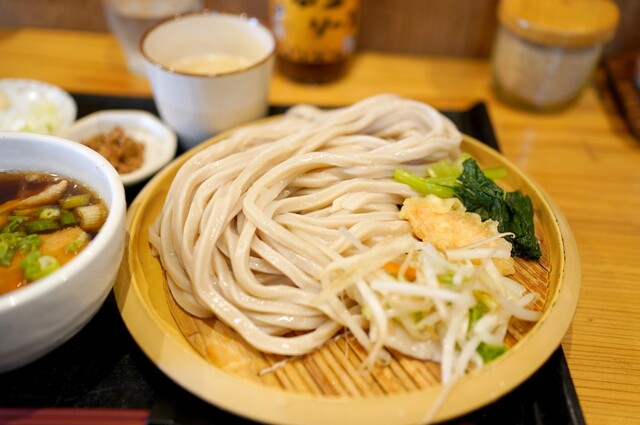
Approaching this part of Musashimurayama, Tokyo shifts into wider roads, lower buildings, and local restaurant geography that rewards leaving the rail-station grid. Udon in Tokyo is often treated as quick fuel, but the city’s serious noodle culture extends beyond the central wards. The outer districts preserve a slower, more local form, where handwork, flour, broth, and neighborhood routine matter more than polished dining-room choreography.
Murayama Mangetsu Udon fits that outer-Tokyo category. Its recognition on Tabelog 100 Udon EAST 2024, with earlier selections in 2022 and a Tokyo selection in 2020, places it in a competitive field not built around luxury pricing. That is the point: udon at this level can sit below JPY 2,000 and still attract scrutiny usually reserved for higher-spend counters. In a city where sushi and kaiseki dominate international attention, this is a useful correction.
Outer-Tokyo udon, judged by craft rather than ceremony
Tokyo’s noodle hierarchy is often misunderstood from outside. Ramen has the loudest global following; soba carries a more austere, seasonal reputation; udon is too often reduced to convenience. In practice, udon is one of the clearest ways to read regional preference inside Japan: wheat texture, dipping style, broth weight, and serving temperature all signal local habits. The Musashimurayama address matters because it moves the meal away from department-store basements and station-adjacent turnover into a residential register.
The house format reinforces that reading. There are 23 seats, split between counter seating and tables across two floors, keeping the scale closer to a neighborhood noodle specialist than a destination dining room. Reservations are unavailable, so the experience follows the older Tokyo pattern: arrive, wait if necessary, eat with purpose, move on. That lack of booking infrastructure is not a flaw here; it is how many serious everyday restaurants protect pace and access.
The price band, JPY 1,000 to JPY 1,999 for both lunch and dinner, frames the restaurant better than any fine-dining comparison. Sayama Okina sits in the same broad JPY 1,000 to JPY 1,999 bracket, while Teuchi Udon Kogera and Jikasei Temomi Men Suzunoki are listed below JPY 999. The useful comparison is not expense but intent: noodle rooms where craft is compressed into a short, affordable meal rather than stretched into a tasting format. Unagiya Shubo Gasou Echigoya, by contrast, operates in a far higher spend band, showing how quickly Tokyo-area specialist dining can enter another decision category.
Local wheat culture meets a broader Japanese noodle discipline
Lesson here is not that imported technique has replaced local foodways. It is the opposite: Japanese noodle cooking has absorbed and refined methods across regions, then made them legible through local ingredients and appetite. Udon’s structure is simple enough to expose shortcuts. Flour choice, kneading, resting, cutting, and boiling leave little room for disguise, and broth or dipping sauce must support rather than bury the noodle. That is why a modestly priced udon shop can earn repeat national-level attention without a named chef narrative or elaborate menu theatre.
Murayama Mangetsu Udon’s awards record is the strongest public signal: Tabelog’s Hyakumeiten lists give category-specific recognition, and udon is judged within its own tradition rather than as a secondary Japanese comfort food. A 3.82 Tabelog score adds local diner approval, though the list selection carries more editorial weight because it places the restaurant within the EAST udon field. In Tokyo terms, that matters: the city has enough noodle density that selection implies more than general popularity.
The drinks list keeps the restaurant rooted in Japanese casual dining rather than international tasting-menu logic. Sake, shochu, and wine are listed, but wheat noodles anchor the meal. Take-out is available, children are welcome, private rooms are unavailable, and the room is non-smoking. Those details describe a restaurant built for regular use, not special-occasion insulation.
How to read the trip across Tokyo
This is not a central-Tokyo add-on between Ginza and Shibuya. The nearest station is Hakonegasaki, and the restaurant sits 3,321 meters from it, so planning must account for the suburban approach. Bus routing is practical reality: routes from Tachikawa Station North Exit toward Hakonegasaki Station East Exit, Toei Bus Ume 70, or the MM Shuttle from Kamikitadai can bring diners to Choenji bus stop, followed by a short walk. Drivers get parking and a second lot with space for two cars and a road-bike stand.
Hours concentrate reliable service into Wednesday through Sunday lunch, 11:00 AM to 3:00 PM, with last order at 2:30 PM; Monday and Tuesday are closed, while evening service varies by schedule. For travelers, this is a planned daytime detour rather than a spontaneous late dinner. The no-reservations policy sharpens that point: go with a flexible lunch window and treat the journey as part of exploring Tokyo’s less central food map.
For readers building a wider Tokyo itinerary, this sits opposite more urban, genre-shifting stops such as . 鮪と炭火焼き うお炭 秋葉原店, 12/10 Shinjuku ten, 124. KAGURAZAKA (Yakitori), 2D Cafe, and 3 Chome no Curry Ya San. It also fits broader regional planning through Our full Tokyo restaurants guide, Our full Tokyo hotels guide, Our full Tokyo bars guide, Our full Tokyo wineries guide, and Our full Tokyo experiences guide.
Outside Tokyo, the same low-frills specialist logic appears differently, from -Grilled beef Sukiyaki- KAMAKURA TANUKIAN 鎌倉 たぬき庵 in Kamakura to.cafe in Osaka.know in Kumamoto, (Shoku) Vietnam in Kawasaki, [Curry Senmon Ten] Maruyama Kyoju. in Sapporo, and [ki:] in Kyoto. For a transpacific contrast in Japanese casual formats, Jōdo Saké Bar in Los Angeles and Onigiri Time in Pasadena show how specific Japanese categories travel differently abroad.
The editorial case for Murayama Mangetsu Udon is clear: it gives serious Tokyo dining a lower-cost, outer-district counterweight. Its value lies in category recognition, small scale, no-reservations access, and a price point close to daily life. In a city where prestige often clusters around scarcity and expense, this address reminds diners how much Japanese food culture depends on repetition, locality, and disciplined simplicity.
Cuisine and Recognition
Comparable venues for context, by category and price tier.
| Venue | Cuisine | Price | Notes |
|---|---|---|---|
| Murayama Mangetsu UdonThis venue — the venue you are viewing | Traditional Murayama kate udon | $ | Not listed |
| Arry 8Bites | Japanese Small Bites | $ | Tokyo |
| Echigo Tsuruy | Traditional Japanese mochi & wagashi shop | $ | Suginami |
| Imagawayaki Kashiwaya | Traditional imagawayaki & Japanese sweets stand | $ | Setagaya |
| China Soba Osada | Ramen & Tantanmen | $ | Itabashi |
| Chimoto | Traditional Japanese Wagashi & Cafe | $ | Meguro |
Recognition history
Dated appearances from independent guides and award organizations, with the underlying list record or original source where available.
Tabelog 100 #74 · No. 74
Tabelog · Tabelog 100 - Udon - EAST - 2024
Continue exploring
More in Tokyo
Restaurants in Tokyo
Browse all →



Bars in Tokyo
Browse all →


Hotels in Tokyo
Browse all →



Wineries in Tokyo
Browse all →
At a Glance
- Rustic
- Cozy
- Classic
- Casual Hangout
- Family
- Solo
- Group Dining
- After Work
- Standalone
- Local Sourcing
- Farm To Table