Our verdict
On a quiet stretch of Nguyễn Phúc Chu in Hoi An's Minh An ward, MANGO MANGO occupies a spot in a dining neighbourhood where the gap between street-food simplicity and formal restaurant ambition is narrower than in most Vietnamese cities.

Pearl is the En Primeur Club membership app, where members save venues, book tables and use the concierge.
The menu
What to order
- Mango-Viche
- Scent of Green Papaya
- Phoenix Duck
Nguyễn Phúc Chu and the Logic of Hoi An's Quieter Dining Streets
Hoi An's dining geography divides more sharply than most visitors expect. The Ancient Town's Trần Phú and Nguyễn Thái Học corridors draw the foot traffic: lantern-lit, photogenic, and priced accordingly. But the streets fanning out from that core, including Nguyễn Phúc Chu in the Minh An ward, function on a different rhythm. Fewer tour groups, more deliberate choices. Restaurants here tend to attract guests who have already done the obligatory Old Town circuit and are now looking for something with more staying power. MANGO MANGO at 45 Nguyễn Phúc Chu sits inside that second tier of the city's dining map, where the ambient pressure to perform for Instagram is lower and the room can concentrate on the plate.
That geography matters in Hoi An more than it does in, say, Da Nang or Hanoi, because Hoi An's food reputation is unusually compressed into a small area. The city's canonical dishes, cao lầu, white rose dumplings, and bánh mì, are so closely associated with specific producers and streets that any restaurant operating slightly off the main drag is implicitly making a claim: that it offers a reason to seek it out. For context on how that street-food canon anchors the wider scene, Banh Mi Phuong (Hoi An) and Bánh Mì Phượng represent the baseline against which all other Hoi An food addresses are measured, consciously or not.
Where MANGO MANGO Sits in Hoi An's Restaurant Spectrum
Hoi An's mid-range restaurant scene has expanded considerably over the past decade, pulled in two directions at once. On one side, street-food specialists with hyper-local focus: single-dish rooms or market stalls where the entire operation runs on one recipe perfected over generations. On the other, fusion-leaning spaces targeting international visitors with menus that bridge Vietnamese technique and European presentation. MANGO MANGO occupies a position in that broader field, and its address on Nguyễn Phúc Chu places it within reach of guests staying in the Minh An area without requiring the full commitment of a cross-town journey.
For comparison, Hoi An's more formally positioned restaurants, such as Before and Now, and addresses like 115 Đ. Trần Cao Vân and 42 Đường Phan Bội Châu, demonstrate how much variation exists even within a city of Hoi An's compact scale. Each has carved a distinct identity through format or neighbourhood positioning. The broader Vietnamese dining conversation happening at places like Gia in Hanoi and Akuna in Ho Chi Minh City increasingly frames regional specificity, including Central Vietnamese cooking traditions, as a serious editorial subject rather than a backdrop for fusion experiments.
Central Vietnamese Cooking as a Frame, Not Just a Menu
Hoi An's food culture is one of the most regionally distinct in Vietnam, which is itself a country with unusually high culinary regionalism. The city's proximity to the former imperial capital Hue produces a cuisine that prizes balance, technique, and presentation at a level that street-food formats elsewhere in Vietnam don't always prioritise. Saffron in Hue City represents how that imperial culinary tradition gets expressed in a formal restaurant setting further north; in Hoi An, the translation is more casual but no less rooted.
The significance of that context is that any restaurant operating in Hoi An, whatever its specific offer, is competing against a food tradition with strong local opinions about what constitutes quality. Guests arriving from Central Vietnam's broader dining circuit, having passed through spots like Mi Quang Ba Vi in Thanh Khe or eaten alongside the coast at Bau Troi Do in Son Tra, arrive with calibrated expectations. That competitive pressure is, in practice, what keeps Hoi An's restaurant standards higher than the tourist-volume alone would suggest.
The Case for Restaurants That Require a Short Walk
There is a practical argument for restaurants positioned just outside Hoi An's densest tourist corridor. Booking pressure is typically lower, the dining room tends to be quieter, and the surrounding street character gives the meal a different texture than eating inside the Ancient Town's lantern-draped core. Nguyễn Phúc Chu retains the architectural character of the Minh An ward without the crowding that the primary tourist streets generate by mid-evening.
Across Vietnam's dining cities, the restaurants that attract the most considered visits are rarely those with the most convenient addresses. La Maison 1888 in Da Nang requires a specific trip; so does the cooking-school and riverside format at Red Bridge outside Hoi An proper. The pattern holds at high-ambition rooms internationally, from Le Bernardin in New York City to Lazy Bear in San Francisco: the rooms that matter most are rarely the ones you walk past by accident. In Hoi An's more modest register, MANGO MANGO's position on Nguyễn Phúc Chu follows that same logic, offering a deliberate destination rather than an opportunistic stop.
Vietnam's Broader Restaurant Moment
The past five years have seen Vietnamese cuisine receive sustained international editorial attention, driven partly by Hanoi and Ho Chi Minh City's growing fine-dining scenes and partly by a reassessment of regional cooking traditions that had previously been underrepresented in food media. Northern coast addresses like Le Pont Club in Hai Phong and island-adjacent spots like Phuong Nhung Restaurant in Cat Hai illustrate how wide the country's culinary geography has become as a subject. Central Vietnam, with Hoi An and Hue at its centre, sits within that reassessment as one of the most technically rich and historically layered regional food cultures in Southeast Asia.
Restaurants like Nhà hàng Madame Lân in Hai Chau and Duyên Anh Restaurant in Phu Vang show how the region's restaurants handle the intersection of local tradition and visitor demand at different price points and formats. MANGO MANGO enters that wider picture as a Hoi An address in a part of the city where the dining offer continues to develop. For a full map of the city's restaurant scene across price tiers and neighbourhoods, the EP Club Hoi An restaurants guide provides the most complete current reference.
Planning Your Visit
MANGO MANGO is at 45 Nguyễn Phúc Chu, Phường Minh An, in the Minh An ward of Hoi An. The address is walkable from the Ancient Town's eastern edge, making it accessible on foot from most central Hoi An accommodation. Given that the venue's specific hours, booking policy, and pricing are subject to change, verifying details directly before visiting is advisable. Walk-in availability at Hoi An restaurants in the Minh An ward tends to be more reliable than at the most heavily trafficked Old Town addresses, particularly on weekday evenings, though this varies seasonally as the city's visitor numbers peak between October and April.
Frequently asked questions
Where exactly is MANGO MANGO?
MANGO MANGO is located at 45 Nguyễn Phúc Chu, Phường Minh An, Hội An, Quảng Nam, Vietnam, Hoi An.
Is MANGO MANGO worth the short walk from Hoi An's Ancient Town?
The restaurant sits at 45 Nguyễn Phúc Chu in Minh An ward, reachable on foot from the Ancient Town's eastern edge in a few minutes. For travellers focused on Central Vietnamese cooking, Hoi An is one of the most regionally distinct food cities in Vietnam, the Minh An cluster offers an alternative to the higher-turnover dining rooms concentrated along the main tourist streets. The walk is short enough that it adds no meaningful logistical cost.
What dish is MANGO MANGO famous for?
What is confirmed is the address, 45 Nguyễn Phúc Chu in Hoi An's Minh An ward, which places the restaurant within a neighbourhood cluster associated with Central Vietnamese cooking rather than the tourist-facing menus common along Trần Phú. Ordering along regional lines (think cao lầu, white rose dumplings, or banh mi variations) is a reasonable starting point when in this part of Hoi An.
Do they take walk-ins at MANGO MANGO?
Restaurants at addresses like 45 Nguyễn Phúc Chu, away from Hoi An's highest-traffic Ancient Town corridors, tend to operate with lower booking pressure than venues directly on Trần Phú or Nguyễn Thái Học. Arriving early in a meal service, particularly at lunch, typically improves walk-in chances across Minh An ward.
What's the standout thing about MANGO MANGO?
The clearest verifiable distinction is location: 45 Nguyễn Phúc Chu puts MANGO MANGO in Hoi An's Minh An ward, outside the densest tourist corridor but still walkable from the Ancient Town's eastern edge. That positioning, common to a small cluster of restaurants in this ward, tends to mean a quieter dining room and a clientele that skews toward return visitors and longer-stay travellers rather than single-night foot traffic.
Just the Basics
| Venue | Cuisine | Price |
|---|---|---|
| MANGO MANGOThis venue (the venue you are viewing) | Modern Vietnamese | $20–30 |
| Cargo Club Cafe & Restaurant | Vietnamese-Western Fusion Cafe | $10–20 |
| Red Bridge Cooking School, Restaurant, and Villa - Hoi An Riverside | Modern Vietnamese | $20–30 |
| Mai Fish Restaurant | Traditional Vietnamese Family-Style | $10–20 |
| Seashell by Nu Eatery | Modern Vietnamese Fusion Tapas | $10–20 |
| Tam Tam Cafe & Restaurant Hoi An | Vietnamese Cafe | $10–20 |
Continue exploring
More in Hoi An
Restaurants in Hoi An
All restaurants in Hoi An →
Bars in Hoi An
All bars in Hoi An →
Details
- Trendy
- Lively
- Scenic
- Cozy
- Date Night
- Casual Hangout
- Family
- Celebration
- Waterfront
- Open Kitchen
- Terrace
- Private Dining
- Craft Cocktails
- Local Sourcing
- Waterfront
- Street Scene
- A La Carte
- Cocktails
- Wine And Beer
- Vegetarian Friendly
- Vegan Options
- Gluten Free Options
Current opening hours
- Monday
- 8 AM–11 PM
- Tuesday
- 8 AM–11 PM
- Wednesday
- 8 AM–11 PM
- Thursday
- 8 AM–11 PM
- Friday
- 8 AM–11 PM
- Saturday
- 8 AM–11 PM
- Sunday
- 8 AM–11 PM
Hours can change for holidays and private events. Hours as of .
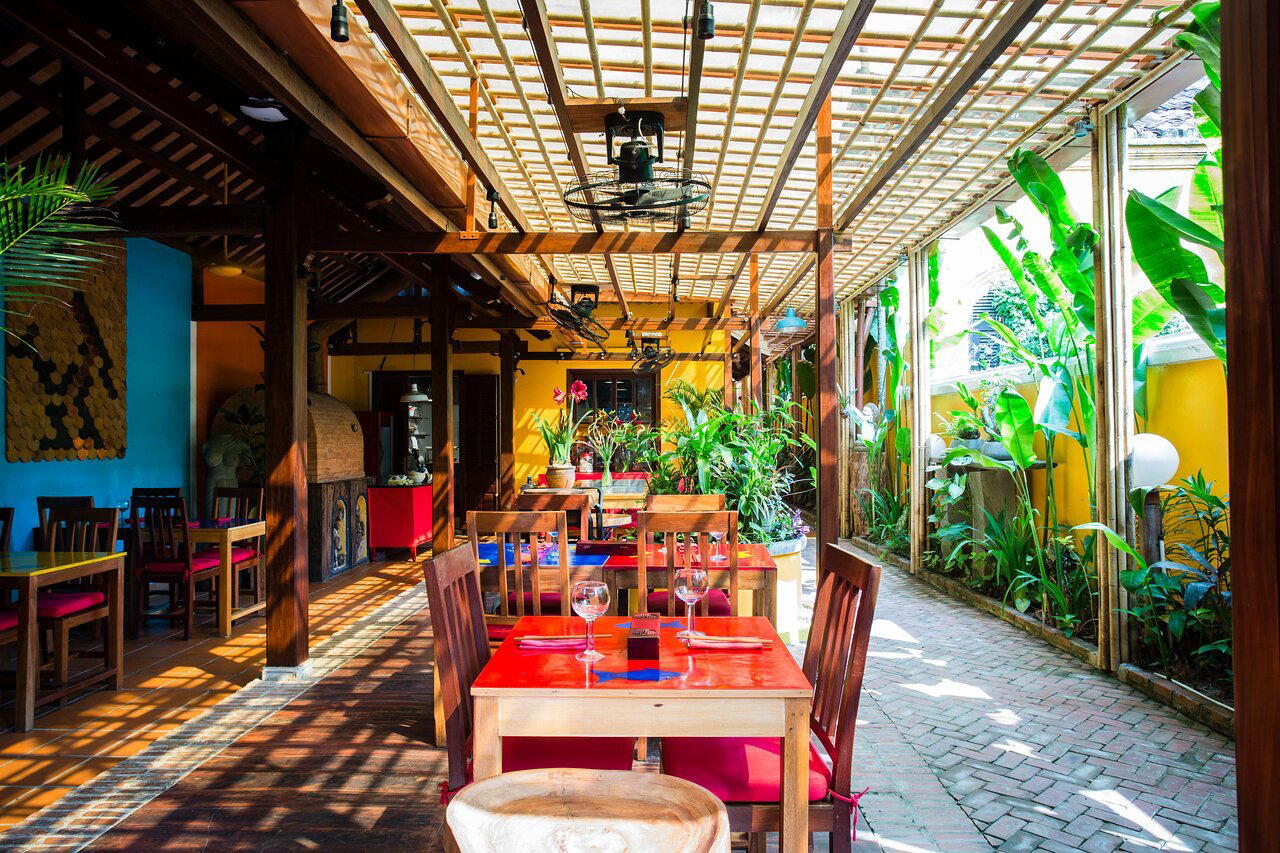
Eclectic and cool atmosphere with balconies overlooking the river and night market, lively lighting from lanterns, and a brighter, airy space.