Google: 4.3 · 1,962 reviews
.png)
Le Nove Scodelle brings Sichuan cooking to Milan's Viale Monza corridor at a price point that makes it one of the more accessible addresses in the city's growing specialist Chinese dining scene. A 2025 Michelin Plate holder, it draws a steady crowd for its spice-forward dishes from south-west China, backed by 4.3 stars across more than 1,800 Google reviews.
 Discover on Pearl
Pearl is the En Primeur Club membership app — saves, bookings, and concierge access live there. Same editors, same standards.
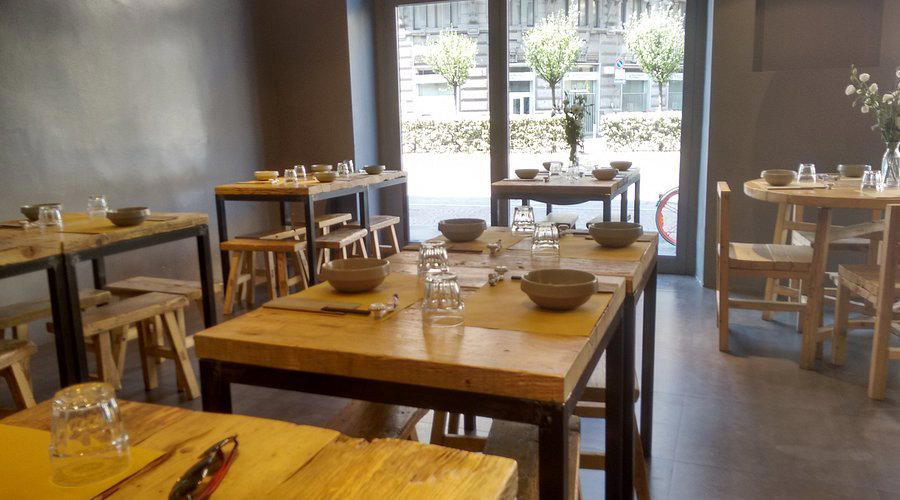
Sichuan in Milan: The Specialist Turn in Italian Chinese Dining
For most of the past three decades, Chinese restaurants in Italy occupied a single, undifferentiated tier: reliable, inexpensive, and broadly Cantonese in form if not always in execution. That picture has shifted. Across Milan, Turin, and Rome, a second wave of Chinese dining has taken shape around regional specificity rather than catch-all menus, and the province of Sichuan, with its numbing peppercorns and chilli-heavy broths, has become the clearest marker of that shift. Le Nove Scodelle, on Viale Monza in Milan's north-eastern quadrant, belongs firmly to this newer cohort: a restaurant whose identity is built around one of China's most technically demanding regional traditions rather than a generalised pan-Chinese offer.
That positioning matters when reading the 2025 Michelin Plate the restaurant holds. The Plate is the Guide's signal that a kitchen is producing food worth seeking out, placed below starred recognition but above the undifferentiated mass of the city's dining options. For a single-cuisine-area specialist operating at the budget end of Milan's price spectrum, it functions less as a fine-dining credential and more as a quality warrant: the kitchen is doing what it claims to do, and doing it with enough consistency to register on the Guide's radar. With 1,861 Google reviews averaging 4.3 stars, the popular signal runs in the same direction.
What Sichuan Cooking Actually Demands
The editorial angle assigned here is dim sum craft, though Le Nove Scodelle's identity runs more specifically through the Sichuan canon than through the Cantonese morning ritual that defines classic dim sum service. It is worth separating these clearly. Dim sum, in the strict sense, belongs to Guangdong province: bamboo steamer towers, har gow, siu mai, cheong fun rolled at tableside, and the trolley-pushed yum cha format that Hong Kong exported to the world. Sichuan cooking is a different tradition entirely, built on the mala (numbing-spicy) flavour profile created by the combination of dried chillies and Sichuan peppercorn, a spice that produces a distinctive tingling on the lips and tongue before the heat arrives.
Where the two traditions share ground is in the emphasis on craft at the component level: the texture of dumpling skin, the balance of filling-to-wrapper ratio, the precision of fold technique. Sichuan dumplings, particularly zhong shui jiao (sweet and spicy wontons) and red-oil dumplings, require the same attention to dough thickness and filling consistency as any Cantonese har gow. The difference is in the sauce work and the finish: the complex, oil-based dressings that carry the characteristic mala signature. Getting that balance right, enough chilli oil to coat rather than overwhelm, enough peppercorn to tingle rather than anaesthetise, is the benchmark skill in this tradition.
In the broader European context, Sichuan specialists remain relatively rare outside London, Paris, and a handful of German cities. Milan is ahead of most Italian cities in building this kind of regional Chinese depth, with addresses like Ba Restaurant and Bon Wei operating in overlapping Chinese dining territory, and Gong representing the higher-end, more fusion-oriented Chinese offer in the city. Le Nove Scodelle sits at a different price point and registers a different ambition: accessible, specifically regional, and recommended on the strength of its cooking rather than its room or its service format.
Viale Monza and the Geography of Milan's Ethnic Dining
The address on Viale Monza is deliberate context. Milan's Chinese community has historically concentrated in the area around Via Paolo Sarpi, in Zona 8, which developed through the mid-20th century as a hub for Chinese textile and wholesale trade before evolving into a dining street. Viale Monza, further out towards the north-east and serving the Loreto and Precotto zones, represents a second radius of Chinese food culture in the city, less tourist-visible than Sarpi and more neighbourhood-oriented in character. Restaurants here compete on regular custom rather than passing foot traffic, which tends to keep quality honest.
This contrasts sharply with Milan's fine-dining corridor, where addresses like Enrico Bartolini and Cracco in Galleria operate at the €€€€ tier in architecturally prominent settings. Le Nove Scodelle's single-euro price marker places it at the opposite end of the city's dining economy, where value is assessed by flavour density per euro rather than by room design or tasting menu architecture. In a city where Michelin recognition normally correlates with high price points, a Plate at a budget address is a meaningful distinction.
For reference on how Sichuan cooking reads at higher price points in Europe, Restaurant Tim Raue in Berlin uses Chinese flavour frameworks, including Sichuan influence, as the basis for a two-starred tasting menu format. Mister Jiu's in San Francisco applies a Chinese-American lens at a similarly refined register. Le Nove Scodelle is not operating in those registers, but understanding where the tradition sits internationally makes the Michelin recognition at the budget tier easier to contextualise.
Ordering in the Sichuan Register
Without a confirmed current menu on record, specific dish recommendations require care. What the Michelin citation describes is a kitchen built around Sichuan specialities and a cooking style characterised by spice, depth, and what the Guide calls "exciting and original" execution. In the Sichuan canon, that almost always means some combination of cold dishes dressed in chilli oil, a mapo tofu preparation (silken tofu in a fermented black bean and chilli sauce), some form of dan dan noodles, and at least one style of red-oil dumpling. Whether all of these are on the current menu at Le Nove Scodelle cannot be confirmed here, but they represent the tradition the kitchen is working within.
For those building a wider picture of Milan dining beyond Chinese cuisine, the city's Italian fine-dining options include several Michelin-recognised addresses at a range of price points. Our full Milan restaurants guide covers the spectrum, and for planning beyond dinner, the Milan hotels guide, bars guide, wineries guide, and experiences guide provide comparable editorial coverage. Italy's wider Michelin table includes addresses like Osteria Francescana in Modena, Enoteca Pinchiorri in Florence, Uliassi in Senigallia, Dal Pescatore in Runate, Atelier Moessmer Norbert Niederkofler in Brunico, and Quattro Passi in Marina del Cantone, all operating at the opposite end of the price scale but worth noting as context for how Michelin recognition distributes across Italian dining.
Know Before You Go
- Address: Viale Monza, 4, 20127 Milan
- Cuisine: Sichuan Chinese, regional specialist
- Price range: € (budget tier)
- Recognition: Michelin Plate 2025
- Google rating: 4.3 stars, 1,861 reviews
- Phone / Website: Not currently listed; check Google Maps for current contact details and hours
- Getting there: Viale Monza is accessible via Milan's tram network and the MM1/MM2 Loreto interchange
Standing Among Peers
A fast peer set for context, pulled from similar venues in our database.
| Venue | Awards | Cuisine | Notes |
|---|---|---|---|
| Le Nove Scodelle | Now available everywhere in Italy, ethnic cuisine is gradually becoming more spe… | Chinese | This venue |
| Enrico Bartolini | Michelin 3 Star | Creative | Creative, €€€€ |
| Cracco in Galleria | Michelin 1 Star | Modern Cuisine | Modern Cuisine, €€€€ |
| Andrea Aprea | Michelin 2 Star | Modern Italian, Italian Contemporary | Modern Italian, Italian Contemporary, €€€€ |
| Seta | Michelin 2 Star | Modern Italian | Modern Italian, €€€€ |
| Contraste | Michelin 1 Star | Progressive Italian, Modern Cuisine | Progressive Italian, Modern Cuisine, €€€€ |
Continue exploring
More in Milan
Restaurants in Milan
Browse all →
Bars in Milan
Browse all →
Hotels in Milan
Browse all →
At a Glance
- Cozy
- Intimate
- Casual Hangout
Relaxed and nice atmosphere in a pretty small space.