






Seta occupies a refined position within Milan's two-Michelin-star tier, operating inside the Mandarin Oriental on Via Monte di Pietà. Chef Antonio Guida structures the kitchen around three distinct tasting menus, with seasonal ingredients and citrus as recurring reference points. Ranked 29th in Opinionated About Dining's Classical Europe list for 2025, it draws both business travellers and dedicated diners seeking modern Italian cooking with compositional precision.
 Discover on Pearl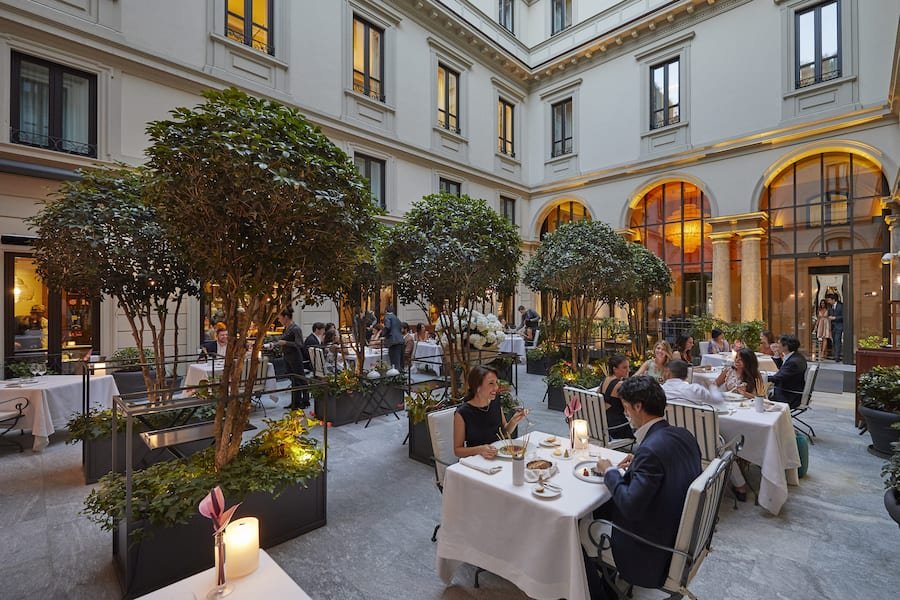
A Different Register of Milan Dining
Via Monte di Pietà sits at the quieter, moneyed edge of Milan's Quadrilatero della Moda, a district where fashion houses and private banks occupy the same sober stone buildings. Dining rooms in this part of the city tend toward restraint rather than spectacle: lower ceilings, smaller covers, less theatre. Seta, positioned within the Mandarin Oriental Milan, fits that register precisely. The interior reads as considered rather than showy, the kind of room where the architecture recedes and the food moves forward.
That positioning matters because Milan's top tier of modern Italian cooking has become a genuinely crowded field. Enrico Bartolini, Cracco in Galleria, and Andrea Aprea all operate in the €€€€ bracket with comparable award recognition, and the city's dining public has become more exacting about what distinguishes one kitchen from another. Seta's answer is structural: a three-menu format built around different editorial principles — chef's classics, seasonal focus, and ingredient theme — that signal a kitchen organised around ideas rather than simply executions.
The shortlist, unlocked.
Hard-to-book tables, cellar releases, and concierge-planned trips.
Get Exclusive Access →Italian Fine Dining and the Question of Restraint
Modern Italian cuisine at the two-star level now operates in a particular tension. The international expectation of Italian food, built on tradition, regionality, and ingredient loyalty, runs against the contemporary fine-dining demand for narrative, technique, and differentiation. The kitchens that resolve this tension most durably tend to be those with a coherent point of view about what they are drawing on and why.
At Seta, that coherence comes partly through Antonio Guida's declared use of citrus as a structural element. Citrus functions differently in Italian cooking than in, say, Japanese or Scandinavian kitchens, where acid is often used as a brightener or a counterweight to fat. In southern Italian and Sicilian traditions, citrus carries cultural weight: it is a primary crop, a historical export, a flavour that marks place. Using it as a signature ingredient at a Milan hotel table is, in effect, a way of anchoring a cosmopolitan kitchen to something geographically specific. The same logic applies to the vegetarian strand of the menu, which Seta has developed with unusual seriousness. In a dining culture that has historically treated vegetables as accompaniment rather than subject, a kitchen that builds vegetarian dishes with distinct character rather than as modified alternatives occupies a meaningful niche.
This approach aligns Seta with a broader shift visible across northern Italy's most decorated restaurants: a move away from demonstrating technique for its own sake and toward using technique to make ingredients more fully themselves. You can trace comparable thinking at Atelier Moessmer Norbert Niederkofler in Brunico, where alpine produce is treated with similar philosophical seriousness, and at Uliassi in Senigallia, where Adriatic seafood receives the same depth of attention.
Three Menus, Three Editorial Positions
The three-tasting-menu format is not merely a commercial accommodation for different appetite levels or price points. Each menu operates on a different logic. The first, built around Guida's classic specialities, is essentially a repertoire menu: it shows what the kitchen has developed over time and how it defines its own identity. The second, with a seasonal focus, positions the kitchen as a direct respondent to what is available and when. The third, which anchors each iteration around a single ingredient, is the most intellectually demanding of the three , it asks the kitchen to exhaust an ingredient's possibilities rather than simply feature it.
In winter, for example, that ingredient focus has centred on game, producing dishes such as cinnamon-flavoured veal sweetbreads with carrots and passion-fruit sauce, alongside risotto with raspberries and herb cream. Those combinations , sweetbreads and passion fruit, risotto and raspberry , are not comfortable or predictable moves. They suggest a kitchen willing to work at the boundary between Italian classical tradition and something more contemporary in its flavour logic. Desserts in the same season have included millefeuille with pumpkin cream, coffee, and caper leaf, which again combines the very familiar (millefeuille is a pastry-case staple) with ingredients that push against expectation.
This kind of menu construction places Seta in a peer set that includes Osteria Francescana in Modena and Enoteca Pinchiorri in Florence in the sense that all three operate with strong authorial voices and a willingness to use Italian culinary language in ways that are not strictly conventional. The difference is that Seta does this inside a hotel context, which brings both advantages (the infrastructure to execute at high volume without corners being cut) and constraints (the requirement to serve a broader dining public, including guests who have not specifically sought out this kitchen).
The Wine Program as a Separate Argument
Italy's fine-dining wine programs have historically been built around the peninsula's own productions, with Piedmont and Tuscany forming the structural backbone. Seta's list, under Wine Director Andrea Loi and Sommelier Immacolata Mauro, maintains that regional loyalty while extending meaningfully into France, with Champagne and Burgundy cited as particular strengths alongside Italian and Piedmontese selections. The list runs to 1,200 selections across an inventory of 15,000 bottles, with pricing at the upper tier.
Two details stand out. The corkage fee is set at $100, which is on the higher end of the scale and signals that the house takes its own program seriously rather than treating outside bottles as a service offering. The availability of selections by the glass is actively promoted, alongside magnum formats for larger groups , an unusual combination that suggests a sommelier team confident enough in the list to present it in flexible formats rather than defaulting to standard pours. Non-drinkers are accommodated with a substantive mocktail offering, which at this price point is a minimum expectation rather than a differentiator, but it is at least explicitly addressed.
For context on what a serious Italian fine-dining wine program looks like at comparable scale, Dal Pescatore in Runate and Quattro Passi in Marina del Cantone offer instructive comparisons, as does Dolce Stil Novo in Veneria Reale, where Piedmont anchors both the kitchen and the cellar.
Awards and Competitive Position
Seta carries two Michelin stars in 2025, a rating it also held in 2024. On Opinionated About Dining's Classical Europe ranking, it moved from 43rd in 2023 to 28th in 2024 and 29th in 2025, a trajectory that reflects both consistency and upward momentum within that specific evaluative framework. La Liste placed it at 92.5 points in 2025 and 92 points in 2026, indicating stable high-end recognition across different critical methodologies. It has also held Les Grandes Tables du Monde membership, a designation that speaks to service and room standards as much as to cooking.
Within Milan specifically, that two-star position places Seta alongside a small number of peers. Verso Capitaneo operates at a different price point and format, while Torre at Fondazione Prada addresses a more explicitly culture-adjacent dining public. The Italian contemporary field also extends beyond Milan: Contaminazioni in Somma Vesuviana works a very different regional register, and the comparison is useful for understanding how much the same broad category designation can cover.
Seta's social program, which involves partnerships with charities, non-profit organisations, and schools to train students and support workforce inclusion, has become a visible part of how the restaurant presents itself publicly. At this level of the market, such commitments function as part of the institutional identity of the restaurant, distinguishing it from kitchens that exist purely as commercial operations.
For a broader picture of where Seta sits within the city's full dining range, see our full Milan restaurants guide. Visitors planning wider itineraries can also reference our Milan hotels guide, our Milan bars guide, our Milan wineries guide, and our Milan experiences guide.
Know Before You Go
- Address: Via Monte di Pietà, 18, 20121 Milano MI, Italy
- Chef: Antonio Guida
- Price range: €€€€ (cuisine pricing $66+ for a typical two-course meal, excluding beverages)
- Hours: Tuesday to Saturday, 12:30–2:30 pm and 7:30–10:30 pm; closed Monday and Sunday
- Format: Three tasting menus (chef's classics, seasonal, ingredient-focused); lunch and dinner service
- Wine list: 1,200 selections, 15,000-bottle inventory; strengths in Italy, Piedmont, France, Champagne, and Burgundy; corkage fee applies
- Awards: Michelin 2 Stars (2025); La Liste 92pts (2026); OAD Classical Europe #29 (2025); Les Grandes Tables du Monde (2025)
- Google rating: 4.6 from 581 reviews
- Location: Within the Mandarin Oriental Milan, Quadrilatero della Moda
Via Monte di Pietà, 18, 20121 Milano MI, Italy
+39 02 8731 8897
What It’s Closest To
Comparable options at a glance, pulled from our tracked venues.
| Venue | Cuisine | Awards | Notes |
|---|---|---|---|
| Seta | Modern Italian | Michelin 2 Stars, Les Grandes Tables Du Monde Award (2025) | This venue |
| Enrico Bartolini | Creative | Michelin 3 Star | Creative, €€€€ |
| Cracco in Galleria | Modern Cuisine | Michelin 1 Star | Modern Cuisine, €€€€ |
| Andrea Aprea | Modern Italian, Italian Contemporary | Michelin 2 Star | Modern Italian, Italian Contemporary, €€€€ |
| Contraste | Progressive Italian, Modern Cuisine | Michelin 1 Star | Progressive Italian, Modern Cuisine, €€€€ |
| Il Luogo Aimo e Nadia | Italian Contemporary | Michelin 1 Star | Italian Contemporary, €€€€ |
Need a table?
Our members enjoy priority alerts and concierge-led booking support for the world's most difficult tables.
Get Exclusive AccessThe shortlist, unlocked.
Hard-to-book tables, cellar releases, and concierge-planned trips.
Get Exclusive Access →