


1 Michelin Star · Star Wine List · We're Smart World 5 Radishes
Our verdict
Milan's first Michelin-starred vegetarian restaurant, Joia has anchored plant-based haute cuisine in Italy since Pietro Leemann introduced the format to the country's fine dining scene. Now guided by chefs Sauro Ricci and Raffaele Minghini, who took over in 2024, the restaurant holds one Michelin star and a 5-Radish rating, offering two tasting menus and a midday Piatto Quadro format at its Via Panfilo Castaldi address in the Porta Venezia district.

Pearl is the En Primeur Club membership app — saves, bookings, and concierge access live there. Same editors, same standards.
- Address
- Via Panfilo Castaldi, 18, 20124 Milano MI, Italy
- Phone
- +39 02 204 9244
- Hours
- Mon ClosedTue–Fri 12:30–2 PM, 7:30–9:30 PMSat 12:30–1:30 PM, 7:30–9:30 PMSun Closed
- Website
- joia.it
- Directions
- Get directions
- Booking
- Book on TheFork
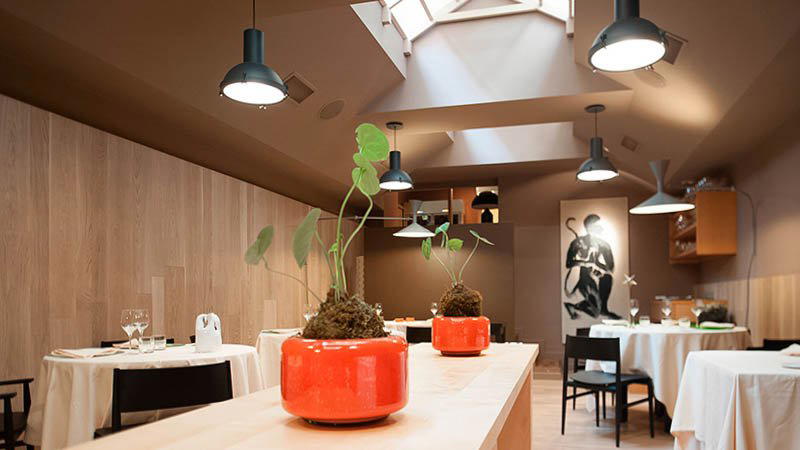
Where Plant-Based Fine Dining Began in Italy
Step through the entrance on Via Panfilo Castaldi and the dining room makes its argument quietly. Pale tones, minimal ornamentation, clean lines that invite the eye to settle rather than wander. The space reads more like a considered pause in the middle of a dense city than a conventional restaurant interior. In Milan's €€€€ fine dining tier, where theatricality and chef personality tend to anchor the room, Joia operates at a different frequency: the visual restraint is part of the statement, not a design default.
That register connects directly to the food. Italian haute cuisine has long treated plant-based cooking as a supporting role, the garnish around protein, the intermezzo sorbet. Joia arrived as a counter-argument. Pietro Leemann introduced vegetarian fine dining to Italy's Michelin ecosystem here, an institutional contribution that shaped how the country's restaurant culture eventually came to think about plant-forward menus at the leading price point.
The 2024 Transition and What It Means for the Menu
Leadership transitions at long-established fine dining restaurants are always a structural test. When Pietro Leemann stepped back in 2024 and handed the kitchen to Sauro Ricci and Raffaele Minghini, both of whom joined the Joia team in 2012, the question was whether the philosophical architecture of the restaurant would hold under new authorship. The early evidence suggests it has, and possibly gained some range in the process. The Radishes guide noted the transition with its full five-Radish rating intact, describing the restaurant as still Joia, perhaps even with an extra dimension.
Within the broader Italian fine dining picture, that kind of continuity through generational change is rare. Compare the trajectory at places like Dal Pescatore in Runate, where family succession preserved institutional identity across decades, or the ongoing creative evolution at Osteria Francescana in Modena, where the house philosophy rather than any single personality became the anchor. At Joia, the philosophy, organic, pure plant, local sourcing, a six-season rhythm, and a spiritual dimension running through the visual and flavour logic of the dishes, now belongs to Ricci and Minghini to carry forward.
The Sensory Logic of the Dishes
The menu is approximately 80 percent vegan and gluten-free. That figure is worth pausing on, because in the context of fine dining it has practical consequences for how dishes are constructed. Without the structural shortcuts that dairy fats, eggs, and gluten-based pasta provide in classical Italian cooking, the kitchen must build texture, depth, and satiation through different means: fermentation, reduction, layered umami from plant sources, and the kind of careful attention to temperature and colour that makes a dish legible before the first bite.
Ricci and Minghini's stated framework describes dishes suspended between reality and dream, a phrase that sounds impressionistic but maps onto something technically specific. The colour coding is intentional, each plate designed so that visual cues preview what the palate will encounter. The six-season model, which subdivides the Italian year more finely than the standard four, means the ingredient rotation is tighter than at most restaurants of this type, with sourcing cycles that track produce closer to peak maturity. This is a different operational logic than the approach at, say, Enrico Bartolini or Cracco in Galleria, both of which operate within a broad creative Italian idiom where protein anchors the menu architecture. Joia's constraints produce a different kind of discipline.
For comparison at the international level, the vegetarian fine dining tier is relatively sparse. Fu He Hui in Shanghai and Lamdre in Beijing approach plant-based haute cuisine through a Chinese philosophical lens; Joia's reference points are rooted in European fine dining structure with a spiritual overlay that Leemann brought from his time in Asia. The intersection is uncommon enough that Joia holds a genuinely distinct position in the global category.
Format and Pace: Tasting Menus and the Piatto Quadro
The restaurant runs two tasting menus at dinner, the more appropriate format for guests wanting full immersion in the current seasonal programme. At lunch, the Piatto Quadro offers five samples in a more compressed format, designed for guests who want the kitchen's perspective without the time commitment of a full tasting progression. The midday option is worth flagging for Milan visitors working around a business schedule or those who prefer to experience a restaurant at its most relaxed pace. The Piatto Quadro positions Joia accessibly within a price tier where the entry cost at dinner can feel prohibitive for a first visit.
The €€€€ price range places it alongside Andrea Aprea and Seta in Milan's top-tier restaurant bracket. What distinguishes Joia's value proposition from those peers is that the menu's constraint is the point: the kitchen is not offering a reduced or adapted version of a protein-centred menu. The plant-based format is the full expression of the restaurant's capabilities, and guests paying at this level should expect that the craft goes into the construction of plant matter rather than the sourcing of premium animal protein.
The Joia Academy and the Broader Context
Adjacent to the restaurant, the Joia Academy operates as a vehicle for transmitting the kitchen's philosophy beyond the dining room. In the Italian fine dining context, this kind of institutional extension is relatively unusual at the single-restaurant scale. It signals a degree of confidence that the ideas developed in the kitchen have transferable value, and it places Joia in a conversation with the educational arms of larger Italian institutions such as Enoteca Pinchiorri in Florence or the research-linked programming that surrounds Atelier Moessmer Norbert Niederkofler in Brunico. The Academy component also reinforces why Joia's influence on Italian vegetarian fine dining extends beyond its own covers: it has actively worked to disseminate the approach.
Where Joia Sits in Milan's Dining Scene
Milan's €€€€ restaurant tier is primarily anchored in modern Italian cooking, creative techniques applied to regional ingredients, with a strong bias toward seafood and premium meat cuts. The city's progressive restaurants, including Altatto Bistrot at a lower price point, tend to treat plant-based options as part of a broader menu rather than as the central proposition. Joia occupies a category of one at this price level within the city. There is no direct Milan peer operating at the same price tier with the same plant-based commitment and comparable institutional history.
For the broader Italian fine dining reader, it is worth noting where Joia sits geographically and symbolically. Unlike the countryside estate restaurants such as Quattro Passi in Marina del Cantone or the coastal positioning of Uliassi in Senigallia, Joia is a city restaurant in the full sense, operating in a dense residential neighbourhood where the clientele includes local regulars, business diners, and international visitors. The Porta Venezia location places it within walking distance of central Milan but away from the immediate fashion district concentration, which suits the restaurant's less performative atmosphere.
Planning a Visit
Joia is located at Via Panfilo Castaldi 18 in the 20124 postal zone, in the Porta Venezia area northeast of the city centre. Guests considering the full tasting menu experience should plan for a dinner booking; the Piatto Quadro lunch format is a practical alternative for shorter visits. The minimalist dining room is quiet by the standards of Milan's more animated fine dining addresses, which makes it a reasonable option for conversation-focused meals. For guests planning a wider Milan itinerary, our full Milan restaurants guide covers the city's range across price tiers and styles, and our Milan hotels guide, bars guide, wineries guide, and experiences guide round out the city picture.
Frequently asked questions
What should I expect atmosphere-wise at Joia?
What do people recommend at Joia?
Would Joia be comfortable with kids?
Cuisine and Credentials
A quick peer check to anchor this venue’s price and recognition.
| Venue | Cuisine | Price | Awards | Notes |
|---|---|---|---|---|
| JoiaThis venue — the venue you are viewing | Creative Vegetarian Fine Dining | $100–150 | 1 Michelin Star · Star Wine List | Not listed |
| Enrico Bartolini | Modern Italian Fine Dining | $300–500 | 3 Michelin Stars · World's 50 Best #85 | Creative |
| Cracco in Galleria | Modern Italian Fine Dining | $150–200 | 1 Michelin Star · World's 50 Best #33 | Modern Cuisine |
| Andrea Aprea | Modern Italian Fine Dining | $200–300 | 2 Michelin Stars · La Liste Top Restaurants | Modern Italian, Italian Contemporary |
| Seta | Modern Italian Fine Dining | $150–200 | 2 Michelin Stars · La Liste Top Restaurants | Modern Italian |
| Contraste | Modern Italian Fine Dining | $150–200 | 1 Michelin Star · La Liste Top Restaurants | Progressive Italian, Modern Cuisine |
Recognition history
Dated appearances from independent guides and award organizations, with the underlying list record or original source where available.
Michelin 1 Star
Michelin
Star Wine List
Star Wine List
We're Smart World 5 Radishes
We're Smart World
Full recognition history (6 entries)
Michelin 1 Star
Michelin
We're Smart World Top 100 #38
We're Smart World
Michelin 1 Star
Michelin
Continue exploring
More in Milan
Restaurants in Milan
Browse all →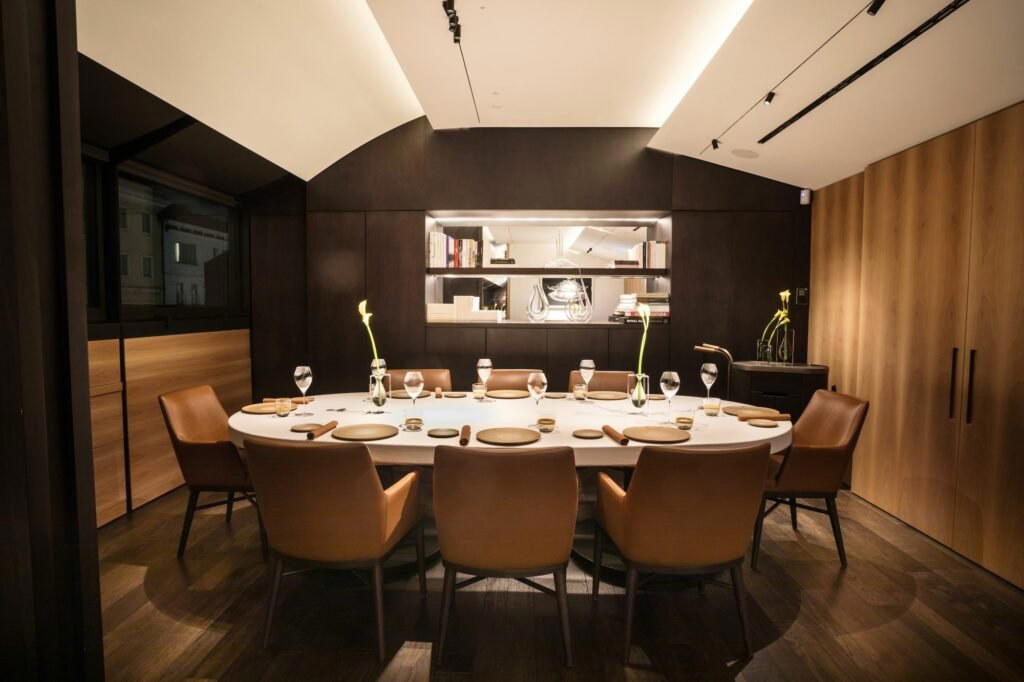
Bars in Milan
Browse all →
Hotels in Milan
Browse all →
Details
- Elegant
- Sophisticated
- Intimate
- Cozy
- Date Night
- Special Occasion
- Celebration
- Open Kitchen
- Extensive Wine List
- Sommelier Led
- Tasting Menu
- Prix Fixe
- Non Alcoholic Pairing
- Vegetarian Friendly
- Vegan Options
- Allergy Accommodating
Current opening hours
- Monday
- Closed
- Tuesday
- 12:30–2 PM, 7:30–9:30 PM
- Wednesday
- 12:30–2 PM, 7:30–9:30 PM
- Thursday
- 12:30–2 PM, 7:30–9:30 PM
- Friday
- 12:30–2 PM, 7:30–9:30 PM
- Saturday
- 12:30–1:30 PM, 7:30–9:30 PM
- Sunday
- Closed
Hours can change for holidays and private events. Last verified .
Sober, elegant, and zen-like with soft lighting, a calm and orderly atmosphere, and meticulous attention to detail creating a refined sensory experience.