
Michelin Bib Gourmand
Our verdict
A Michelin Bib Gourmand-recognised Sichuan restaurant in Beijing's Chaoyang district, Lao Chuan Ban sits in the accessible mid-tier of the capital's Chinese regional dining scene. The kitchen draws on classic Sichuan technique at a price point that reads as genuine value against the city's higher-tariff regional houses, making it a reference address for mala cooking north of Chengdu.

Pearl is the En Primeur Club membership app, where members save venues, book tables and use the concierge.
The menu
What to order
- Appealing chicken
- Maoxuewang
- Dan dan noodles
- Spicy beef
- Dried fried spicy green beans
- Spicy chicken
Sichuan in Beijing: The Regional Dining Argument
Beijing has never been a single-cuisine city. The capital draws regional cooking from every province, and Sichuan has long held a particularly strong foothold, partly because its flavours, the numbing heat of Sichuan peppercorn, the slow burn of doubanjiang, the sharp punctuation of dried chilli, travel well and translate across different dining registers. The question for any Sichuan address in Beijing is not whether the cuisine can find an audience here, but whether it can hold its own against the source. Chengdu and Chongqing set the benchmark. Everything north of that corridor is measured against it.
In Chaoyang, that argument plays out at a specific price tier. Lao Chuan Ban, located on Shenlu Street near Ritan Park, operates at the ¥¥ level, a mid-range bracket where genuine regional cooking competes with casual chain formats and where a Michelin Bib Gourmand recognition carries particular weight. The Bib Gourmand, awarded in 2024, signals something specific: value-to-quality ratio, not fine-dining ambition.
The Chaoyang Setting
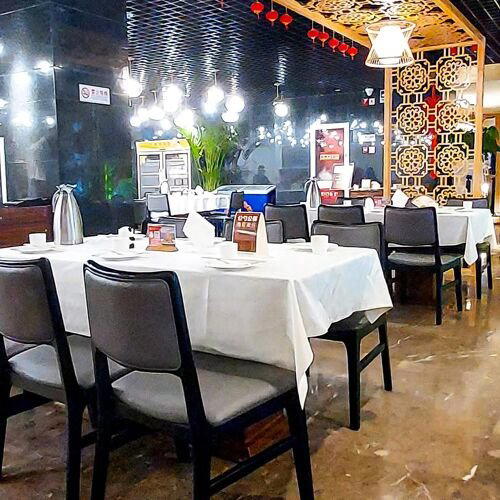
The Ritan area has a particular dining character within Beijing's sprawl. It sits close to the embassy district, which historically brought a cosmopolitan clientele, but the streets around the park have retained a neighbourhood grain, lower-rise, locally frequented, less given to the spectacle that defines Sanlitun a kilometre away. A restaurant on Shenlu Street sits inside that quieter register. The address (39 Shenlu Street, unit 1-63) suggests a ground-floor commercial block rather than a landmark building, which is consistent with how mid-range Sichuan tends to present itself in this part of the city: the cooking does the talking, and the room stays in the background.
That restraint in setting is worth noting in the context of Beijing's broader dining shifts. Higher-tariff regional houses in the capital, places like Gongyuan Shulou or Rong Pao, invest heavily in interior design and service theatre. The ¥¥ tier operates differently: the room is functional, turnover matters, and the food carries the full burden of the experience. When Michelin recognises a kitchen at this level, it is recognising exactly that, cooking under conditions where there is no set-dressing to compensate for a weak plate.
Tea and the Sichuan Table
Sichuan cuisine's relationship with tea is older and more structurally embedded than it tends to appear at most restaurants outside the province. The teahouse tradition in Chengdu is not a separate cultural layer but an extension of the dining culture, the two have always coexisted in close proximity, and the flavour logic of Sichuan food makes tea an active partner rather than a palate-cleansing afterthought. The fat-cutting capacity of a green tea, the tannin in a aged pu-erh, the floral lift of a jasmine blend all interact differently with mala heat, and serious Sichuan kitchens in China treat that pairing with the same deliberateness that European restaurants bring to wine.
At the ¥¥ price tier, the tea offering will not run to the reserve selections you find at Chengdu's rarefied addresses, such as Yu Zhi Lan or Fang Xiang Jing, where tea programmes can rival the kitchen in depth and ceremony. What the mid-range Sichuan table in Beijing typically offers is more functional, a selection of standard varieties, served in direct fashion, but the underlying principle remains the same: the correct tea order transforms the experience of eating through successive rounds of mala dishes. Arriving without any sense of what to drink alongside this food is the most common error that non-specialist diners make.
The Sichuan peppercorn creates a particular sensory situation: the numbing effect (má) alters taste perception temporarily, which means beverages that rely on delicate aromatics can disappear entirely. Pu-erh, with its earthy depth and low aromatic volatility, survives that effect intact. Cooler, lightly steeped green teas act as palate resets between courses. Jasmine tea, if it appears on the menu, works well at the start of a meal, before the heat accumulates. These are not rules but practical observations drawn from how the cuisine actually behaves.
Placing Lao Chuan Ban in Beijing's Sichuan Tier
Beijing has a handful of Sichuan addresses that operate above the ¥¥ bracket, and the distinction matters. Moving up the price register in Chinese regional cooking in the capital does not necessarily mean better Sichuan, it often means more elaborate presentation, private room facilities, and a service style calibrated for business entertainment. The cooking at mid-tier restaurants can match or exceed what is served at significantly higher price points, which is precisely what the Bib Gourmand category is designed to identify.
Compared to the Chengdu-based benchmark houses that have expanded into Beijing, or the capital's own Sichuan fine-dining operations, Lao Chuan Ban does not compete on ceremony. It competes on the plate. That positions it alongside other EP Club-tracked Sichuan addresses at the honest end of the market, rather than near the tasting-menu tier occupied by venues like Ji Chuan. For context across Beijing's wider Chinese regional scene, Yibin and Chef 1996 occupy adjacent registers within the same conversation about regional authenticity.
Cross-referencing the Sichuan tradition more broadly across China, the style at a kitchen like this one connects most directly to the lineage of casual Chengdu cooking, the kind of food represented at Xin Rong Ji in Chengdu at a different price tier, or the more restrained registers visible in restaurants like 102 House in Shanghai and Ru Yuan in Hangzhou, where regional Chinese cooking is taken seriously without always reaching for the white-tablecloth format. Further afield, the contrast with Cantonese-influenced fine dining at Chef Tam's Seasons in Macau, Imperial Treasure Fine Chinese Cuisine in Guangzhou, or Dai Yuet Heen in Nanjing illustrates how differently the Chinese regional dining spectrum can present itself when the cuisine and the price register change.
Planning Your Visit
Lao Chuan Ban sits in Chaoyang's Ritan neighbourhood, accessible from central Beijing and close enough to the embassy and CBD areas that it fits into an evening without significant transit. The ¥¥ pricing means a full meal with tea lands within a range that represents clear value against Beijing's higher-tariff regional houses. For wider context on where this kitchen sits within the capital's dining options, see our full Beijing restaurants guide, along with our full Beijing hotels guide, our full Beijing bars guide, our full Beijing wineries guide, and our full Beijing experiences guide.
Frequently asked questions
What's the signature dish at Lao Chuan Ban?
EP Club does not have verified menu data for Lao Chuan Ban's current offerings, and listing specific dishes without a confirmed source would risk inaccuracy. What the 2024 Michelin Bib Gourmand recognition confirms is that the kitchen executes Sichuan cooking at a standard that Michelin inspectors considered worth flagging for value and quality. At a mid-range Sichuan address in Beijing, the cooking will draw on the core Chengdu canon, mala preparations, cold dishes, braised formats, but the specific plates that anchor the menu are best confirmed directly with the restaurant or through recent diner accounts. See the Beijing restaurants guide for the broader context in which this kitchen operates.
Just the Basics
Comparable venues nearby, for context on price, style, and recognition.
| Venue | Cuisine | Price | Awards | Notes |
|---|---|---|---|---|
| Lao Chuan BanThis venue (the venue you are viewing) | Traditional Sichuan Cuisine | $1–10 | Michelin Bib Gourmand | Not listed |
| Hong Fan Qie (Yuyuantan South Road) | Hubei Cuisine | Not listed | Michelin Bib Gourmand | Huichengmen, Hubei Cuisine |
| Hua Sheng Feng (Dongsanhuan South Road) | Zhejiang Wenzhou Cuisine | Not listed | Michelin Bib Gourmand | Chuiyangliu, Zhejiang Wenzhou Cuisine |
| Zhong | Huaiyang Cuisine | Not listed | Michelin Bib Gourmand | Beijingzhan, Huaiyang Cuisine |
| Tan | Tan Family Cuisine | $100–150 | Michelin Bib Gourmand | Dongcheng District, Tan Family Cuisine |
| Bao Bao Hao | Cantonese Claypot | Not listed | Michelin Bib Gourmand | Chaowai, Cantonese Claypot |
Recognition history
Dated appearances from independent guides and award organizations, with the underlying list record or original source where available.
Michelin Bib Gourmand
Michelin
Continue exploring
More in Beijing
Restaurants in Beijing
All restaurants in Beijing →
Bars in Beijing
All bars in Beijing →


Details
- Classic
- Cozy
- Lively
- Casual Hangout
- Family
- Group Dining
- Courtyard
- Standalone
- A La Carte
- Family Style
- Vegetarian Friendly
A bright, modestly decorated and often busy dining hall hidden in an alley, with a courtyard-facing entrance and cozy regional-restaurant feel.