La Esquinica sits in Nou Barris, one of Barcelona's least-touristed northern districts, placing it well outside the circuits that feed the city's Michelin-tier dining rooms. With almost no public data attached to its name, it operates in the register of neighbourhood institutions that locals treat as fixed points rather than destinations, the kind of place that rarely needs a website because the room fills itself.
Pearl is the En Primeur Club membership app — saves, bookings, and concierge access live there. Same editors, same standards.
- Address
- Pg. de Fabra i Puig, 296, Nou Barris, 08031 Barcelona, Spain
- Phone
- +34 933 58 25 19
- Website
- laesquinica.com
- Directions
- Get directions
 Saves & bookings on Pearl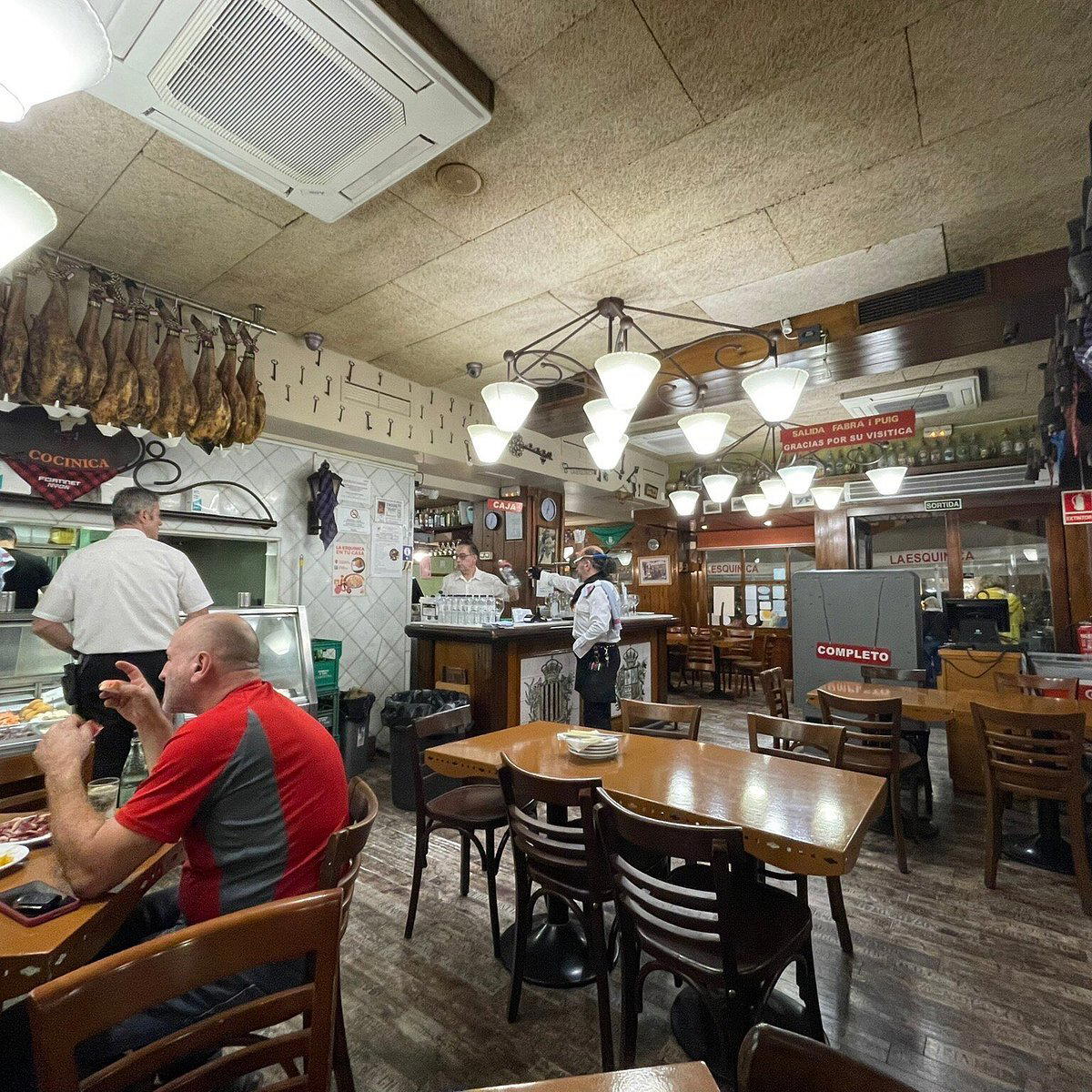
Nou Barris and the Restaurants That Don't Need a Profile
Barcelona's dining conversation tends to collapse around a handful of postcodes. The Eixample holds Cocina Hermanos Torres and Lasarte; the Gothic Quarter and its fringes absorb the tourism-adjacent trade; and the upper city delivers ABaC to the kind of guest who books months ahead. What that conversation leaves out is the working-class north, specifically Nou Barris, where restaurants like La Esquinica serve a neighbourhood audience rather than a tourist one.
That geography matters for how you read a place like this. Restaurants in Nou Barris do not position against Disfrutar or Enigma any more than a Catalan farmhouse kitchen positions against a three-star tasting-menu counter. They exist in a different register entirely, one where the metrics are consistency over years, a regular clientele that returns on weekday evenings without occasion, and a menu whose architecture is shaped by what the district eats rather than what a critic might find interesting.
What the Address Tells You Before You Enter
Passeig de Fabra i Puig is a long, tree-lined boulevard that cuts through the northern stretch of Nou Barris. It is not a dining destination street in any conventional sense: no concentrated restaurant row, no visible signs of the hospitality infrastructure that makes an area legible to food tourists. La Esquinica sits at number 296, which places it toward the quieter residential end of the passeig, far from the Sant Andreu boundary where some cross-neighbourhood foot traffic might otherwise land it.
Arriving here, the physical environment does the first filtering. The walk from the nearest metro stations runs through streets that are functional rather than atmospheric in the way that Gràcia or El Born have been styled for visitor consumption. That is not a criticism: it simply means the room, when you reach it, is carrying no borrowed ambient charge from the neighbourhood's tourism economy. Whatever the experience is, it is self-generated.
In Spain's broader dining geography, this kind of address is not unusual for serious local cooking. Quique Dacosta in Dénia built his reputation in a coastal town that most international visitors would have difficulty locating on a map. El Celler de Can Roca in Girona operates outside Barcelona entirely, in a city that many visitors treat purely as a day trip. Location, in Spanish gastronomy, has rarely been a barrier to reputation when the cooking justifies the detour. The question with a place like La Esquinica is whether the cooking is the kind that travels, or the kind that belongs specifically to the neighbourhood that shaped it.
Menu Architecture in the Neighbourhood Register
The restaurant is a traditional Spanish tapas restaurant, with a casual dress code and a walk-in-friendly policy.
In working-class Catalan neighbourhoods, that typically means a structure built around a carta (à la carte selection) rather than a fixed progression, with portions calibrated for sharing or for a two-course lunch that functions as the main meal of the day. The menu de mediodía, a fixed-price lunch menu that remains among the more culturally durable formats in Spanish dining, is a common anchor in neighbourhoods like Nou Barris, where the clientele is as likely to be construction workers and office staff at midday as it is couples dining in the evening.
This contrasts sharply with the tasting-menu architecture that defines the upper tier of Barcelona dining, where venues like Disfrutar and Enigma have built their reputations on sequential, chef-directed progressions. The à la carte register that neighbourhood restaurants occupy is not a lesser format; it is a different contract between kitchen and guest, one where the diner composes the meal and the kitchen responds to the table rather than presenting a unified statement. Spain has historically been one of the countries where this contract is taken most seriously, from the pintxos bars of San Sebastián to the rice-focused menus of Ricard Camarena in València.
Where La Esquinica Sits in Barcelona's Wider Picture
Barcelona's restaurant ecology is more stratified than most international visitors recognise. At the leading end, venues like Cocina Hermanos Torres and Lasarte compete in a European fine-dining comparable set that includes restaurants like Le Bernardin in New York City and Lazy Bear in San Francisco in terms of ambition and pricing. Below that, a mid-tier of modern bistros and contemporary Catalan restaurants operates in a zone that the city's food press covers with some regularity. And then there is the neighbourhood tier, which is numerically the largest, critically the least-covered, and in many respects the stable, sustained by repeat custom rather than destination traffic.
The restaurant occupies this third tier. It does not appear in the award circuits attached to Azurmendi, Mugaritz, or Aponiente. It is not seeking that positioning. Its competitive set is the other neighbourhood restaurants along Fabra i Puig and in the surrounding streets of Nou Barris, restaurants whose names do not travel far but whose longevity in a neighbourhood is itself a form of earned trust.
For comparison, the creative end of Spanish dining is well-documented elsewhere in the country. DiverXO in Madrid, Martin Berasategui in Lasarte-Oria, and Atrio in Cáceres represent the poles of ambition in Spain's fine dining map. The restaurant is not in dialogue with any of them. It is in dialogue with its street, its district, and the customers who have been eating there long enough to have a habitual order.
Planning a Visit
Given the absence of a confirmed website, phone number, or published hours for the restaurant, one practical approach is to visit on foot during standard Spanish service hours: lunch runs roughly 13:30 to 16:00 and dinner from 20:30 onward, though these windows shift by season and establishment. Nou Barris is accessible by metro on Lines 1 and 4, with Fabra i Puig station serving the boulevard directly.
A Tight Comparison
Comparable venues nearby, for context on price, style, and recognition.
| Venue | Price | Notes |
|---|---|---|
| La EsquinicaThis venue — the venue you are viewing | $$ | Not listed |
| SantaGula | $$ | la Vila de Gracia, Seasonal Catalan Bistro with International Touches |
| Fusco | $$ | Vallcarca i els Penitents, Traditional Spanish with Mediterranean and Fusion Influences |
| Casa Lola | $$ | la Dreta de l'Eixample, Modern Spanish Tapas |
| La Paella de Su | $$ | la Dreta de l'Eixample, Authentic Valencian Paella |
| La Bodegueta Provença | $$ | la Dreta de l'Eixample, Modern Spanish Tapas |
Continue exploring
More in Barcelona
Restaurants in Barcelona
Browse all →
Bars in Barcelona
Browse all →
Hotels in Barcelona
Browse all →

At a Glance
- Lively
- Rustic
- Casual Hangout
- Group Dining
- Terrace
- Street Scene
Current opening hours
- Monday
- Closed
- Tuesday
- 8 AM–12 AM
- Wednesday
- 8 AM–12 AM
- Thursday
- 8 AM–12 AM
- Friday
- 8 AM–12 AM
- Saturday
- 8 AM–12 AM
- Sunday
- Closed
Hours can change for holidays and private events. Last verified .
Lively and boisterous atmosphere with lively terrace seating, well-suited for casual gatherings.