In Osaka's Minamisenba district, Kobe Beef WANOMIYA Kita Shinsaibashi Store sits within the Kita Shinsaibashi corridor where the city's appetite for premium wagyu has concentrated into a defined specialist tier. The menu architecture centres on authenticated Kobe beef, positioning the restaurant within a small comparable set that handles only the highest-grade certified product. For visitors arriving from the broader Shinsaibashi shopping axis, it represents a deliberate detour into serious beef territory.
Pearl is the En Primeur Club membership app — saves, bookings, and concierge access live there. Same editors, same standards.
- Address
- Japan, 〒542-0081 Osaka, Chuo Ward, Minamisenba, 3 Chome−8−11 心斎橋 å 村ビル 1階
- Phone
- +81662443929
- Website
- koubegyuu.com
- Directions
- Get directions
 Saves & bookings on Pearl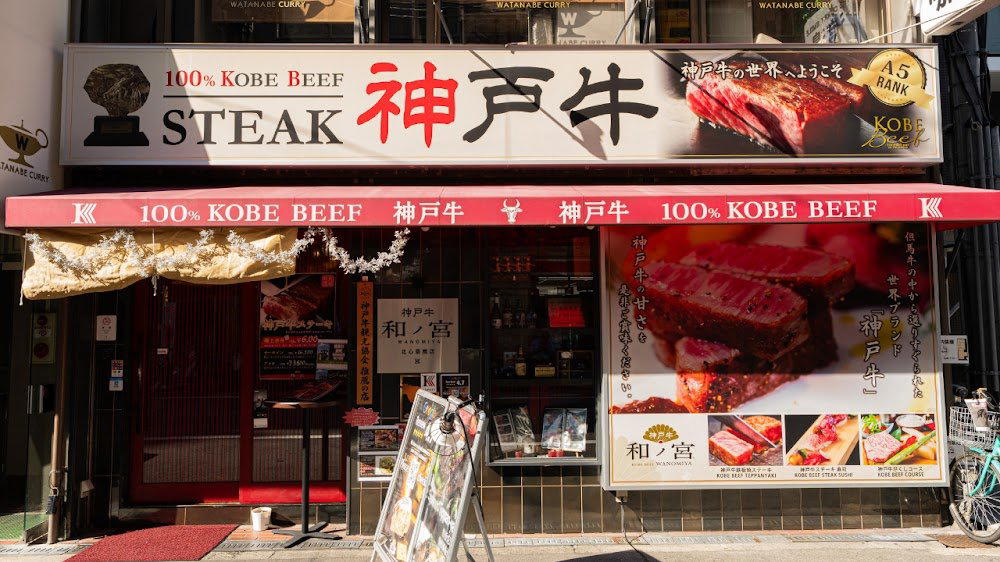
Where Minamisenba's Premium Beef Tier Takes Shape
Kobe Beef WANOMIYA Kita Shinsaibashi Store is a Kobe Beef Teppanyaki restaurant in Osaka's Chuo Ward. Walk south from the Shinsaibashi covered arcade and the character shifts quickly: fewer fast-fashion storefronts, more deliberate restaurant facades, more doors that open onto focused, single-subject menus. Kobe Beef WANOMIYA Kita Shinsaibashi Store occupies this corridor at 3-Chome 8-11 Minamisenba, a stretch where the city's appetite for certified wagyu has produced a concentration of specialist operators rather than the generalist yakiniku houses that dominate cheaper postcodes. The physical approach signals the register before you enter: this is beef country that takes provenance seriously.
Menu Architecture and What It Reveals
Restaurants that put a protected designation in their name are making a structural argument before the first course arrives. Kobe beef is a certified designation tied to Tajima-gyu cattle and strict grading standards. A restaurant built explicitly around that designation is committing to a sourcing cost and a product floor that immediately separates it from wagyu restaurants that use the term loosely or rotate between designations based on market price.
That commitment shapes how a menu in this category tends to be organised. Rather than a broad catalogue of proteins or a fusion framework, Kobe-specialist menus typically move through cuts and cooking formats as a way of demonstrating the range within a single certified product. The logic is educational as much as commercial: different cuts carry different fat distributions, different temperatures produce different melt behaviour, and a structured menu can make that visible across a meal. This is the opposite of the multi-protein tasting format common at kaiseki-influenced restaurants such as Ajikitcho Bunbuan, where beef might appear as one movement in a longer seasonal sequence. At a Kobe beef specialist, the architecture of the meal is the architecture of the animal.
Within Osaka's dining scene, this creates a distinct tier. The city supports a wide range of wagyu formats, from standing yakiniku counters in Namba to high-concept beef kaiseki operations. WANOMIYA Kita Shinsaibashi occupies the middle distance: specialist enough to carry an appellation name, positioned in a neighbourhood that draws both local professionals and hotel-based visitors from the nearby Shinsaibashi accommodation cluster.
The Kobe Beef Certification Context
Understanding what Kobe beef means operationally helps calibrate expectations. Kobe beef remains a tightly controlled designation, which helps explain its premium positioning. For comparison, Matsusaka and Omi beef operate under separate prefectural certification systems with different grading thresholds. Restaurants that carry Kobe-only positioning are buying into a supply chain with documented scarcity and corresponding price floors. That is distinct from restaurants serving A5 wagyu in a generic sense, where the grade refers to yield and marbling but not to a specific geographic or breed certification.
In Japan's Kansai region, Kobe beef's geographic origin in neighbouring Hyogo Prefecture gives Osaka restaurants a proximity advantage in sourcing. The city's specialist beef restaurants are closer to the Tajima cattle farms and Kobe processing facilities than their counterparts in Tokyo, a logistical fact that supports the concentration of serious Kobe beef operations in Osaka and the surrounding area. Travellers familiar with fine-dining wagyu programs in Tokyo or Kyoto will find Osaka's specialist beef tier shaped by regional proximity to Hyogo.
Placing WANOMIYA in Osaka's Beef Specialist Set
Osaka supports several formats of serious beef dining. At the technical end sit operations like HAJIME, where protein sourcing integrates into a broader conceptual and seasonal framework. At the other end, neighbourhood yakiniku houses serve quality beef in a social, grill-your-own format without the certification specificity. WANOMIYA Kita Shinsaibashi sits closer to the specialist-certification end of that range, where the product designation itself is the organising principle. Comparable pressure on the sourcing side exists at operations handling other protected Japanese proteins, from the fugu specialists of Dotonbori to the kaiseki houses managing seasonal fish allocations.
For diners arriving from outside Japan's beef culture, one useful comparison point is not with steakhouse traditions but with how single-appellation wine restaurants operate in France or how specific soba or ramen shops are dedicated to one grain or broth style. The product has a documented origin and a measurable quality floor, and the restaurant's job is to present it with enough format discipline to make that floor legible to the diner.
Elsewhere in the city, restaurants such as Aka to Shiro, Calendrier, and Az operate within French-influenced or cross-cultural frameworks where wagyu may appear but the menu architecture follows a different logic entirely. The distinction matters for trip planning: a meal at a Kobe beef specialist and a meal at a kaiseki-influenced modern restaurant are not substitutes for each other, even at similar price points.
Planning Your Visit
The Kita Shinsaibashi address places the restaurant within comfortable walking distance of Shinsaibashi Station on the Midosuji Line, Osaka's main north-south subway spine. The Minamisenba 3-Chome block sits near the Shinsaibashi shopping corridor, but the restaurant itself is positioned on a quieter block rather than the main arcade. Visitors planning a broader Kansai beef itinerary might consider pairing a meal here with operations in Nara, where akordu represents a contrasting European-Japanese approach, or in Fukuoka, where Goh handles Kyushu beef traditions within a different regional framework. For those moving through Japan's beef specialist tier more broadly, the comparable operations in Nanao (一本松 山川製) and the northern reaches at 夕来山乃 in Sapporo demonstrate how Japan's regional beef certifications diverge sharply outside Kansai.
The restaurant is recommended for reservations and is open daily from 12 to 10 PM. The venue is best approached with a reservation, especially for dinner service. Diners comparing options in the same neighbourhood should also consider Ajihei Sonezaki for a different protein focus within the broader Chuo Ward dining cluster.
Reputation First
Comparable venues nearby, for context on price, style, and recognition.
| Venue | Cuisine | Price | Notes |
|---|---|---|---|
| Kobe Beef WANOMIYA Kita Shinsaibashi StoreThis venue — the venue you are viewing | Kobe Beef Teppanyaki | $$$$ | Not listed |
| 寿し芳 | Modern Edomae Sushi Omakase | $$$$ | Kita |
| 緒乃 | Modern Edomae Omakase | $$$$ | Kita |
| Kobe Beef WANOMIYA Dotonbori Main Store | Teppanyaki Kobe Beef | $$$$ | Chūō |
| 和旬たい喜 | Modern Japanese Kaiseki | $$$$ | Kita |
| きたしんち 弓場慎之佑 | Modern Japanese Kappo | $$$$ | Kita |
Continue exploring
More in Osaka
Restaurants in Osaka
Browse all →




Bars in Osaka
Browse all →

Hotels in Osaka
Browse all →




Wineries in Osaka
Browse all →
At a Glance
- Elegant
- Intimate
- Sophisticated
- Date Night
- Special Occasion
- Chefs Counter
- Open Kitchen
- Sake Program
Current opening hours
- Monday
- 12–10 PM
- Tuesday
- 12–10 PM
- Wednesday
- 12–10 PM
- Thursday
- 12–10 PM
- Friday
- 12–10 PM
- Saturday
- 12–10 PM
- Sunday
- 12–10 PM
Hours can change for holidays and private events. Last verified .
Cozy and refined black-themed interior with counter seating, pleasant jazz music, and an elegant adult-oriented atmosphere.