

Michelin Plate
Our verdict
On the Elbchaussee, where Hamburg's old money meets the water, Jacobs Restaurant holds its position in the city's classical dining tier with a French-German menu under Chef Thomas Martin. Ranked #272 in Opinionated About Dining's Classical in Europe list for 2025 and carrying a Michelin Plate, it operates Tuesday through Saturday evenings, placing it firmly within the conversation of Hamburg's serious dinner destinations.

Pearl is the En Primeur Club membership app, where members save venues, book tables and use the concierge.
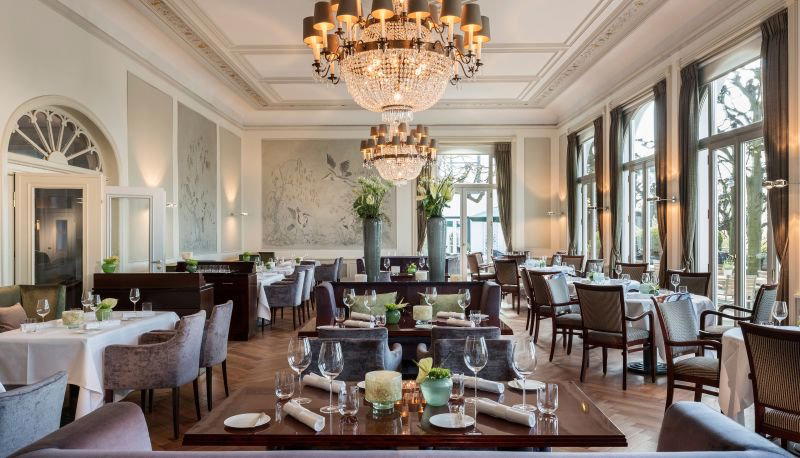
Where the Elbe Sets the Stage
The Elbchaussee is one of Hamburg's most storied addresses, a tree-lined western corridor where grand villas face the river and the atmosphere carries a particular formality that the city's harbour districts do not. Arriving at number 401 in the early evening, when the light over the Elbe shifts from grey to copper, the setting does the first work before any menu is consulted. Classical fine dining in Germany has increasingly concentrated in hotels and country houses rather than urban centres, and this address fits that pattern: a room where occasion is assumed, where the pace of service is deliberate, and where the meal itself is understood as a structured event with a beginning, a middle, and an end.
Jacobs operates Tuesday through Saturday, dinner only, from 6 to 9:30 pm, closed Sunday and Monday. That compression of service into five evening windows is common among serious classical kitchens, and it signals something about the preparation required on either side of each service. Reservations are the practical starting point for any visit; the hours suggest a kitchen running at full concentration rather than across a broad weekly calendar.
Classical French-German Cooking and the Arc of a Meal
The French-German cuisine category that Jacobs occupies is one of the older frameworks in German fine dining. It predates the country's current moment of regional-produce-led creative cooking and draws instead on a classical European tradition in which technique, sequence, and composition carry as much meaning as ingredient origin. This is cooking that rewards attention to the meal's internal logic: the way an opening course establishes acidity and restraint, how the middle courses build weight and concentration, and how the dessert sequence releases that tension. It is a different contract with the diner than the 20-course modern tasting menu format, and not a lesser one.
Chef Thomas Martin has been the figure at Jacobs long enough that his name and the kitchen's identity are not easily separated. In the context of classical French-German cooking, longevity at a single address is itself a credential: it signals consistency of execution rather than the restless reinvention that marks other corners of the German dining scene. The progression of a meal here is not built around surprise for its own sake, but around the accumulated pleasure of courses that each hold their place in a coherent sequence. Those expecting the visual theatrics of Hamburg's creative tier, represented elsewhere in the city by restaurants like The Table Kevin Fehling or 100/200 Kitchen, are approaching a different proposition.
How Jacobs Sits in Hamburg's Fine Dining Tier
Hamburg's top end of the restaurant market at the €€€€ price point includes several distinct approaches. Restaurant Haerlin brings a creative French orientation; bianc holds two Michelin stars in the modern Mediterranean register; Lakeside anchors a German-focused two-star position. Jacobs carries a Michelin Plate rather than stars at this juncture, but its standing in the Opinionated About Dining Classical in Europe list offers a more granular peer comparison. Ranked at #295 in 2024 and moving to #272 in 2025, it has edged upward in a ranking system that specifically evaluates classical cooking on its own terms rather than against the broader contemporary fine dining field. For diners whose reference points are classical French houses, the OAD classical list is the more relevant signal than the Michelin hierarchy alone.
Germany's classical fine dining tradition runs through addresses like Schwarzwaldstube in Baiersbronn and Vendôme in Bergisch Gladbach, both of which occupy the serious classical register. Internationally, the same sensibility connects to rooms like Le Bernardin in New York, where the discipline of a multi-course classical sequence is the product, not the packaging. For contrast, Hamburg's own creative tier extends to ES:SENZ in Grassau and, further afield, to Aqua in Wolfsburg or JAN in Munich for those building a wider German fine dining itinerary. CODA Dessert Dining in Berlin and Atomix in New York represent the far end of the contemporary tasting format, where the structural logic of a meal becomes the overt subject of the kitchen's work.
The Tasting Progression as the Point of the Visit
Classical multi-course menus work on the assumption that the diner's experience accumulates across the table rather than peaking at any single dish. The first courses tend to be precise and relatively light, calibrating the palate rather than overwhelming it. As the meal moves through its middle register, richness and depth increase, proteins arrive with their sauces in careful proportion, and the kitchen's technical command becomes most legible. The final savoury courses often carry the highest concentration; the transition into dessert should feel earned rather than arbitrary.
This arc is the reason that classical French-German kitchens place such weight on sequence and timing. Pacing between courses matters in a way it simply does not in à la carte formats or shorter menus. A well-timed classical dinner at a room like Jacobs tends to last two to three hours, and the service rhythm is part of the product. Diners who arrive knowing this, who are not expecting efficiency, tend to experience the meal differently from those treating it as a transaction.
At the €€€€ price tier, that time commitment is part of the value proposition. Hamburg's classical dining culture has never been as densely concentrated as Munich's or as publicly discussed as Berlin's, but the Elbchaussee address has held its place in a city where serious classical cooking competes for attention against a strong creative dining scene.
Planning a Visit
Jacobs Restaurant is at Elbchaussee 401, 22609 Hamburg, in the western Othmarschen district along the river. The kitchen runs dinner service Tuesday through Saturday, 6 to 9:30 pm, with Sunday and Monday dark. At the €€€€ tier with OAD classical recognition and a Michelin Plate, reservations in advance are standard practice, particularly for weekend tables. Those constructing a Hamburg dining itinerary across multiple evenings can map the city's fine dining range through our full Hamburg restaurants guide, alongside resources for hotels, bars, wineries, and experiences in the city.
Frequently asked questions
What does dinner at Jacobs Restaurant typically cost?
Pricing at Jacobs Restaurant is listed as €€€€.
How do I find Jacobs Restaurant?
Jacobs Restaurant is located at Elbchaussee 401, 22609 Hamburg, Germany, Hamburg.
Comparable Spots
| Venue | Cuisine | Price | Awards | Notes |
|---|---|---|---|---|
| Jacobs RestaurantThis venue (the venue you are viewing) | Modern French Fine Dining | $150–200 | Michelin Plate | Not listed |
| The Table Kevin Fehling | Avant-Garde Fusion Fine Dining | $200–300 | 3 Michelin Stars · La Liste Top Restaurants | Creative |
| bianc | Modern Mediterranean Fine Dining | $200–300 | 2 Michelin Stars · La Liste Top Restaurants | Modern Mediterranean, Mediterranean Cuisine |
| Lakeside | Modern European Fine Dining | $200–300 | 2 Michelin Stars · La Liste Top Restaurants | German Lakeside |
| Landhaus Scherrer | Michelin-Starred North German Fine Dining | $150–200 | 1 Michelin Star · Star Wine List | Modern European, Classic Cuisine |
| Heimatjuwel | Modern Regional German Vegetarian Fine Dining | Not listed | 1 Michelin Star · We're Smart World 3 Radishes | German, Creative |
Recognition history
Dated appearances from independent guides and award organizations, with the underlying list record or original source where available.
Michelin Plate
Michelin · 2026 Michelin Plate
Opinionated About Dining Classical in Europe Ranked #272
Opinionated About Dining
Full recognition history (6 entries)
Michelin Plate
Michelin
Michelin Plate
Michelin
Opinionated About Dining Classical in Europe Ranked #295
Opinionated About Dining
Opinionated About Dining Classical in Europe Recommended
Opinionated About Dining
Continue exploring
More in Hamburg
Restaurants in Hamburg
All restaurants in Hamburg →
Bars in Hamburg
All bars in Hamburg →
Hotels in Hamburg
All hotels in Hamburg →
Wineries in Hamburg
Browse all →
Jacobs Restaurant
The wine
- Wine program
- Deep wine list
- Extensive wine list
- Sommelier-led
Details
- Elegant
- Sophisticated
- Classic
- Intimate
- Special Occasion
- Date Night
- Business Dinner
- Hotel Restaurant
- Terrace
- Historic Building
- Extensive Wine List
- Sommelier Led
- Local Sourcing
- Waterfront
- Tasting Menu
- Vegetarian Friendly
Current opening hours
- Monday
- Closed
- Tuesday
- 6–9:30 PM
- Wednesday
- 6–9:30 PM
- Thursday
- 6–9:30 PM
- Friday
- 6–9:30 PM
- Saturday
- 6–9:30 PM
- Sunday
- Closed
Hours can change for holidays and private events. Hours as of .
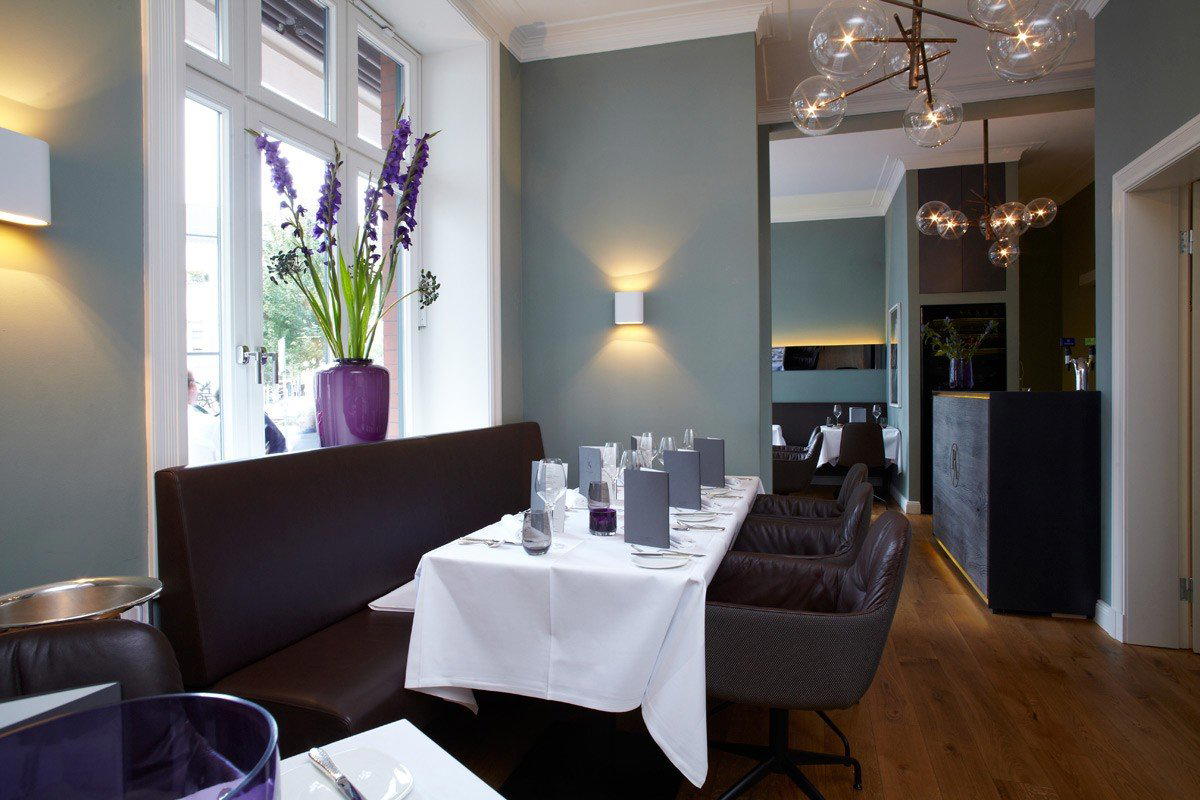
Elegant high-ceilinged dining room with generously spaced tables and large windows overlooking the river, complemented by a shady terrace; tasteful, modern decor with lovely lighting creating a serene and sophisticated atmosphere.