Ichiran
Ichiran's Brooklyn location on Johnson Avenue brings the Japanese chain's solo-dining ramen format to New York City, where each guest occupies a private booth, orders via paper form, and receives their bowl through a bamboo curtain without staff interaction. The format has built a loyal following among regulars who return for the consistency and the ritual as much as the tonkotsu itself.
 Discover on Pearl
Pearl is the En Primeur Club membership app — saves, bookings, and concierge access live there. Same editors, same standards.
- Address
- 374 Johnson Ave, Brooklyn, NY 11206
- Phone
- +1 718 381 0491
- Website
- ichiranusa.com
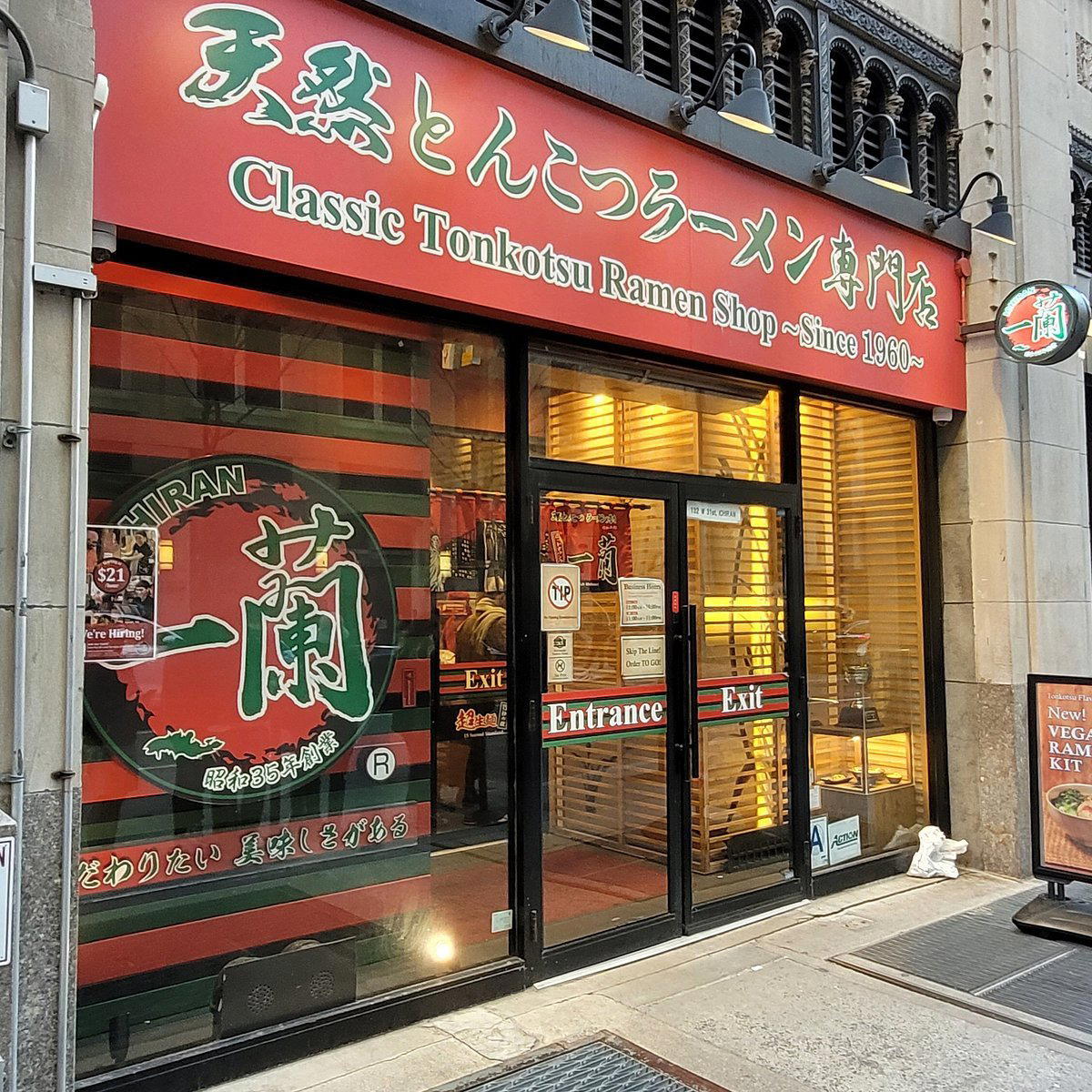
The Booth, the Curtain, the Bowl
Ichiran is a Brooklyn restaurant in New York City serving tonkotsu ramen at a casual price point, with individual wooden booths, each sealed by a bamboo curtain at counter level, each designed to hold exactly one person and one bowl of ramen. The format arrived in New York from Japan, where Ichiran built its reputation around the proposition that the ideal ramen experience is an uninterrupted, solitary one. In Bushwick, that proposition lands with particular force. The neighbourhood is dense, loud, and communal in the way post-industrial Brooklyn tends to be, which makes the interior's deliberate stillness feel more considered, not less.
What began as a handful of imports and local interpretations has stratified into a market with clear tiers: high-volume street-level shops, mid-range chef-driven counters, and a handful of formats that have built identity around something other than the broth itself. Ichiran operates in that last group. The draw is not menu breadth or chef profile, it is system. The paper order form, the flavour concentration dial, the curtain that descends when your bowl arrives: these are the product. Regulars at Ichiran are not returning because the menu changed. They are returning because it did not.
What Keeps Regulars Coming Back
Regulars return for the same ritual sequence and the same bowl, adjusted by a few incremental variables. It is built on precision repetition: the same bowl, adjusted by a few incremental variables, delivered in the same ritual sequence. The order form is the fulcrum of this experience. Guests specify broth richness, garlic level, spice intensity, green onion quantity, and noodle firmness before a single bowl reaches the counter. Over multiple visits, a regular develops a personal configuration, their Ichiran, that no other table knows and no server has memorised on their behalf.
This is the inverse of the tasting-menu model that defines much of New York's high-end dining circuit. At Le Bernardin, Eleven Madison Park, or Per Se, the kitchen's sequence governs the meal. At Ichiran, the diner governs it, within a tightly constrained parameter set. The constraint is the point. Regulars are not choosing from an open field, they are dialling a known instrument.
The unwritten menu at Ichiran is largely about noodle quantity. Extra noodles, ordered mid-meal via the same paper-slip system, are the move that separates a first-timer from someone who knows the format. The broth-to-noodle ratio shifts with each addition, and experienced guests time the request so the second portion arrives before the broth cools below optimal temperature. This kind of operational literacy is what regulars accumulate and what no amount of online research fully replicates.
The Solo-Dining Format in Context
Solo dining has been a contested category in American restaurant culture for years. The instinct at most venues is to accommodate the single diner rather than design for them, a table for one placed near the kitchen, a bar seat offered as consolation. Ichiran's format refuses that framing. Every seat is a solo seat, and the booth design actively removes the social friction that single diners elsewhere absorb. There is no neighbouring table to overhear, no server making eye contact at the wrong moment, no implicit pressure to turn the seat quickly.
The format connects to a broader Japanese dining tradition in which eating alone is not a social deficit but a practice with its own conventions. Ramen, in particular, has long been associated with solitary consumption in Japan, quick, precise, absorbed without ceremony. Ichiran formalised that convention and exported it. In New York, where dining alone still carries residual awkwardness in many settings, the booth structure gives the format a specific utility that has nothing to do with trend and everything to do with function.
That utility distinguishes Ichiran from the solo-dining experiences available at omakase counters like Masa or Atomix, where a single seat at the counter still places you in a shared social space with other diners. The physical isolation at Ichiran is total, which produces a different psychological register entirely.
Ichiran Within New York's Ramen Tier
New York's ramen market has diversified enough that Ichiran's tonkotsu-only focus reads as a deliberate position rather than a limitation. Many of the city's most-visited ramen shops now run rotating specials, seasonal broths, and tsukemen variations as a strategy for drawing return visits through novelty. Ichiran's counter-strategy is sameness. The tonkotsu base is standardised across all global locations by design, and the customisation system exists to personalise within that standard, not to replace it.
This puts Ichiran in a different competitive conversation from chef-driven ramen operations. It is closer, structurally, to the kind of format-first dining that places like Lazy Bear in San Francisco or Smyth in Chicago have explored at the high end, where the dining structure itself is the editorial statement, except that Ichiran executes this at an accessible price point and with a product that has no equivalent among the city's tasting-menu set. The comparison is not about cuisine but about intentionality of format.
Similar commitments to format over flexibility appear at Blue Hill at Stone Barns in Tarrytown, Single Thread Farm in Healdsburg, and The French Laundry in Napa.
Planning Your Visit
Ichiran Brooklyn operates on a walk-in basis for most of its hours. Lines form during peak dinner hours on weekends, but the throughput is high given the solo-booth format, seats turn faster than at conventional tables because there is no social prolonging of the meal. The practical advice from those who visit regularly: arrive at off-peak times (early weekday evenings in particular) and the wait is minimal or nonexistent.
The location on Johnson Avenue in Brooklyn is easy to reach by subway. The neighbourhood itself has a dense concentration of bars and casual dining options, making Ichiran a viable anchor for a broader evening in the area rather than a standalone destination requiring cross-borough travel on its own merits.
| Venue | Cuisine | Price Tier | Booking Method | Solo-Dining Format |
|---|---|---|---|---|
| Ichiran (Brooklyn) | Tonkotsu Ramen | $ | Walk-in | Private booth, full isolation |
| Masa | Sushi / Omakase | $$$$ | Advance booking required | Counter, shared social space |
| Atomix | Modern Korean | $$$$ | Advance booking required | Counter, shared social space |
| Le Bernardin | French Seafood | $$$$ | Advance booking required | Table service, conventional |
| Per Se | French Contemporary | $$$$ | Advance booking required | Table service, conventional |
For reference points in other cities, Providence in Los Angeles, Addison in San Diego, Emeril's in New Orleans, The Inn at Little Washington, Frasca Food and Wine in Boulder, Atelier Moessmer Norbert Niederkofler in Brunico, and Dal Pescatore in Runate each represent format-conscious dining with strong returning clientele in their respective markets.
Cost Snapshot
Comparable venues nearby, for context on price, style, and recognition.
| Venue | Cuisine | Price | Awards | Notes |
|---|---|---|---|---|
| IchiranThis venue — the venue you are viewing | East Williamsburg, Tonkotsu Ramen | $$ | , | |
| Umi | Fresh Meadows, Japanese Sushi | $$ | , | |
| IPPUDO Westside | $$ | , | Hell's Kitchen, Hakata-Style Tonkotsu Ramen | |
| Tenzan | East Midtown-Turtle Bay, Japanese Sushi | $$ | , | |
| Hakata TonTon | $$ | , | Chinatown-Two Bridges, Hakata-style Japanese Izakaya | |
| Amber | $$ | , | Upper East Side-Carnegie Hill, Japanese Sushi with Pan-Asian Fusion |
Continue exploring
More in New York City
Restaurants in New York City
Browse all →
Bars in New York City
Browse all →
Hotels in New York City
Browse all →


At a Glance
- Minimalist
- Intimate
- Trendy
- Solo
- Late Night
- Casual Hangout
- Sake Program
Minimalist solo booths with dim lighting focused on individual ramen enjoyment.