Hooninae Gimbap
Our verdict
Hooninae Gimbap is a Busan institution operating in a city where gimbap has long been treated as working-class sustenance rather than a subject of serious attention. The shop sits within a broader neighbourhood tradition of unpretentious Korean staples, where the discipline lies not in theatre but in precision, tightly rolled, portioned with consistency, and priced for everyday access.

Pearl is the En Primeur Club membership app, where members save venues, book tables and use the concierge.
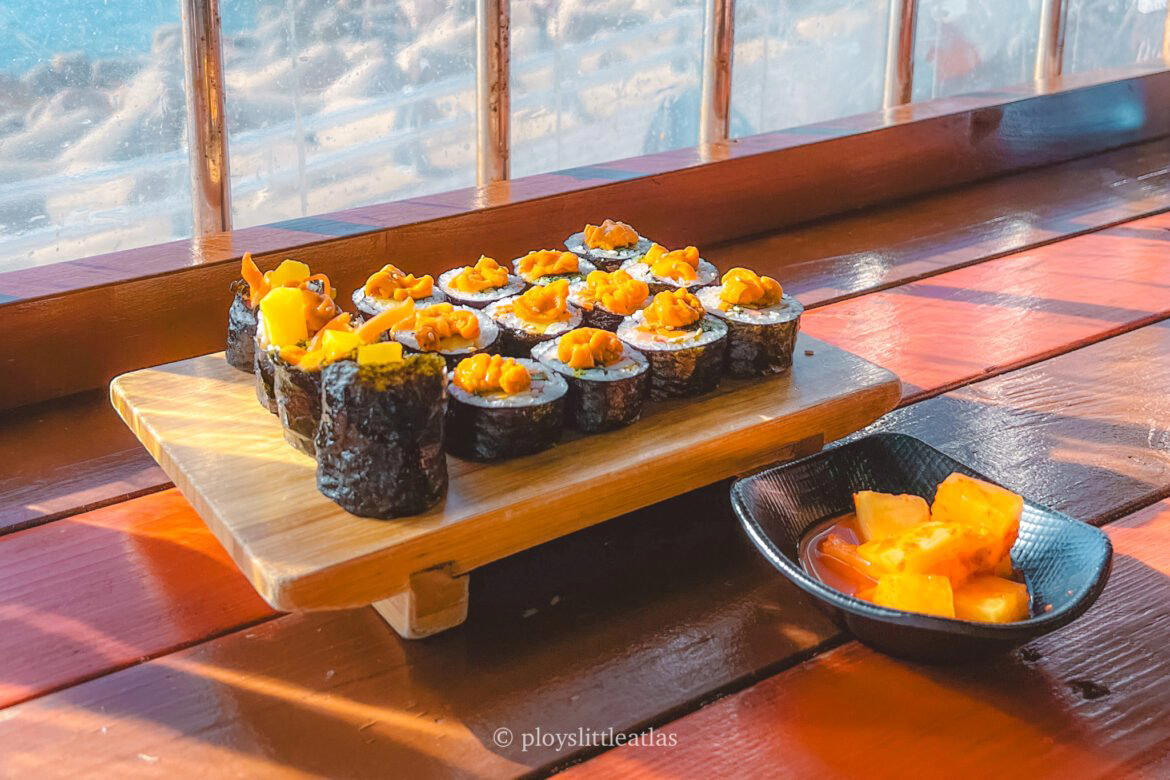
The menu
What to order
- Tuna Gimbap
- Bulgogi Gimbap
- Kimchi Gimbap
Where Busan Keeps Its Everyday Rituals
Korea's gimbap culture has always occupied a peculiar position in the country's food hierarchy: taken seriously by the people who eat it daily, yet rarely granted the critical vocabulary reserved for fermented pastes or aged galbi. In Busan, that dynamic plays out in the streets rather than in dining rooms. The city's food identity has been built on port-town pragmatism, dwaeji-gukbap at 6am, naengmyeon at noon, gimbap whenever the moment calls for it. Hooninae Gimbap sits inside that tradition, operating in a register that prioritises repetition and craft consistency over occasion.
That framing matters because gimbap, much like 100.1. Pyeongnaeng's naengmyeon, is a format where the discipline is invisible. The quality signals are structural: the tightness of the roll, the moisture balance of the rice, the ratio of filling to seaweed. Get those right across hundreds of portions a day and you have something worth returning to. Get them wrong once and there is no presentation or plating to compensate. Busan's leading gimbap shops have historically understood this, and the neighbourhood-level reputation a place like Hooninae carries reflects that accountability.
Gimbap's Quiet Evolution in South Korean Street Food
Over the past two decades, Korean street food has split into two trajectories. One moved toward experimentation, fusion fillings, premium ingredients, Instagram-friendly cross-sections photographed on cutting boards. The other held its ground, maintaining the original logic of gimbap as affordable, portable, satisfying food that asks nothing theatrical of the diner. Hooninae Gimbap appears to belong to the second current, the kind of place that earns its reputation through tenure and volume rather than novelty.
This mirrors a pattern visible across South Korean food cities. In Seoul, Mingles represents one pole of Korean dining ambition, refined, conceptual, internationally recognised. The other pole, equally legitimate, is the neighbourhood institution that has refined a single format across years of daily practice. Both poles produce serious food. The difference is the vocabulary we use to talk about them. Busan's informal dining culture has always been more comfortable acknowledging the second type.
In Jeju, a similar pattern holds. Badang Lounge and 88돼지 both operate within food traditions that prioritise local specificity over fine-dining codes. Hooninae Gimbap reads within the same register: a place whose credibility derives from neighbourhood embedding rather than award recognition.
The Craft Inside a Modest Format
Gimbap's construction is deceptively technical. The rice must be seasoned with sesame oil at the correct ratio, too little and it tastes flat, too much and it overwhelms the filling. The nori sheet requires precise moisture to roll cleanly without tearing at the seam. The fillings, typically including egg, pickled radish, spinach, and some form of protein, need to be distributed evenly so that every cross-section delivers a consistent bite. These are repeatable craft decisions, not creative ones, and they define the difference between gimbap that holds together at the fifth piece and gimbap that unravels by the third.
Shops like Hooninae earn long-running local followings precisely because that consistency is difficult to fake. In Busan's competitive casual food environment, where 1969 Buwondong Kalguksu has built decades of trust around handmade noodles and where Anmok has defined a standard for dwaeji-gukbap, the bar for neighbourhood institution status is set by regulars, not critics. A place that has reached naming recognition in its area has, by definition, passed that test repeatedly.
For context on how Busan's dining spectrum looks across price points, Palate occupies the ₩₩ contemporary tier, Mori sits in the ₩₩₩ Japanese bracket, and Born and Bred anchors the ₩₩₩₩ steakhouse category. Gimbap shops occupy the base of that range, a tier where the transaction is daily rather than occasional, and where consistency across hundreds of visits matters more than the memory of any single one.
Positioning Within Busan's Food Geography
Busan does not have a single food district in the way Seoul has Gwangjang Market or Gyeongju has its traditional confectionery corridor. The city's casual dining is distributed across neighbourhoods, with reputation moving through foot traffic and word of mouth rather than aggregator rankings. A gimbap shop that achieves name recognition in that environment has typically done so by being the place locals direct visitors to, a social endorsement that is harder to manufacture than a digital one.
That neighbourhood logic also shapes how the city's informal food culture develops over time. Shops in Suwon like Doosoogobang or Gobojeong Galbi operate under similar conditions: long-tenured, locally trusted, credentialed by repetition rather than media. Hooninae Gimbap carries that kind of authority within its own radius. Our full Busan restaurants guide maps this across the city's different dining registers.
For visitors arriving from the fine-dining end of Korean cuisine, those who have spent time at Atomix in New York or followed the Korean fine-dining thread through internationally recognised rooms, places like Hooninae represent the opposite logic. No tasting menus, no tableside theatre. Just a format executed with the accumulated confidence of daily practice. That gap is worth crossing, because the two things are not in competition. One shows what Korean food has become at its most ambitious register. The other shows what it has always been at its most reliable.
Also worth noting for visitors building a Jeju itinerary alongside a Busan leg: Black Pork BBQ in Seogwipo, Hinode in 서귀포시, and Gyeongju Wonjo Kongguk all operate in the same informal-but-serious tier. The Dining Room (다이닝룸) offers a counterpoint at the more composed end of Korean dining.
Planning a Visit
Gimbap shops in Busan generally operate on walk-in basis with no reservation system, the format is built for speed and turnover, not pre-planned occasion dining. Peak hours typically align with meal rushes, so mid-morning or mid-afternoon visits tend to involve shorter waits. For visitors combining Busan's casual food circuit with higher-register meals, pairing a gimbap stop with a reservation at one of the city's more formal rooms produces a useful cross-section of what the city actually eats.
Frequently asked questions
How does Hooninae Gimbap reflect Busan's local food culture compared to Seoul?
Busan's food identity diverges from Seoul's in a clear direction: shaped by port-city working rhythms and a preference for direct, unfussy preparation over trend-driven presentation. A neighbourhood gimbap shop in Busan sits within that tradition, serving a format that functions as daily sustenance rather than an occasion. Hooninae Gimbap, as a Busan venue, carries that context regardless of whether it has received formal recognition.
What do people recommend at Hooninae Gimbap?
EP Club's database does not include confirmed menu data for Hooninae Gimbap. Across Busan's gimbap shops at this tier, regulars typically order the standard sesame-seasoned rolls rather than specialty fillings, treating the house gimbap as the reliable baseline. Verify current offerings directly with the shop on arrival.
Do they take walk-ins at Hooninae Gimbap?
Gimbap shops in Busan operate almost universally as walk-in venues, the format is built around speed and accessibility, not reservation systems. Hooninae Gimbap, situated within this neighbourhood tier, follows that same convention. No booking is needed or expected.
What's the defining dish or idea at Hooninae Gimbap?
The core logic of a serious gimbap shop is structural consistency: rice seasoning, roll tension, and fill ratio that holds across every order during a busy lunch shift. At a Busan shop like Hooninae, the measure is whether the roll arrives tight and evenly proportioned rather than whether it features an unusual ingredient. That discipline is what separates a reliable daily stop from a forgettable one.
Is Hooninae Gimbap good for vegetarians?
Standard gimbap fillings across South Korea commonly include egg and fish cake, though vegetable-only rolls are a recognised option at most shops. The format is generally accommodating, given that vegetables are a structural component of the traditional roll.
Is a meal at Hooninae Gimbap worth the investment?
Gimbap sits at the base of Busan's dining price spectrum, typically measured in the low thousands of Korean won per roll, a category where the value question is less about cost and more about execution. At this price point, consistency and rice quality are the actual returns on the transaction. The format does not carry the overhead of a sit-down restaurant, which keeps pricing accessible.
What's the best season to visit Hooninae Gimbap?
Gimbap has no meaningful seasonal dependency, it does not shift its menu around summer produce or winter ingredients in the way that Korean soups or grilled dishes often do. Hooninae Gimbap in Busan is a year-round operation by the nature of the format. Visit whenever it fits your time in the city.
Where the Accolades Land
| Venue | Cuisine | Price | Awards | Notes |
|---|---|---|---|---|
| Hooninae GimbapThis venue (the venue you are viewing) | Korean Gimbap | $1–10 | Not listed | Not listed |
| Palate | Contemporary French with Korean Fusion | $150–200 | 1 Michelin Star · La Liste Top Restaurants | Contemporary |
| Mori | Japanese Kaiseki | $200–300 | 1 Michelin Star | Japanese |
| Born and Bred | Modern Hanwoo Beef Omakase Steakhouse | $100–150 | Michelin Plate · World's 50 Best #51 | Steakhouse |
| 100.1. Pyeongnaeng | Pyongyang-style Naengmyeon | $10–20 | Michelin Bib Gourmand | Naengmyeon |
| Anmok | Modern Korean Dwaeji-Gukbap | $10–20 | Michelin Bib Gourmand | Dwaeji-gukbap |
Continue exploring
More in Busan
Restaurants in Busan
All restaurants in Busan →
Bars in Busan
All bars in Busan →
Details
- Cozy
- Casual Hangout
- Family
- Local Sourcing
- A La Carte
- Vegetarian Friendly
Casual and welcoming with bright lighting and a homey feel typical of neighborhood Korean eateries.